


The shoulder is often described as the most complex joint in the human body, but that framing misses the bigger picture. The shoulder is not just a joint—it is part of an integrated system designed to transfer force from the ground and core through the torso and into the arms. In that sense, the shoulder truly is the gateway to upper-body performance.
Importantly, the shoulder itself is not built for stability. It is built for mobility, relying on stability generated elsewhere in the body. When that system is functioning well, the shoulder joint moves freely and efficiently. When it is not, the joint often becomes the place where pain, irritation, or loss of performance shows up.
How the Shoulder System Works
True shoulder strength does not originate at the shoulder. It depends on coordinated contributions from several regions working together:
Thoracic spine mobility allows the upper back to extend and rotate, creating space for the arm to move overhead without compression.
Rib cage positioning influences how the shoulder blade sits and moves on the torso, affecting force transfer and breathing mechanics.
Scapular control provides a dynamic base for the arm, allowing load to be distributed rather than concentrated at the joint.
Core force production generates power that is transmitted outward to the upper extremities.
When these components are aligned, the shoulder joint can do what it does best—move. When one or more of these pieces degrade, the shoulder is often forced to absorb stress it was never designed to handle alone.
This is why shoulder symptoms so often appear without a clear injury. The joint hasn’t failed—the system supporting it has quietly lost capacity.
Why Pain Shows Up at the Shoulder
Research in sports medicine consistently shows that shoulder pain is frequently associated with changes in movement coordination, strength distribution, and load tolerance—not just tissue damage. Loss of thoracic mobility, diminished trunk strength, or altered scapular mechanics can all shift stress toward the shoulder joint.
Over time, the shoulder becomes the “weak link” not because it is weak, but because it is being asked to stabilize and generate force without adequate support. This explains why imaging findings often poorly correlate with symptoms, and why rest alone rarely resolves persistent shoulder issues.
A more useful question than “What’s wrong with my shoulder?” is often:
“What part of the system is no longer doing its share of the work?”
Why this is Important for Mid-life Women
At mid-life, the hormonal changes of the menopause transition and the effects of aging, can lead to decreased muscle mass, strength, and power - and yes, this includes the muscles of the shoulder and its supporting structures. This hormonal transition also drives changes in the character of the tendons and ligaments (they become stiffer and lax), which can result in a degree of destabilization of the shoulder joint. Keeping your shoulder system healthy can mitigate the effects of these changes, keeping your upper body strong, vital, and at peak performance into the later decades of life.
Tips for Optimizing Your Shoulder System
Performance Physical Therapy: This can be a game-changer! They can do an assessment of your specific limitations and prescribe exercises targeting what parts of your “shoulder system” need help. What is a Performance PT? Learn more HERE.
Crossover Symmetry - This is a structured, resistance-band-based training method designed to rehabilitate and enhance shoulder performance by focusing on the scapular stabilizers and rotator cuff muscles.
Train within a “Pain-free range of motion” - When starting physical therapy or any shoulder mobility program, working within a pain-free range of motion is critical. As you start moving the shoulder system and supporting structures more efficiently, your range of motion will continue to improve!
Nutrition and Recovery - Providing the nutritional building blocks and recovery environment is essential for re-building your shoulder system. Adequate carbohydrates, protein, healthy fats, sleep, and tissue care (sauna, cold plunge, body work/massage) create the fertile environment needed for these interventions to take root.
This week’s workout targets the shoulder system in many different ways. We have kettlebell swings for a strong core, dumbbell thrusters for overhead stability, push-ups for upper body strength, and dumbbell rows for posterior strength and scapular activation. As a closer, jump-start your recovery with a neck and shoulder-focused yoga sequence. Enjoy!
Warm-Up
AMRAP 5 (as many rounds as possible in 5 minutes)
Movement Practice
Take 5-10 minutes to practice all four movements to find your weights/options where you can perform 10 repetitions of all movements unbroken and move with confidence.
For the push-ups, choose either the strict or elevated push-up option. For optimal core engagement, avoid doing push-ups from your knees.
As fatigue sets in, break up the larger sets into smaller ones with only a few breaths of rest before starting again. By the last few rounds you may be doing reps one or two at a time - that’s ok! This is supposed to get really hard toward the end.
Workout
Perform 15 kettlebell swings, then 15 dumbbell thrusters, then 15 push-ups, then 15 bent-over rows, then perform 12 kettlebell swings, 12 thrusters, and so on until you have performed all 4 movements through the entire repetitions scheme.
For Time:
15 - 12 - 9 - 6 - 3
Kettlebell Swings (modification: Swing to eye level instead of overhead. If no kettlebell, try 12 mountain climbers -R+L = 1 repetition)
Cool-Down
Help your upper body recover with this 10 min neck and shoulder-focused yoga sequence from Five Parks
This Just Dropped……
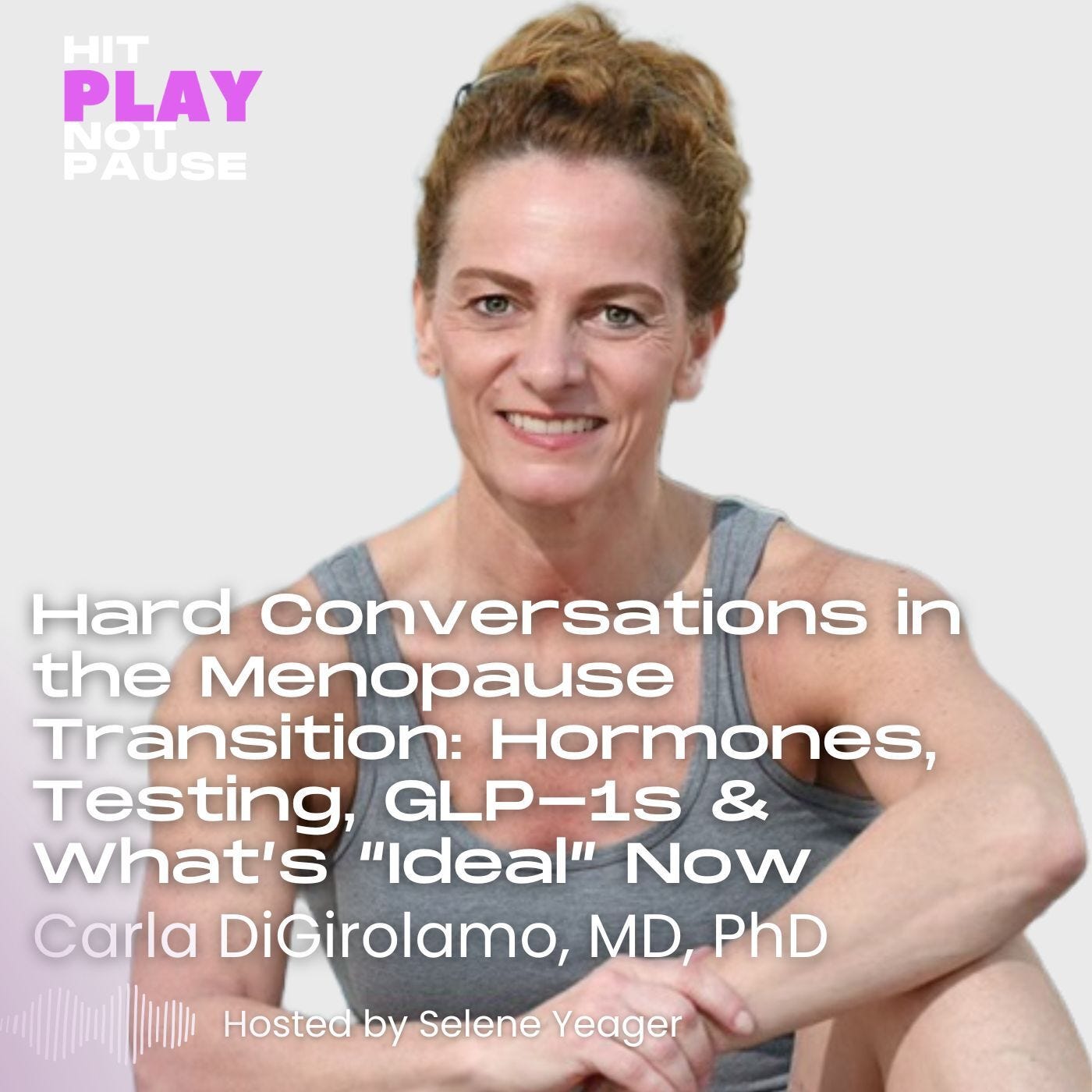
Hard Conversations in the Menopause Transition: Hormones, Testing, GLP-1s and what’s “Ideal” Now
This week we welcome back our resident reproductive endocrinologist and menopause specialist, Dr. Carla DiGirolamo, for another candid conversation. We pull back the curtain on Carla’s own menopause experience—how she navigates her symptoms, what she’s learned, and what she practices herself. We also dig into the hard conversations so many of us are having as we navigate this ever-evolving space, and how years of working closely with active midlife women have shaped her thinking on hormone therapy, GLP-1 medications, testosterone, hormone testing, and what actually moves the needle for athletic women in the transition.
TAKING NEW CLIENTS!

If you are an active woman or competitive midlife athlete who feels abandoned by mainstream medicine, I’m here for you!
It is with great excitement that after more than 2 years of preparation, I have FINALLY launched my Telehealth Consultation Medical practice focusing on the Reproductive Endocrine needs and Menopausal Care for active, athletic, and high-performing women.
Active and athletic midlife women have needs and risk profiles that are different from the general population. These needs often go unmet by the mainstream medical community due to a lack of understanding of fitness and sport and their impact on mid-life hormonal physiology or even a lack of acknowledgment that this dynamic exists. We put your health, fitness, and performance at the center of the equation so that you can achieve your healthiest, highest-performing self!
You will find all my service offerings on my website, including a link to my calendar so that you can reserve your place in my schedule online! Looking for a more Human encounter? Call Mary, my awesome and amazing assistant at 754-262-5674 (M-F 9a-5p ET)
Hello! Thank you so much for this great comment and for reading! I discoverd this firsthand dealing with my own shoulder challenges (that has spanned 5+ years) and when I went to see a Performance PT about it, I appreciated the "system" approach for rehabbing my shoulder and now its stronger than ever.... definitely a believer! Thanks again for reading! Cheers! -Dr. Carla
Hi Destiny! Thanks so much for the comment and for reading! I have been on quite a journey with my own shoulders and have learned a ton from my performance PT, body worker, and the journey itself. I'm glad you found this post helpful! :)