

Hey Team!
This week's post is chock full of great stuff for your health, performance, and longevity!

* Learn about how a performance physical therapist can get you feeling, moving and performing at your best!

* The most efficient 20 minutes of strength training you will do this week

* ..and finally, a new podcast has dropped where Selene Yeager and I take a deep dive into the controversial topic of the role of the menopause transition in muscle health and physiology.
Enjoy!
-Dr. Carla
If you’re an active or athletic woman over 40, you’ve probably felt it—that nagging ache that never fully goes away, the stiffness that shows up after workouts, or the injury that keeps resurfacing. You may have been told this is “just part of getting older.”
It’s not.
One of the most valuable—and often overlooked—resources for active women in midlife is a performance physical therapist.
I discovered this very recently when I was struggling with a forearm injury from playing tennis. After multiple sessions with a massage therapist with modest improvement, I just couldn’t shake it - and it was affecting my CrossFit workouts. Ideas like “Was this the beginning of the end?” “Will I have this problem forever?” were swirling in my mind, causing me great angst.
Then I found Dr. Casey Francis, a fellow athlete and Performance Physical Therapist at CrossFit Pompano Beach. She evaluated my situation, and we started working together. She gave me exercises to do on my own, we did some dry needling, and in just 2 months, the injury was gone. Yes! GONE! Like it never happened. After that, I reached out to her for some hip and shoulder pain, and again, she evaluated my movement and helped me move better and improve strength in these movements, which carried over into my workouts and everyday life.
Today, I’m as good as new and have an incredibly valuable resource for my performance and longevity arsenal.
What Is a Performance Physical Therapist?
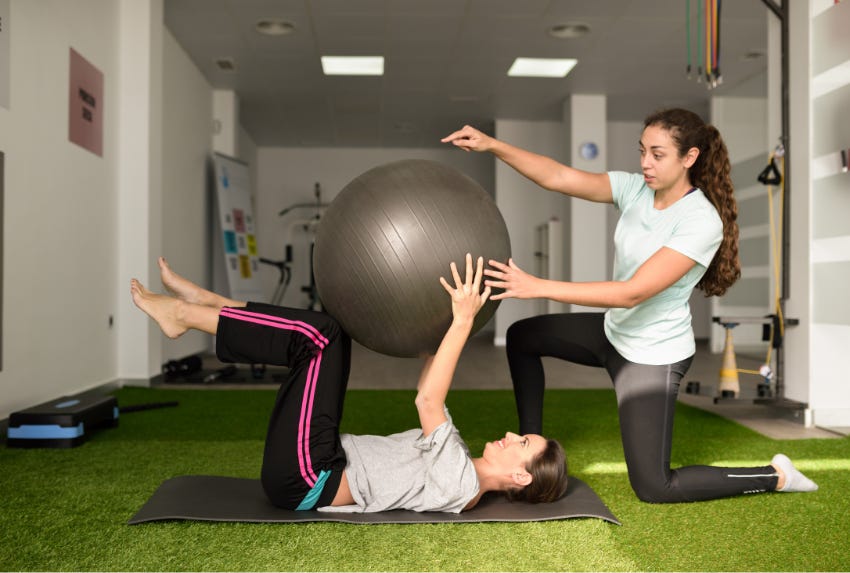
A performance physical therapist is a licensed PT who specializes in helping active people move well, train hard, and stay in their sport. Unlike traditional physical therapy that often focuses on basic daily function, performance PT is about restoring—and improving—how you move as an athlete.
They don’t just ask if something hurts.
They ask how you train, how you recover, and what you want to keep doing long-term.
Why This Matters More in Mid-life
As we age, recovery changes. Hormonal shifts, prior injuries, and years of repetitive movement all affect how our bodies handle training stress. Many athletic, mid-life women deal with:
Slower recovery
Recurrent “niggles” instead of clear injuries
Loss of mobility or power
Pain that shows up during otherwise strong training
A performance PT understands these changes and works with your body—not against it.
How Performance PT Helps With Pain and Injury
Instead of chasing symptoms, performance PTs look at the whole system:
How you move
How your joints load
Strength, mobility, and stability patterns
Training volume and recovery habits
The goal isn’t just pain relief—it’s building resilience so the issue doesn’t keep coming back.
Often, this means you don’t have to stop training entirely. You learn how to modify intelligently while healing.
Performance PT as Maintenance (Not Just Rehab)
You don’t need to be injured to benefit.
Many athletic women use performance physical therapy as preventative care—just like strength training or mobility work. It can help you:
Stay ahead of injuries
Improve efficiency and performance
Navigate heavier training blocks
Adapt to body changes in midlife
Think of it as maintenance for the body you rely on every day.
How Performance PT Is Different From Traditional PT
Performance PTs typically:
Spend more time one-on-one
Use strength training as a core tool
Understand sport-specific demands
Expect you to work—but with purpose
The goal isn’t to get you back to “normal.”
It’s to help you stay strong, capable, and confident.
The Bottom Line
Aging and longevity aren’t about slowing down—it’s about training smarter and getting better support.
A performance physical therapist can help active and athletic mid-life women move better, recover faster, and continue doing what they love—without accepting pain as the price of aging.
Resources
Here is a shout-out to two Performance Physical Therapists whom I have come to know:
Dr. Casey Francis - The MVMT MTHD Pompano Beach, Florida
Dr. Haley Harrison - Empower Physical Therapy and Performance, Wakefield, MA
** Inquire about virtual services.
Now let’s get on with this week’s workout!
As we just learned, Performance Physical Therapy uses strength training as a core tool, and this week’s workout does not disappoint!
I love this one and have posted it multiple times. What’s great about it is that you can mix and match movements, and it is very time-efficient. After warming up, it takes 20 minutes, and in that time we target upper AND lower-body strength. The intensity lives in the every-minute-on-the-minute time domain.
Are you ready for the most efficient, 20 minutes of strength training you’ll do this week?
Let’s do this!
Warm Up
4 Rounds – light load
*1 round = Up-downs, then push-ups, then air squats
Movement Practice
If you have the available equipment, choose a barbell for one movement and dumbbells for the other. Both options should be on the heavier side with the goal of doing all 5 reps unbroken, but reps 4 and 5 are VERY challenging.
If you do not have a barbell, use dumbbells for both movements and choose one weight that is challenging for both. Do not change weights between movements as there is not enough time. Take 5-10 minutes to practice 3-5 repetitions per movement to find the appropriate weight.
Modification: If you do not have heavy weights available, use lighter weights and do 10 repetitions.
Movements: Practice the dumbbell push-press and the front squat and select your weights according the suggestions above.
Check out this video for the dumbbell push-press. This movement utilizes hip extension to transfer momentum to the dumbbells, assisting the shoulders in driving the weight overhead. This allows you to go a little heavier on the weight and targets shoulder stabilization as well as strength.
Check out this video for the dumbbell front squat. Whether using a barbell or set of dumbbells, this is one of my favorite squat movements because it targets core strengthening in addition to recruiting the quads, glutes, and hamstrings… and it is a little friendlier to the lower back compared to the back squat.
Workout
EMOM 20:00 (every minute on the minute x 20 minutes). Set your SmartWOD app or other timer for EMOM (1:00) x 20 minutes or set a 20-minute timer. On even minutes (0, 2, 4), perform the push press. On odd minutes perform the front squat. Use a barbell or dumbbells for either or both of these movements. THESE SHOULD BE ON THE HEAVIER SIDE! Reps 4 and 5 should be hard but not ugly. All repetitions should be done unbroken.
Minute 1 (and odd minutes) – 5 dumbbell or barbell push presses (rest for the remainder of the minute)
Minute 2 (and even minutes) – 5 heavy barbell or dumbbell front squats
TIP! Avoid the need to change weights each minute due to time constraint. If only one sent of weights is available, find your heaviest push press weight. If this weight feels light for your front squats, then DOUBLE the front squat repetitions!
Cool-Down
Enjoy this 15-minute post-workout stretch that will help your upper and lower body on its way to fast recovery
The Menopause Muscle Continuum….
Does the menopause transition directly impact muscle health and physiology?
This has been the subject of some very intense discussion recently. Join me and the awesome and amazing Selene Yeager for Hit Play Not Pause Episode 253 where we take a deep dive into the science behind this debate.

NOW TAKING NEW CLIENTS!
If you are an active woman or competitive midlife athlete who feels abandoned by mainstream medicine, I’m here for you!

It is with great excitement that after more than 2 years of preparation, I have FINALLY launched my Telehealth Consultation Medical practice focusing on the Reproductive Endocrine needs and Menopausal Care for active, athletic, and high-performing women.
Active and athletic midlife women have needs and risk profiles that are different from the general population. These needs often go unmet by the mainstream medical community due to a lack of understanding of fitness and sport and their impact on mid-life hormonal physiology or even a lack of acknowledgment that this dynamic exists. We put your health, fitness, and performance at the center of the equation so that you can achieve your healthiest, highest-performing self!
You will find all my service offerings on my website including a link to my calendar so that you can reserve your place in my schedule!