

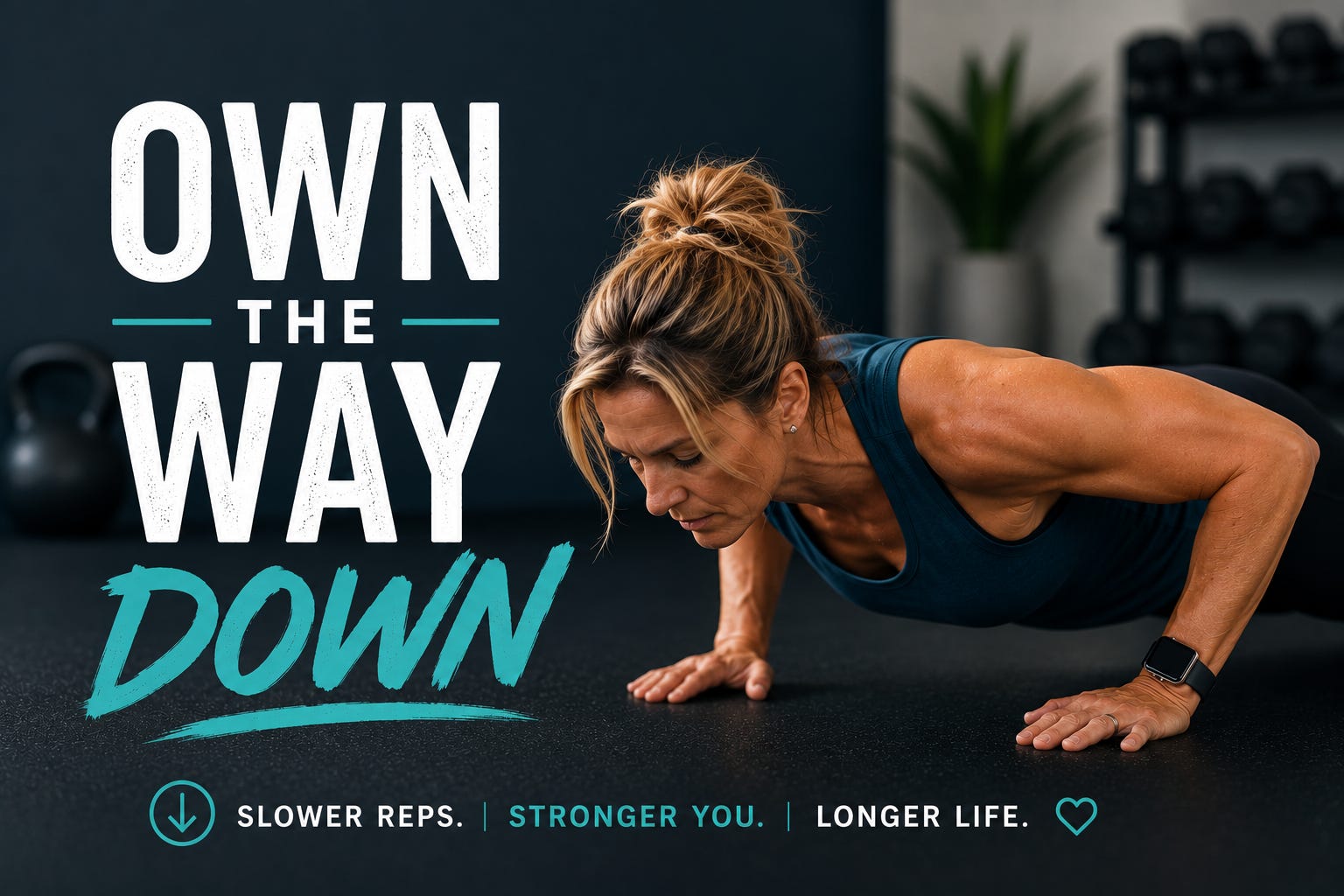
When most people think about strength training, they focus on the lifting portion of an exercise—the push-up, squat, or pull-up. But some of the greatest strength gains happen on the way down.
This lowering phase is called an eccentric contraction, often referred to as a negative repetition. During an eccentric contraction, the muscle produces force while it lengthens under load. Think about lowering yourself into a chair, walking down a flight of stairs, or slowly lowering your body during a push-up.
For active, athletic midlife women, negative repetitions are among the most effective—and often overlooked—tools for building strength, improving movement quality, and progressing to more challenging exercises.
Why Do Negative Repetitions Work?
Your muscles are capable of producing greater force during an eccentric contraction than during the lifting (concentric) phase of the same movement. This allows you to challenge your muscles in ways that aren’t always possible with traditional repetitions.
Research has consistently shown that eccentric training can:
Increase muscular strength
Promote muscle growth
Improve neuromuscular control and coordination
Enhance functional performance
Build confidence in movements that may not yet be possible through a full repetition
For example, someone who cannot yet perform a full push-up can still begin in the top position and slowly lower themselves to the floor under control. This develops strength throughout the chest, shoulders, triceps, core, and scapular stabilizers while reinforcing proper movement mechanics.
The same principle can be applied to pull-ups, split squats, step-downs, and many other exercises.
Perhaps most importantly, negative repetitions teach control.
Every day life depends just as much on controlling movement as it does on producing force. We lower ourselves into chairs, descend stairs, absorb the impact of landing, and catch ourselves when we lose our balance. These are all eccentric movements, making this type of training highly functional both inside and outside the gym.
How to Perform a Negative Push-Up
Choose a variation that matches your current strength level—a wall, countertop, bench, box, or the floor.
Begin in the top of a push-up position with your body in a straight line from head to heels (or knees if performing a modified push-up). Engage your core and gently pull your shoulders down and back.
Slowly lower yourself over 3–5 seconds, maintaining good alignment throughout the movement. Descend only as far as you can while maintaining control.
Once you reach the bottom, reset by standing back up (or returning to the starting position using your knees or an elevated surface) rather than pressing yourself back up.
Start with 2–4 sets of 3–5 controlled negative repetitions, performed one to two times per week.
Remember: the goal is quality, not fatigue.
Safety Considerations
Because eccentric contractions generate high muscular forces, they can also produce more muscle soreness than traditional resistance training—particularly when they are new to your program.
To minimize soreness and maximize benefit:
Lower under control—never simply “drop.”
Stop if shoulder, wrist, or elbow pain develops.
Begin with only a few repetitions.
Allow adequate recovery before repeating the exercise.
Progress gradually by increasing either the lowering time or the number of repetitions—not both at once.
As with any exercise, good movement quality is more important than completing additional repetitions.
Progressions and Alternatives
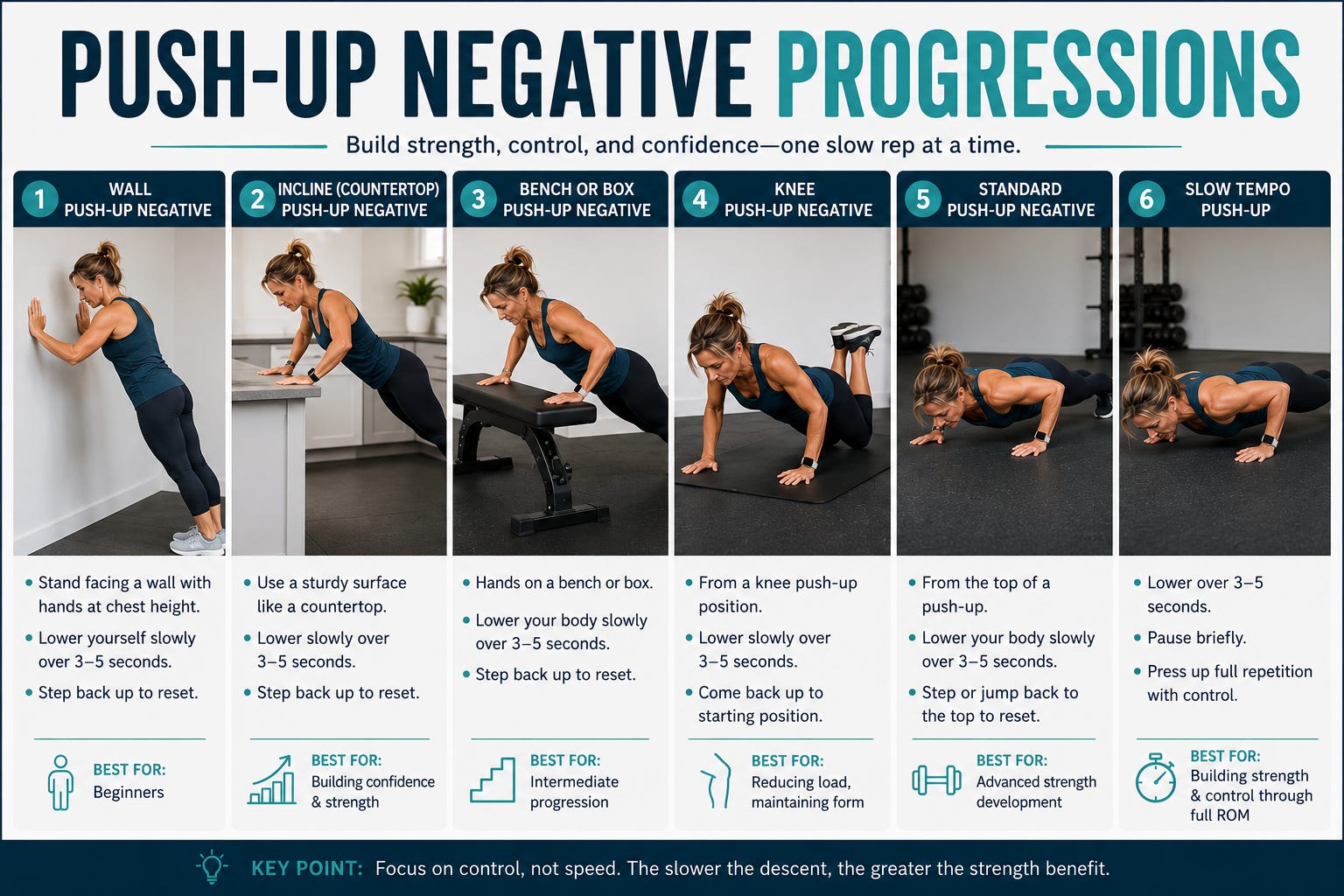
One of the greatest advantages of negative repetitions is that they can be incorporated into almost any exercise.
Try these progressions:
Wall Push-Up Negatives
Countertop or Incline Push-Up Negatives
Floor Push-Up Negatives
Assisted Pull-Up Negatives
Split Squat or Step-Down Negatives
Parallel Bar or Ring Dip Negatives (for experienced athletes)
The Bottom Line
Strength isn’t just about lifting your body or a weight—it’s about controlling it.
Negative repetitions help bridge the gap between where you are today and the movements you’re working toward tomorrow. They develop strength, coordination, confidence, and resilience while reinforcing high-quality movement patterns that carry over into everyday life.
Sometimes, getting stronger doesn’t mean moving faster or lifting heavier. Sometimes, it simply means learning to own the way down.
This week, we are continuing our focus on functional, upper-body pushing movements, building strength, stamina, and control.
Today, we will use the push-up negative movement as a PRE-WORKOUT accessory that will serve as a great warm-up for the workout, and introduce an accessory that you can add to other training sessions.
Enjoy!
Warm Up
AMRAP 7 minutes
Pre-Workout Accessory
Take 3-5 minutes to find a movement option for the push-up negative.
Start with 2 sets of 5 repetitions with 2:00 of rest in between sets. If you are still feeling strong, do a third set.
Do this accessory a second time this week and twice weekly for 4-6 weeks for real gains in upper body strength! Increase your progression as the movement becomes easier.
Movement Practice
Take 5-10 minutes to select your weights and options for the workout. For the thrusters and pull-ups, select an option/weight that allows you to do 10 repetitions unbroken with confidence during the warm-up. Strive to complete the thrusters and pull-ups in 1-2 sets during the workout. For the burpees over the dumbbell, move steadily at a pace where can you catch your breath. You’ll need it when you begin the next round of thrusters. If you need to step over the dumbbell rather than jump over it, that is completely fine!
Movement options:
For the dumbbell thrusters, substitute air squats and double the repetitions
For the pull-ups, use assistance with a band or machine or substitute a heavier bent-over dumbbell row.
For the burpee over the dumbbell, step over the dumbbell rather than jumping over it. If no dumbbell, substitute a traditional burpee option.
Workout
HOW TO: Perform each of the three movements each round of the repetition scheme. Perform 6 thrusters, 6 pull-ups and 6 burpees over dumbell, then perform 9 thrusters, 9 pull-ups, and 9 burpees, and so on until you complete the repetition scheme.
*The goal of this workout is to pace and move steadily and efficiently. Remember: “Slow is smooth and smooth is fast!”.
FOR TIME:
6-9-12-9-6
Pull-ups (video includes scaling options)
Cool Down
Workouts like this one require a thorough cool-down to promote recovery and ready you for the training week ahead. This sequence is AMAZING!!!! #dontskiptheyoga
20-minute Ashtanga Inspired Yoga - Total Body Yoga Flow for Flexibility, Strength, and Peace
In case you missed it…..
Muscle, Hormones & the Menopause Transition with Carla DiGirolamo, MD, PhD (Episode 253)

As active women, muscle is the engine that powers us through our lives, no matter what sport we love. When we hit midlife and menopause, it can feel like that 8-cylinder engine drops to six—less punch when we hit the gas, even though we’re still training. We may notice less muscle and more body fat when we look in the mirror. Muscle and strength loss during the menopause transition is multifactorial. It’s hormonal changes and estrogen decline. It’s inflammation. It’s symptoms like poor sleep, joint pain, and fatigue. It’s body fat gain. It’s how we recover and fuel. And, of course, it’s aging itself, as both women and men lose muscle with age. Our approach to making and maintaining it has to be multifactorial as well. This week we talk all about muscle and menopause–from basic science to menopause symptoms to hormone therapy–to understand what’s going on under the hood and help keep that engine strong.
NOW TAKING MEDICAL CLIENTS FROM COLORADO AND CONNECTICUT… NH COMING SOON!
..in addition to MA, NY, NJ, PA, CA, FL, OH
If you are an active woman or competitive midlife athlete who feels abandoned by mainstream medicine, I’m here for you!

It is with great excitement that after more than 2 years of preparation, I have FINALLY launched my Telehealth Consultation Medical practice focusing on the Reproductive Endocrine needs and Menopausal Care for active, athletic, and high-performing women.
Active and athletic midlife women have needs and risk profiles that are different from the general population. These needs often go unmet by the mainstream medical community due to a lack of understanding of fitness and sport and their impact on mid-life hormonal physiology or even a lack of acknowledgment that this dynamic exists. We put your health, fitness, and performance at the center of the equation so that you can achieve your healthiest, highest-performing self!
You will find all my service offerings on my website including a link to my calendar so that you can reserve your place in my schedule!
Great stuff. Love what you put out. Regards. John. Stay locked in. Doc.
Thank you for reading and for the kind words! :)