


Last week, we discussed the importance of quadriceps-focused training and highlighted the VMO squat as a valuable tool for building strength and preserving long-term function.
Today, I want to take the next step in that progression by introducing one of my favorite lower-body exercises: the Bulgarian split squat.
While traditional squats remain foundational, most real-world movement occurs one leg at a time.
Walking.
Climbing stairs.
Hiking.
Running.
Recovering balance after a stumble.
Even simple activities such as getting out of a car or stepping onto a curb require us to generate force primarily through a single leg.
This is where the Bulgarian split squat shines.
The Bulgarian split squat is a single-leg dominant exercise that combines many of the benefits of traditional squats with the additional challenges of balance, stability, and unilateral strength development.
For active adults, it may be one of the most effective exercises for maintaining lower-body function as we age.
Why Single-Leg Training Matters
Single-leg training helps develop:
Quadriceps strength
Hip strength and stability
Balance and coordination
Force absorption during landing and deceleration
Side-to-side symmetry
Research consistently demonstrates that lower-extremity strength and balance are important contributors to physical function, mobility, and fall prevention throughout adulthood.
As we reviewed in Leg Day Essentials - Part 1, the quadriceps remain particularly important because they contribute to:
Walking speed
Stair-climbing ability
Sit-to-stand performance
Overall mobility
Activities of daily living
Longitudinal studies suggest that declines in quadriceps strength closely parallel declines in physical function over time.
What Is a Bulgarian Split Squat?
The Bulgarian split squat is performed in a staggered stance with the rear foot elevated on a bench, box, or stable platform.
The front leg performs most of the work while the rear leg provides minimal assistance.
This allows substantial loading of the quadriceps while simultaneously challenging balance and stability.
The movement can be performed with:
Body weight
Dumbbells
Kettlebells
A barbell
Safety Considerations
Like any exercise, the Bulgarian split squat should be performed within your current strength, mobility, and balance capabilities.
Individuals with significant knee pain, acute lower-extremity injury, uncontrolled balance deficits, or severe hip or ankle mobility limitations may need to begin with modified variations.
Modifications
Balance is often the limiting factor rather than strength. If this is the case, add support with a stable object as seen in panel 3 below. As strength, balance, and confidence improve, progression to Bulgarian split squats may be possible!
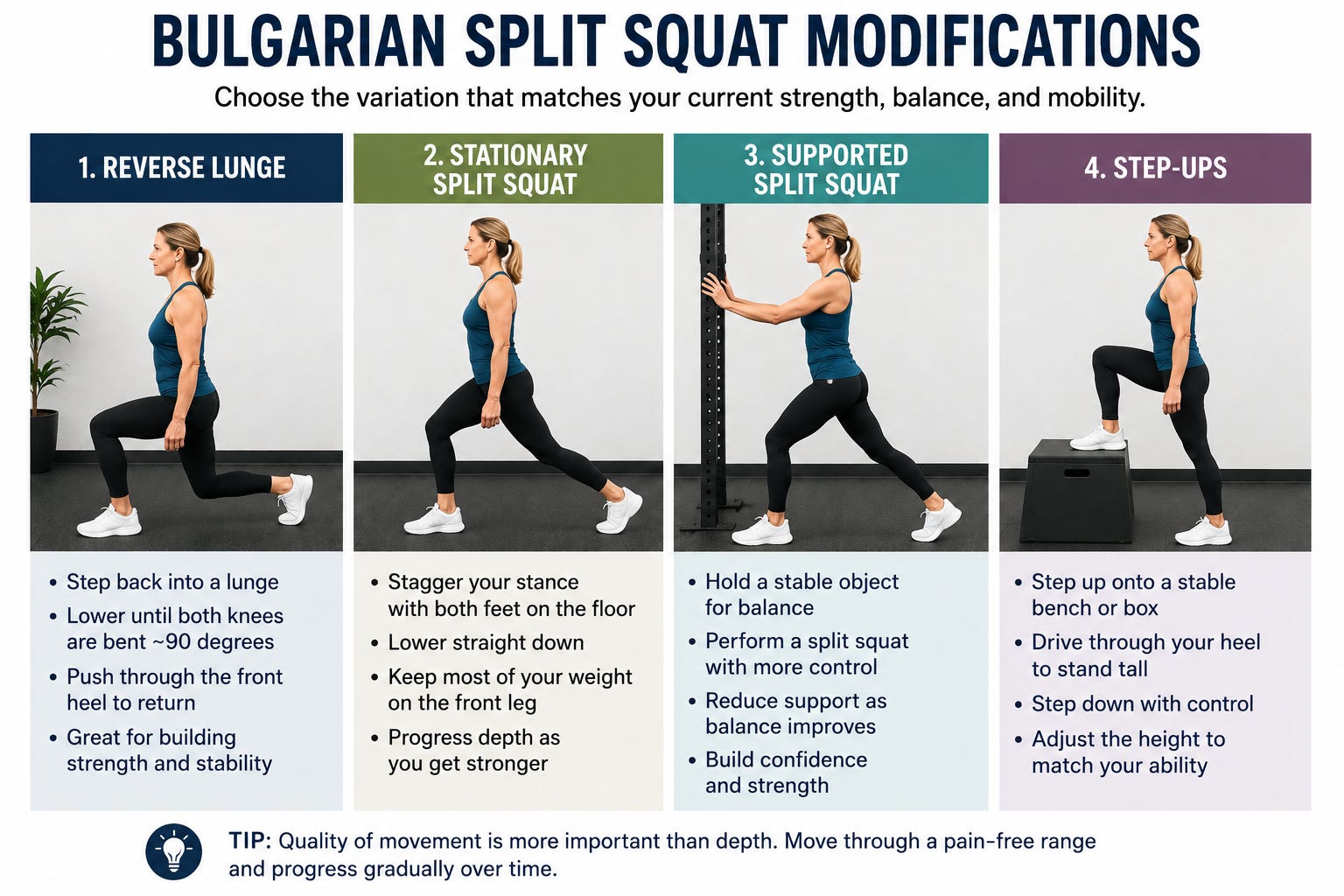
During the exercise:
Keep the majority of your weight over the front leg
Maintain an upright torso
Allow the front knee to track naturally over the toes
Avoid collapsing inward through the knee
Move through a pain-free range of motion
Mild muscle fatigue and muscular discomfort are expected. Sharp joint pain is not.
Warm Up
AMRAP 7 minutes (As many rounds as possible in 7 minutes) - low to moderate intensity
20 single-under jump rope or simulated jump rope
Movement Practice
Take 5-10 minutes to watch the video and test out various options for the single-leg squat. If none of these is an option for your abilities, check out the Movement alternatives below to find your best fit for this workout!
For the pull-ups, select the option that allows you to achieve 5 unbroken repetitions confidently but not easily.
Workout
Today’s workout is taken from an excerpt from the CrossFit Gymnastics Training course and from the CrossFit workout library, Workout 230428.
AMRAP 20 (As many rounds as possible in 20 minutes)
5 strict pull-ups
20 Bulgarian Split Squats (or your selected option) (total of 10 left and 10 right)
TIP: Depending on your option, you may choose to alternate legs each rep, or do small sets on one side before switching legs. Either way, ensure that you perform the same number of repetitions on both sides.
40 double-unders (or 80 single-unders or simulated jump rope)
So, why the pull-ups? It’s a sneaky way to further challenge the core muscles needed for the single-leg squat while allowing the legs to rest!
Movement alternatives
Lunge with forward lean (use dumbbells or body weight only) - do 5 or 10 repetitions before switching sides. TIP! Keep the front knee in line with the ankle - avoid tracking the knee over the toes
Walking or alternating lunge in place - body weight only, holding 2 dumbbells by your sides or holding a kettlebell in a “goblet” position at your chest.
For the pull-ups, sub any of the following:
Band or machine-assisted pull-ups
Cool Down
Team! This is not one to skip! Your legs are a skeletal muscle powerhouse - and this workout challenged them to a high level. In turn, this requires high-level recovery and it begins with tissue care. Your legs will thank you!
20-minute “follow-along” lower-body foam roll and stretch
References
Hughes VA, Frontera WR, Wood M, et al. Longitudinal muscle strength changes in older adults: influence of muscle mass, physical activity, and health. J Gerontol A Biol Sci Med Sci. 2001;56(5):B209-B217.
Liao KF, Ku YH, Lin LF, et al. Effects of unilateral versus bilateral resistance training on athletic performance measures: a systematic review and meta-analysis. Front Physiol. 2021;12:745199.
Gonzalez AM, Mangine GT, Fragala MS, et al. Resistance training improves single-leg stance performance in older adults. Aging Clin Exp Res. 2014;26(1):89-92.
Amin S, Baker K, Niu J, et al. Quadriceps strength and the risk of cartilage loss and symptom progression in knee osteoarthritis. Arthritis Rheum. 2009;60(1):189-198.
Papa EV, Dong X, Hassan M. Resistance training for activity limitations in older adults: a systematic review. Clin Interv Aging. 2017;12:955-961.
In case you missed it…..

Why are we all confused about cortisol? Is it good? Is it bad? Is it simply too much of a good thing? Dr Carla DiGirolamo MD, Women's performance endocrinologist, lays out the physiology, data, and practical applications of how cortisol affects our life and health.
No doubt you have seen Dr. Vonda in the news and on social media. She is an absolute force when it comes to promoting an empowering message about how women can thrive during midlife. Check out her new best-selling book “Unbreakable: A Woman’s Guide to Aging with Power”.
NOW TAKING NEW CLIENTS!
If you are an active woman or competitive midlife athlete who feels abandoned by mainstream medicine, I’m here for you!

It is with great excitement that after more than 2 years of preparation, I have FINALLY launched my Telehealth Consultation Medical practice focusing on the Reproductive Endocrine needs and Menopausal Care for active, athletic, and high-performing women.
Active and athletic midlife women have needs and risk profiles that are different from the general population. These needs often go unmet by the mainstream medical community due to a lack of understanding of fitness and sport and their impact on mid-life hormonal physiology or even a lack of acknowledgment that this dynamic exists. We put your health, fitness, and performance at the center of the equation so that you can achieve your healthiest, highest-performing self!
You will find all my service offerings on my website including a link to my calendar so that you can reserve your place in my schedule!
Definitely one of the best lower body exercises, and it’s more versatile than people realize. You can even combine it with a wood chop—hold the bottom position of the BSS and perform the wood chop from there. It loads your quads, glutes, and hamstrings, hits your obliques and shoulders, and puts your rear hip flexors under a deep stretch the entire time.
Bulgarian Split Squats (or Rear Foot Elevated Split Squats/RFESS, as I often call them) have been a staple in my strength training routine for a decade. For me, they can often be the third "big lower body lift" of the week. If I am following a 3 day program, Day 1 would be barbell squats of some description, Day 2 would be barbell or trap bar deadlifts, and Day 3 is RFESS. These things never get easy, and I find them to be one of the more challenging lifts. They are also my go-to when traveling, since most hotel gyms lack proper free weight options for truly heavy leg stuff and I refuse to use machines (plus most do not fit me anywhere since I am under 5' tall). Since most hotel gyms always have a full set of dumbbells up to 50 lbs, I can usually do 3 sets of these with 25-30lb dumb bells and get my heavy leg workout done efficiently.