

Squatting is a foundational functional movement involving the largest muscles of the body. We have discussed them at length in this newsletter multiple times, which speaks to their importance.
The back squat is a balanced or posterior-chain dominant squat pattern that distributes load among the glutes, hamstrings, quadriceps, and spinal stabilizers. This movement pattern is excellent for total body strength, power production, athletic development, bone loading, and muscle mass preservation.
The quadriceps are important for stair descent, hiking downhill, landing mechanics, pickleball and tennis movement, skiing, running, and recovering balance. Quadriceps strength has been associated with:
Walking speed
Stair-climbing ability
Sit-to-stand performance
Overall mobility
Activities of daily living
Longitudinal data suggest that changes in quadriceps strength track closely with changes in physical function over time. Individuals who lose quadriceps strength tend to demonstrate greater functional decline.
Because squats are a complex movement that recruit muscles throughout most of the body, there is value in supplementing squat work with other, more isolated, quadriceps-dominant exercises.
According to the peer-reviewed literature, the benefits of quadriceps-dominant training include:
Improved physical function
Reduced risk of falls
Better knee health and reduced osteoarthritis burden
Improved force absorption and deceleration capacity
Enhanced gait performance
Today, I want to highlight a squat variation called the VMO Squat - also known as the “Quad squat”.
What Is a VMO Squat?
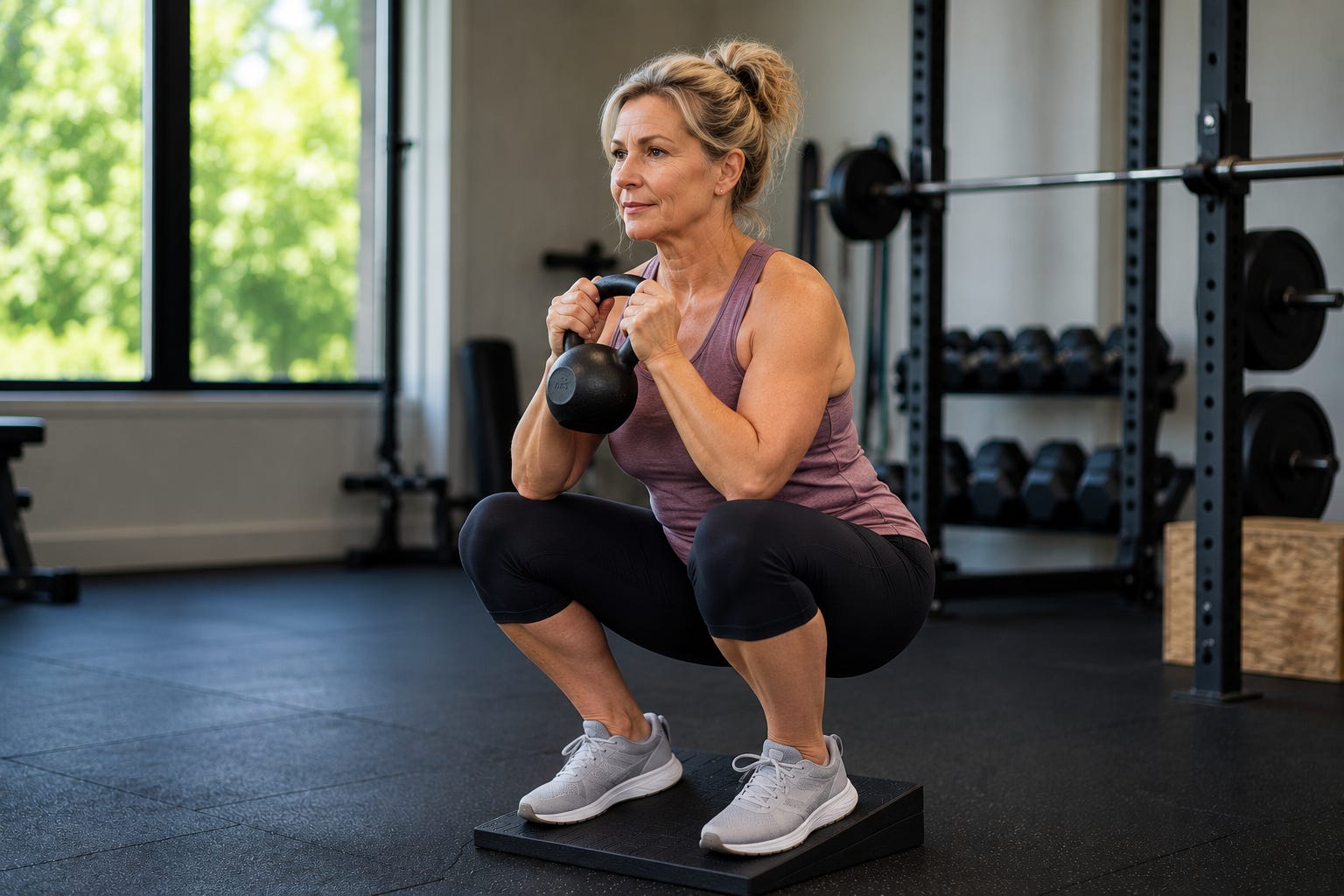
The VMO squat is a knee-dominant squat variation designed to increase quadriceps loading through increased forward knee translation and upright torso positioning.
How to Perform a VMO Squat
The movement can be performed with body weight, dumbbells, kettlebells, or barbells.
Setup
Elevate the heels using wedges, plates, or a slant board
Use a relatively narrow stance
Keep the chest upright
Allow the knees to travel forward naturally
Descent: Lower slowly while maintaining full foot contact, controlled knee tracking, and upright posture
Bottom Position: Descend only as deep as mobility, control, and comfort allow. You can set up a STABLE target such as a bench or a chair behind you to maintain your pain-free range of motion.
Safety Considerations
The VMO squat is not appropriate for everyone immediately.
Individuals with acute knee injury, significant patellofemoral pain, advanced osteoarthritis, meniscal irritation, or poor ankle mobility may need modifications or gradual progression.
Helpful strategies include:
Starting with body weight only
Using a reduced range of motion
Slowing the tempo
Holding onto support initially
Gradually increasing depth
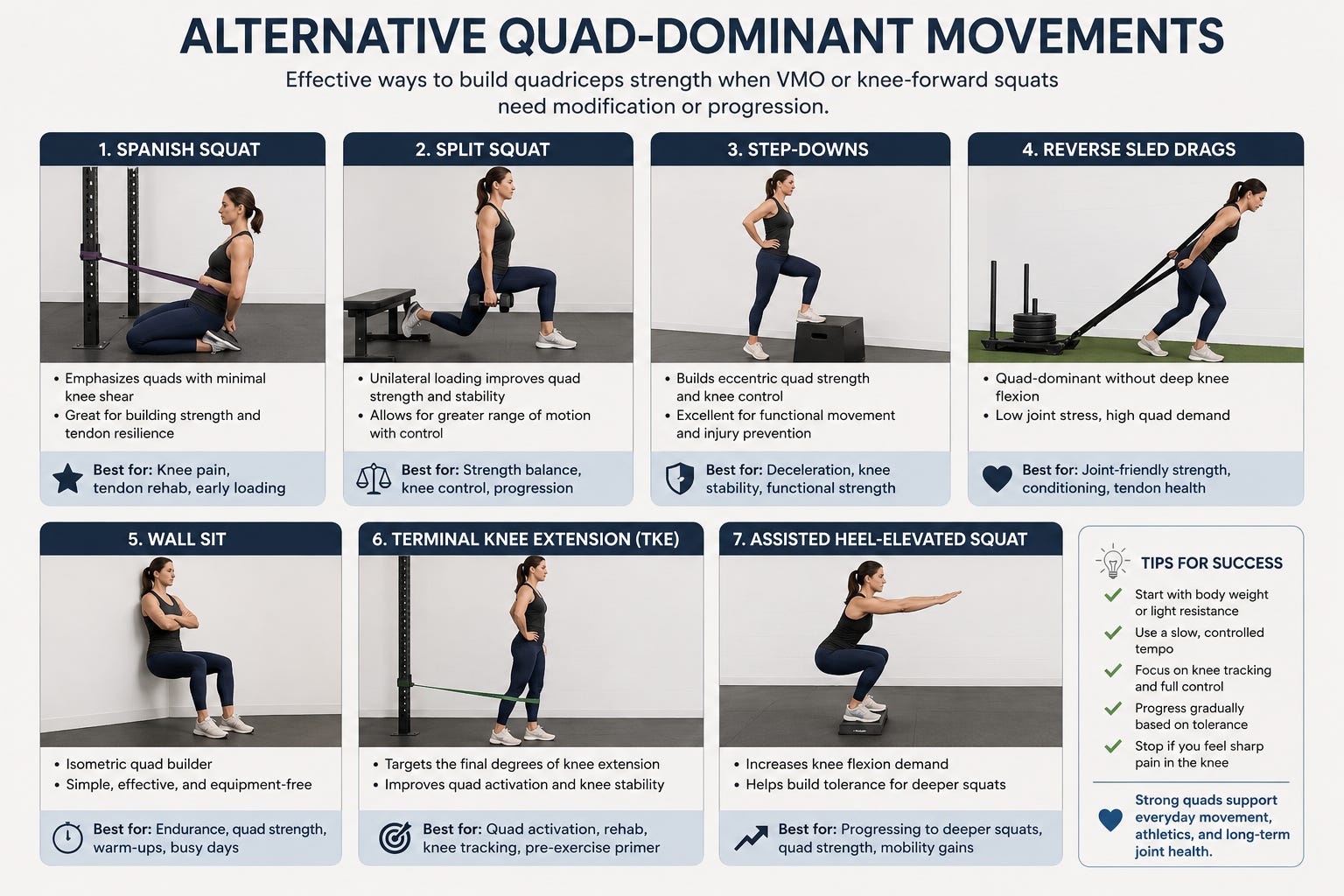
Below are some examples of ALTERNATIVE quadriceps-dominant exercises that provide similar benefits of VMO squats are not accessible for you:
Today’s workout will incorporate the VMO squat as a post-workout accessory. Accessory work can be a game-changer for enhancing the stimulus of your main workout block. For strength-building, consider incorporating this accessory 1-2x per week, progressively adding small amounts of load as tolerated over a 4-6 week period.
Warm-Up
AMRAP 5 minutes (As many rounds as possible in 5 minutes)
10 Jumping Jacks
10 Air Squats
Workout
Part 1 - Lift Heavy
This workout is ideally performed with a heavier barbell taking it off the rack. If you do not have a barbell and are using dumbbells, do these repetitions as 2:2:1 tempo repetitions (2 count down, hold at the bottom for a 2 count, then rise for a 1 count). All 6 repetitions should be performed unbroken, building in weight across all 5 sets.
Every 2 minutes for 5 sets
6-6-6-6-6 (If you are doing tempo repetitions with dumbbells, perform 4 repetitions each set)
Heavy barbell Front Squat - 6 repetitions
TIP!: “Heavy” does not mean that you sacrifice mechanics! Watch the video and maintain the strictest of form and do not compromise safety! Some wiggle-room is allowed as fatigue sets in, but it should never get ugly.
(Alternative: Dumbbell Front Squat at a 2:2:1 tempo x 4 reps per set)
Part 2 - VMO Squat Accessory
Rest 5-7 minutes after completing part 1
If you have any knee or ankle discomfort, take a few minutes to use a chair, bench, or step to find the limits of your pain-free range of motion. Add some light load (kettlebell or dumbbell) if desired. If this movement is not accessible to you, consider one of the options above.
Every 2 minutes x 4 sets - Set a timer and on time zero, 2, 4, and 6 minutes, perform 8-10 repetitions. Use the remainder of the 2-minute interval to rest. All repetitions should be unbroken.
Cool-Down
15-minute Deep Stretch for Hips - Slow Flow Yoga sequence
References
Frontera WR, Hughes VA, Lutz KJ, Evans WJ. A cross-sectional study of muscle strength and mass in 45- to 78-year-old men and women. J Appl Physiol. 1991;71(2):644-650. doi:10.1152/jappl.1991.71.2.644
Bean JF, Kiely DK, LaRose S, Goldstein R, Frontera WR, Leveille SG. Are changes in leg power responsible for clinically meaningful improvements in mobility in older adults? J Am Geriatr Soc. 2010;58(12):2363-2368. doi:10.1111/j.1532-5415.2010.03155.x
Segal NA, Glass NA, Torner J, et al. Quadriceps weakness predicts risk for knee joint space narrowing in women in the MOST cohort. Osteoarthritis Cartilage. 2010;18(6):769-775. doi:10.1016/j.joca.2010.02.002
Øiestad BE, Juhl CB, Eitzen I, Thorlund JB. Knee extensor muscle weakness is a risk factor for development of knee osteoarthritis: a systematic review and meta-analysis. Osteoarthritis Cartilage. 2015;23(2):171-177. doi:10.1016/j.joca.2014.10.008
Skelton DA, Kennedy J, Rutherford OM. Explosive power and asymmetry in leg muscle function in frequent fallers and non-fallers aged over 65. Age Ageing. 2002;31(2):119-125. doi:10.1093/ageing/31.2.119
NOW TAKING NEW CLIENTS!
If you are an active woman or competitive midlife athlete who feels abandoned by mainstream medicine, I’m here for you!

It is with great excitement that after more than 2 years of preparation, I have FINALLY launched my Telehealth Consultation Medical practice focusing on the Reproductive Endocrine needs and Menopausal Care for active, athletic, and high-performing women.
Active and athletic midlife women have needs and risk profiles that are different from the general population. These needs often go unmet by the mainstream medical community due to a lack of understanding of fitness and sport and their impact on mid-life hormonal physiology or even a lack of acknowledgment that this dynamic exists. We put your health, fitness, and performance at the center of the equation so that you can achieve your healthiest, highest-performing self!
You will find all my service offerings on my website including a link to my calendar so that you can reserve your place in my schedule!
In case you missed it…..

Tune in to my guest appearance with the awesome and amazing Selene Yeager where we review the latest medical literature addressing the the role of laboratory testing in managing menopausal hormone therapy.
Great info. I'm going to try this today.