

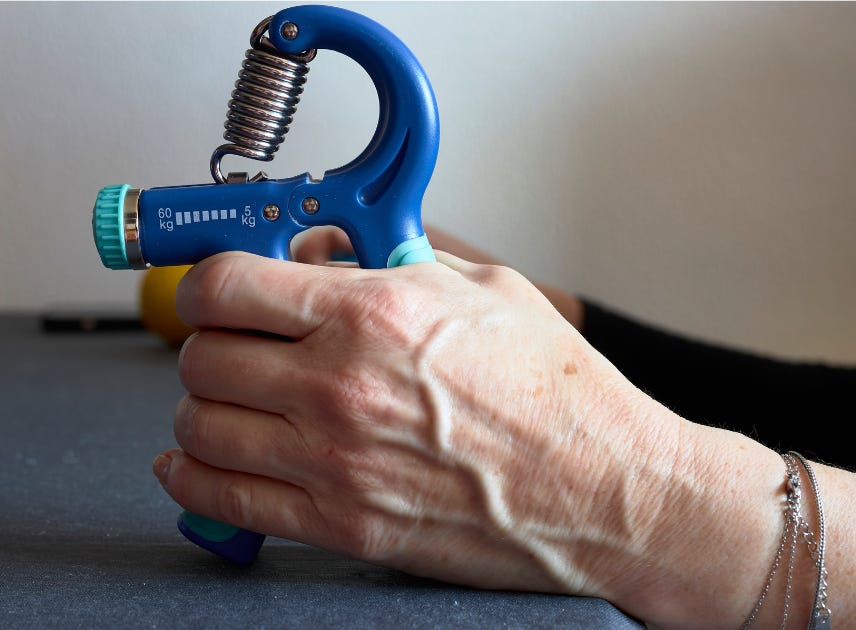
Grip strength has received a lot of attention in recent years because it is a reliable marker of overall muscle strength. I posted on this back in 2022: Grip Strength as a Marker of Vitality in Mid-Life Women. Poor grip strength is associated with low bone mineral density (BMD), depression, anxiety, sleep quality, fractures, diabetes, falls, and malnutrition.
More recently, however, grip strength has also been shown to be associated with overall longevity and resilience.
What is Grip Strength and Why is it Important?
Grip strength is the maximum force generated by the muscles of the hand and forearm when gripping or squeezing an object. In research and clinical settings, grip strength is most commonly measured using a hand dynamometer, which quantifies the force produced during a maximal squeeze.
Over the past several years, grip strength has increasingly been referred to in the geriatric and sports-medicine literature as a potential “vital sign” of aging. This reflects the growing body of evidence linking hand grip strength not only to muscle health, but also to overall longevity and resilience.
Large cohort studies across multiple populations have demonstrated that lower grip strength is associated with higher risk of cardiovascular disease, disability, hospitalization, and all-cause mortality. One particularly influential analysis from the Prospective Urban Rural Epidemiology (PURE) study showed that grip strength was a stronger predictor of cardiovascular and all-cause mortality than systolic blood pressure (Leong et al., The Lancet, 2015). Subsequent studies have continued to confirm this association in both men and women across multiple age groups.
More recent research has expanded on these findings by showing that grip strength may also reflect overall biological aging, not just muscle health, capturing the integrated function of multiple systems, including:
Skeletal muscle
Nervous system signaling
Metabolic health
Cardiovascular health
Bone density
Physical activity patterns
For this reason, several geriatric societies now recommend routine grip strength testing as part of functional assessments in adults over 50.
How is Grip Strength Measured?
Grip strength is measured by a hand-held device called a dynamometer. This instrument is used in the research setting, by physical therapists and other clinicians. But these devices are also available for home use. The CAMRY Dynamometer is a highly reliable device that is sold on Amazon for about $30.
What Should Grip Strength Be?
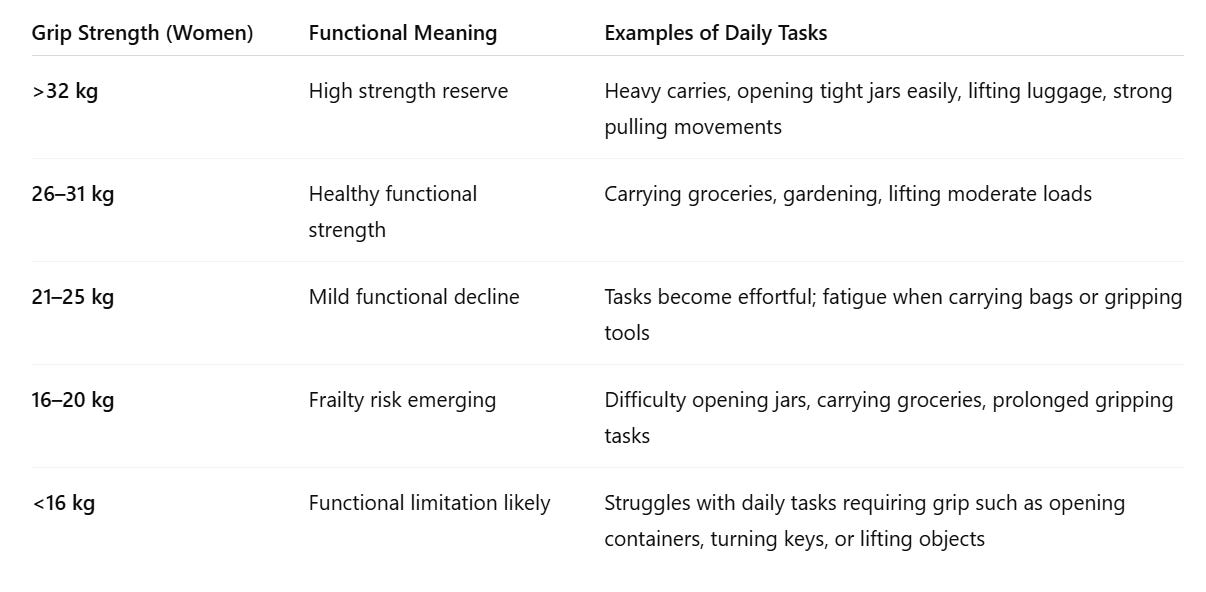
Researchers studying aging and functional capacity often relate grip strength to the ability to perform common daily tasks that allow people to live independently. This table is often used in the Longevity and Gerontology space and is supported by the current literature.
Grip Strength and Functional Independence
References
Cruz-Jentoft AJ, Bahat G, Bauer J, et al. Sarcopenia: revised European consensus on definition and diagnosis. Age and Ageing. 2019;48(1):16–31. doi:10.1093/ageing/afy169.
Simard J, Chalifoux M, Fortin M. Could questions on activities of daily living estimate grip strength of older adults living independently in the community? Journal of Aging Research. 2012;2012:427028. doi:10.1155/2012/427028.
Morera A, et al. Handgrip strength and work limitations: a prospective cohort study of adults aged 50 years and older. Maturitas. 2023.
Vaishya R, et al. Hand grip strength as a proposed vital sign of health. Journal of Clinical Orthopaedics and Trauma. 2024.
Tomkinson GR, et al. International normative reference values for handgrip strength in adults. Journal of Sport and Health Science. 2024.
Mathiowetz V, Kashman N, Volland G, Weber K, Dowe M, Rogers S. Grip and pinch strength: normative data for adults. Journal of Hand Surgery. 1985;10(5):109–112.
How Do I Build Grip Strength?
The goal for us as active and athletic women is not simply to stay above the frailty thresholds. Instead, the goal is to maintain a strength reserve well above the level required for daily tasks.
This reserve matters because strength declines naturally with age, and especially during menopause. Building and maintaining higher levels of strength in midlife helps preserve functional independence decades later.
Here are some examples of activities that help build this reserve:
Farmer’s carries
Deadlifts
Pull-ups or assisted pull-ups
Rows
Kettlebell swings
These movements challenge grip strength while also building whole-body strength and resilience.
… and on that note, let’s get to this week’s workout!
This week’s training is another modification of a Mahem-inspired workout that I did at CrossFit Pompano Beach. It’s a “grippy” one! I could barely hold on to my jumprope by the end! This workout taps into the synergism we get when we combine movements together to build this very important grip strength!!! Enjoy!
Warm Up
Movement Practice
Take 10 minutes to select your options for the workout. Watch the linked videos to review proper mechanics. Select a moderately heavy kettlebell weight where you can do all 10 swings unbroken. For the farmer carry, choose a weight that you can carry continuously, stopping only once or twice for a brief rest. If you can do the entire 100 meters without rest, the weight is too light!
Movement options:
If no jump rope, do a simulated jump rope holding 2 objects (ex-, thick magic marker)
If no ab mat, roll up a towel and put behind your back and perform the ab mat sit up or do standard sit ups with bent-knees and anchored feet.
If no kettlebell, do a double dumbbell swing
Workout
AMRAP 20 (As many rounds as possible in 20 minutes). Perform each movement in sequence for as many rounds as possible in 20 minutes.
70 single-under jump rope (or 35 double-under jump rope)
25 ab mat sit-ups (or standard bent-knee sit-ups)
12 air squats
10 Kettlebell swings (unbroken) (Beginner: swing to eye-level; Advanced: swing to overhead)
100 meter farmer carry (2x kettlebells or dumbbells. Suggested weight: 20 pounds)
SCORE: Number of rounds and repetitions performed in 20 minutes.
Cool Down
This was a very intense workout, so it deserves a thorough cool-down to help your parasympathetic nervous system (“rest and digest”) return your stress response system to baseline.
Here is an “11-minute Yoga Quickie” for your hands, wrists, and forearms, and a 20-minute total body yoga deep stretch to help jump-start your recovery!
TAKING NEW CLIENTS!

If you are an active woman or competitive midlife athlete who feels abandoned by mainstream medicine, I’m here for you!
It is with great excitement that after more than 2 years of preparation, I have FINALLY launched my Telehealth Consultation Medical practice focusing on the Reproductive Endocrine needs and Menopausal Care for active, athletic, and high-performing women.
Active and athletic midlife women have needs and risk profiles that are different from the general population. These needs often go unmet by the mainstream medical community due to a lack of understanding of fitness and sport and their impact on mid-life hormonal physiology or even a lack of acknowledgment that this dynamic exists. We put your health, fitness, and performance at the center of the equation so that you can achieve your healthiest, highest-performing self!
You will find all my service offerings on my website, including a link to my calendar so that you can reserve your place in my schedule online! Looking for a more Human encounter? Call Mary, my awesome and amazing assistant at 754-262-5674 (M-F 9a-5p ET)
This Just Dropped……
Hard Conversations in the Menopause Transition: Hormones, Testing, GLP-1s and what’s “Ideal” Now
This week we welcome back our resident reproductive endocrinologist and menopause specialist, Dr. Carla DiGirolamo, for another candid conversation. We pull back the curtain on Carla’s own menopause experience—how she navigates her symptoms, what she’s learned, and what she practices herself. We also dig into the hard conversations so many of us are having as we navigate this ever-evolving space, and how years of working closely with active midlife women have shaped her thinking on hormone therapy, GLP-1 medications, testosterone, hormone testing, and what actually moves the needle for athletic women in the transition.
Love this! It's amazing what can happen when you just "show up". Well done! :)
Dead hangs are one of my favorite underrated exercises — grip strength, shoulder health, and overhead mobility in one move. No equipment beyond a bar, and the returns are disproportionate to the time invested.