

Weightlifting is an important training element for optimal health and longevity. But what’s better? Barbells or dumbbells?
The truth is, both have their place in any weight training program. We have seen so many times in this newsletter how changing just one small thing about a movement can completely change the stimulus of the workout.
This week, we are going to illustrate how performing a front squat with dumbbells vs a barbell changes the impact of a training session. But first, let’s discuss how the different mechanics of these weight options train the body differently as it relates to the front squat.
Barbell vs Dumbbell Front Squats
What the Research Suggests About the Training Stimulus
For athletes and active adults, the front squat is one of the most effective lower-body strength exercises. But the implement used—barbell vs dumbbells (often as a goblet or double-dumbbell front squat)—changes the mechanical demands and training stimulus. While direct head-to-head trials are scarce, several peer-reviewed biomechanical and electromyography (EMG) studies help explain how these variations differ.
Load Potential and Strength Adaptation
The primary difference between barbell and dumbbell front squats is load capacity.
A barbell allows significantly greater external loading because the weight is distributed across the shoulders rather than limited by grip strength or arm fatigue. Higher loads produce greater neuromuscular stimulus and strength adaptation in the by increasing activation of the hip and thigh musculature compared with lower loads.
Training implication
Barbell front squats are generally favored when the goal is:
maximal strength
progressive overload
hypertrophy of the quads and glutes
Muscle Activation Patterns
EMG studies consistently show that squats strongly activate the quadriceps, glutes, hamstrings, and spinal stabilizers regardless of barbell or dumbbell variation. As compared to back squats, front squats shift emphasis toward the quadriceps and trunk stabilizers due to a more upright torso.
When a load is held in front of the body (as with dumbbells or goblet squats), several changes occur:
Increased grip and upper-body contribution
Unlike a barbell resting on the shoulders, dumbbells require sustained grip and arm involvement.
These factors mean that dumbbell front squats distribute work across more muscle groups, though often with less absolute lower-body loading.
Stability and Motor Control
One consistent finding in squat biomechanics research is that free-weight movements require greater stabilizer activation than guided movements.
Dumbbell front squats amplify this effect because:
The load is divided into two independent implements (ie. 2 dumbbells)
The center of mass is less stable
Arm fatigue can influence posture
This leads to greater demands on the trunk, shoulders, and stabilizing musculature.
For many lifters, this creates a training effect closer to a whole-body coordination exercise rather than a purely maximal strength movement.
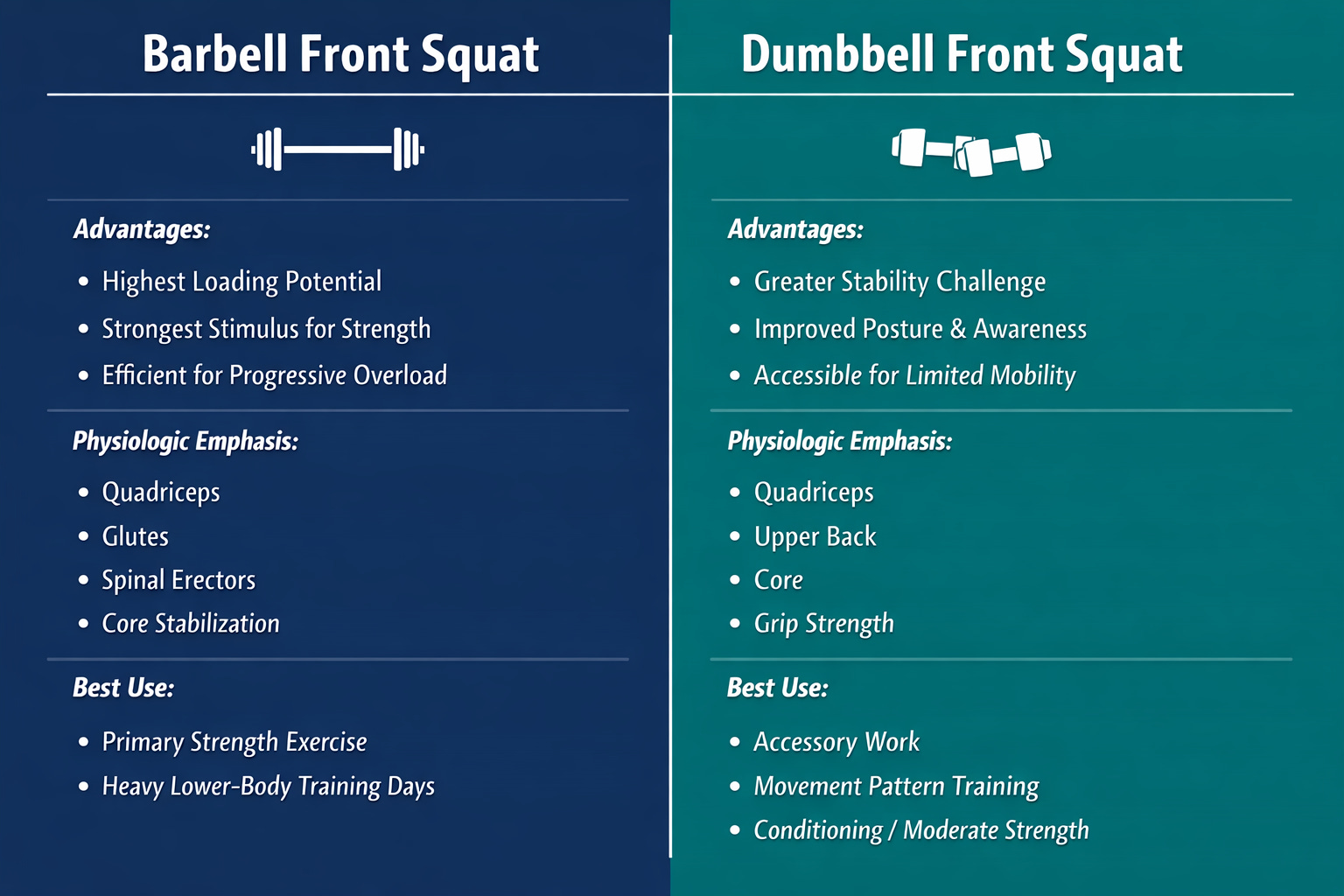
Practical Training Differences
The Big Takeaway
Both variations are valuable—but they deliver different types of stimulus.
Barbell front squat
maximizes lower-body strength and hypertrophy through heavier loading.
Dumbbell front squat
increases stability, posture control, and whole-body coordination.
For many athletes over 40, the two variations work best together:
Barbell front squat → primary strength lift
Dumbbell front squat → accessory movement reinforcing posture, mobility, and core stability.
Now, on to today’s workout! This session is a modification of a Mahem-inspired workout that I did at CrossFit Pompano Beach (that left me curled up in my own sweat on the floor after the barbell version) this past week.
The featured movement is the front squat paired with bar (or dumbbell) -facing burpees. The burpees add the element of fatigue, which further challenges the muscular mechanics of the front squat. If you have access to a barbell and are proficient with barbell front squats, this is the way to go today. Later in the week, try this workout again, but with dumbbells, and experience the difference!
The bar-facing burpee is an important nuance to this workout, adding a more labored flow to these repetitions as compared to standard burpees or lateral burpees over the bar, where you can stay low and get a good rhythm going. Not today!
Warm Up
AMRAP 8 (As many rounds as possible for 8 minutes)
5 up downs
5 high-knee run (or march) in place (Right + Left = 1 repetition)
10 Air Squat
10 mountain climbers (Right + Left = 1 repetition)
Movement Practice
Take 5-10 minutes to select your weights and movement options for the workout. Select a weight for the front squat that allows you to do the rounds of 15 and 12 in no more than 2 sets.
Movement options:
Front squat options: If shoulder mobility prohibits holding two dumbbells or a barbell at your shoulders, choose a single (heavier) kettlebell or dumbbell to hold at your chest goblet-style. If all you have are light weights, increase the repetitions by 5 each round.
Bar facing burpee options: If jumping is an issue, you may step over the bar. You could also do an up down followed by a step over the bar if a full burpee is not accessible to you.
Workout
HOW TO: Perform 15 front squats, then 15 bar-facing burpees, then do 12 front squats and 12 bar-facing burpees, and so on until you complete the repetition scheme.
For time:
15 - 12 - 9 - 6 - 3
BAR-FACING (or dumbbell-facing) Burpees ( HOW TO: See VIDEO. Place the bar or dumbbell on the floor horizontally in front of you.
NOTE: This workout is meant to be a higher intensity, done in less than 12 minutes.
Barbell version weight suggestions:
Advanced: male/female 135#/95#
Intermediate: male/female 95#/65#
Cool Down
Although this was a short workout, it was an intense one that taxed your musculoskeletal AND nervous systems. So let’s show your body some love and jump-start your recovery!
…. and if you missed last week’s accessory workout and need a little more today, try a few sets of the Turkish Get-Up!
REFERENCES
Yavuz HU et al. Kinematic and electromyographic activity changes during maximal loaded squats. Journal of Human Kinetics. 2017.
Schwanbeck S et al. A comparison of free-weight squat to Smith machine squat using electromyography. Journal of Strength and Conditioning Research. 2009.
Straub RK et al. A biomechanical review of the squat exercise. International Journal of Sports Physical Therapy. 2024.
Martínez-Cava A et al. Effect of external load on muscle activation during the squat. European Journal of Sport Science. 2023.
Wei W et al. Effects of progressive body-weight versus barbell squat training. Scientific Reports. 2023.
TAKING NEW CLIENTS!

If you are an active woman or competitive midlife athlete who feels abandoned by mainstream medicine, I’m here for you!
It is with great excitement that after more than 2 years of preparation, I have FINALLY launched my Telehealth Consultation Medical practice focusing on the Reproductive Endocrine needs and Menopausal Care for active, athletic, and high-performing women.
Active and athletic midlife women have needs and risk profiles that are different from the general population. These needs often go unmet by the mainstream medical community due to a lack of understanding of fitness and sport and their impact on mid-life hormonal physiology or even a lack of acknowledgment that this dynamic exists. We put your health, fitness, and performance at the center of the equation so that you can achieve your healthiest, highest-performing self!
You will find all my service offerings on my website, including a link to my calendar so that you can reserve your place in my schedule online! Looking for a more Human encounter? Call Mary, my awesome and amazing assistant at 754-262-5674 (M-F 9a-5p ET)
In case you missed it……
The Menopause Muscle Continuum….
Does the menopause transition directly impact muscle health and physiology?
This has been the subject of some very intense discussion recently. Join me and the awesome and amazing Selene Yeager for Hit Play Not Pause Episode 253 where we take a deep dive into the science behind this debate.

Hi Bryan... thanks so much for your comment! I love kettlebell training - especially for people who have never lifted weights. It's real strength training without the intimidation and can build confidence and physical strength - which in and of itself is important - but also if one wants to take weight training to the next level. Sounds like your wife has already figured all this out! :)
Great info and workout!