

Welcome to this Special Edition Series of Athletic Aging! Hypothyroidism is one of the most common hormonal conditions affecting women, and it becomes more common as we age. This two-part series highlights the most common cause of hypothyroidism, Hashimoto's hypothyroidism, and the special considerations for hypothyroidism in high-performing women. Enjoy! -Dr. Carla
Persistent fatigue. Slower recovery. Feeling cold during workouts. Declining performance despite training just as hard.
For many active women, these symptoms are easy to dismiss.
“Maybe I’m overtraining.”
“Maybe it’s perimenopause.”
“Maybe this is just what happens after 40.”
Sometimes that’s true.
But sometimes the problem isn’t aging at all.
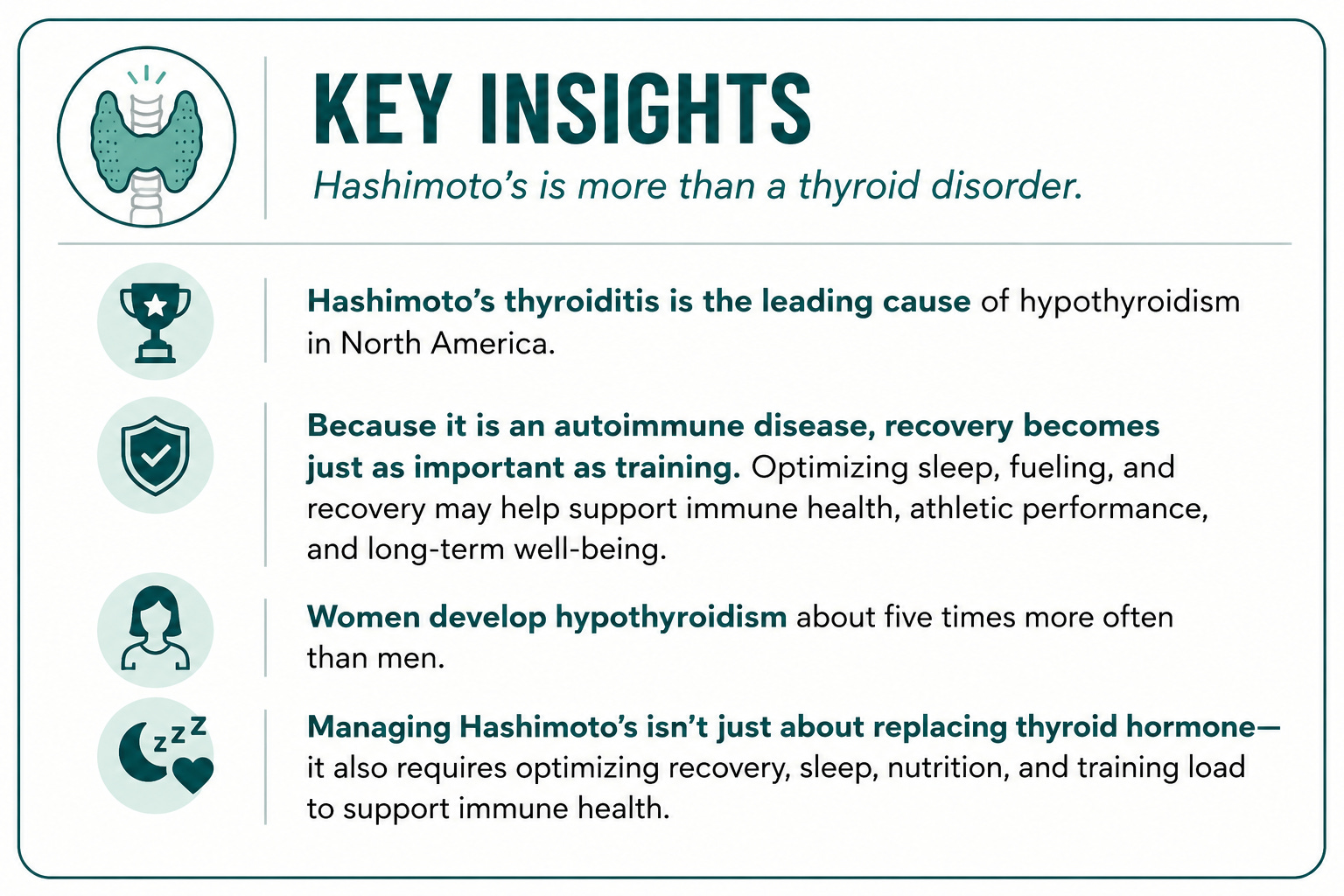
Hypothyroidism is one of the most common endocrine disorders affecting women, and Hashimoto’s thyroiditis—an autoimmune disease—is responsible for nearly 85% of cases. Although it is common in the general population, its effects can be especially challenging in female athletes, where the earliest signs often masquerade as normal consequences of training.
Understanding how thyroid disease influences performance, recovery, and overall health can help athletes seek appropriate evaluation before months—or even years—of unnecessary frustration.
Why Your Thyroid Matters More Than You Think
The thyroid gland is remarkably small, but its influence reaches nearly every organ system.
Through the production of the hormones thyroxine (T4) and triiodothyronine (T3), the thyroid helps regulate:
Metabolic rate
Energy production
Body temperature
Heart function
Skeletal muscle performance
Mitochondrial activity
Recovery and tissue remodeling
Think of thyroid hormone as the body’s metabolic “volume control.” When adequate amounts are available, cells efficiently produce energy and adapt to exercise. When thyroid hormone levels fall, nearly every physiologic process slows.
For an athlete, that slowdown is rarely subtle.
Training feels harder.
Recovery takes longer.
Workouts that once felt routine suddenly become exhausting.
What Is Hypothyroidism?
Hypothyroidism occurs when the thyroid gland fails to produce enough thyroid hormone to meet the body’s metabolic needs.
Most clinicians divide hypothyroidism into two categories.
Overt hypothyroidism occurs when thyroid hormone levels are genuinely low and thyroid-stimulating hormone (TSH) becomes elevated as the pituitary attempts to stimulate the failing thyroid gland. This form almost always requires treatment with levothyroxine.
Subclinical hypothyroidism is different. In this situation, TSH is mildly elevated, but circulating thyroid hormone levels remain within the normal range. Some individuals never progress beyond this stage, while others eventually develop overt disease. Treatment depends on symptoms, laboratory findings, and individual clinical circumstances.
Hypothyroidism affects approximately 1–2% of adults, while subclinical disease may be present in up to 10% of the population. Women develop hypothyroidism roughly five times more often than men, with prevalence increasing steadily after midlife.
Meet the Most Common Culprit: Hashimoto’s Thyroiditis
For most women living in North America, hypothyroidism is not caused by poor diet or iodine deficiency.
It is caused by the immune system.
Hashimoto’s thyroiditis is an autoimmune disease in which immune cells mistakenly recognize the thyroid gland as foreign tissue. Over time, inflammatory cells infiltrate the gland, gradually reducing its ability to produce thyroid hormone.
Long before thyroid hormone levels begin to fall, antibodies directed against thyroid proteins—most commonly thyroid peroxidase (anti-TPO) and thyroglobulin (anti-TG)—may already be detectable in the bloodstream.
The progression is usually slow.
Many women spend years feeling “not quite themselves” before laboratory testing finally reveals overt hypothyroidism.
The Symptoms Athletes Often Miss
One reason hypothyroidism is frequently overlooked is that its symptoms overlap remarkably well with the expected consequences of hard training and, in many cases, perimenopause and menopause.
Athletes often attribute persistent fatigue to increased training volume. Reduced exercise tolerance is blamed on poor fitness. Feeling cold becomes “just me.” Brain fog is dismissed as stress.
Unfortunately, hypothyroidism affects virtually every body system.
Common symptoms include:
Persistent fatigue
Reduced endurance
Difficulty recovering between training sessions
Cold intolerance
Slower heart rate
Muscle weakness
Joint stiffness
Dry skin
Hair thinning
Constipation
Difficulty concentrating
Mood changes
Menstrual irregularities
Because these symptoms develop gradually, many athletes simply adapt to them rather than recognizing that something has changed.
Why Female Athletes Are Different
This is where the story becomes considerably more interesting. Hashimoto’s is not simply a thyroid disorder. It is an immune disorder. Exercise has profound effects on immune function.
Following prolonged or high-intensity exercise, the immune system temporarily shifts its priorities toward tissue repair and adaptation. During this recovery period—often called the “open window”—certain components of immune function are transiently suppressed while inflammatory signaling temporarily increases.
For most healthy athletes, this is a completely normal adaptation. Recovery restores immune balance. Training continues. Performance improves.
For athletes living with Hashimoto’s, however, the situation may be more complicated.
Because immune tolerance is already impaired, repeated periods of inadequate recovery may contribute to ongoing inflammatory activation.
While exercise itself remains extraordinarily beneficial, consistently high training loads combined with insufficient recovery, inadequate sleep, or poor nutrition may create an environment that favors autoimmune activity.
This doesn’t mean women with Hashimoto’s should avoid hard training. Quite the opposite. The goal becomes balancing training stress with equally intentional recovery.
Estrogen Adds Another Layer
Women experience thyroid autoimmunity differently than men for a reason.
Estrogen is far more than a reproductive hormone. It also acts as an important regulator of immune function.
Under physiologic conditions, estrogen often supports immune tolerance and helps restrain excessive inflammation. However, during periods of rapidly changing hormone levels (i.e., postpartum, perimenopause, menopause) —or at very high estrogen concentrations—immune activity can become more pronounced.
This helps explain why autoimmune diseases disproportionately affect women.
It may also explain why many women notice changes in autoimmune symptoms during periods of hormonal transition.
For female athletes, several stages deserve particular attention:
During the menstrual cycle, immune activity may fluctuate around ovulation and the mid-luteal phase, when estrogen reaches its highest levels.
During perimenopause, estrogen becomes increasingly unpredictable. Rather than gradually declining, hormone levels often fluctuate dramatically from cycle to cycle, creating what some researchers describe as “immune turbulence.”
After menopause, estrogen reaches its lifetime low. Loss of estrogen’s anti-inflammatory effects may contribute to greater baseline inflammatory signaling in susceptible women.
Although much remains to be learned about these interactions, they highlight an important concept:
Female physiology matters.
Understanding hormonal biology helps explain why autoimmune diseases rarely behave the same way in women as they do in men.
Living—and Training—Well With Hashimoto’s
The diagnosis of Hashimoto’s should never be interpreted as the end of an athletic career.
Quite the opposite.
When thyroid hormone replacement is appropriately managed, energy availability is optimized, sleep is prioritized, and recovery is respected, women with Hashimoto’s can successfully train for marathons, compete in CrossFit®, race triathlons, and continue strength training well into midlife and beyond.
The key is recognizing that recovery deserves the same attention as training.
Athletes should work closely with their healthcare team to ensure thyroid hormone replacement is appropriately monitored, while coaches can support performance by paying close attention to recovery, adequate fueling, sleep quality, and changes in performance that seem out of proportion to training.
Coming Next...
Not every athlete with fatigue has hypothyroidism.
In fact, one of the most common endocrine adaptations seen in female athletes isn’t thyroid disease at all.
Persistent low energy availability can suppress normal thyroid hormone production, producing laboratory findings and symptoms that closely resemble hypothyroidism—but require an entirely different treatment approach.
Next week, Part 2, we’ll explore how RED-S and low energy availability can mimic thyroid disease and worsen existing thyroid conditions, why this distinction is so important, and how clinicians can avoid one of the most common diagnostic pitfalls in sports medicine.
NOW TAKING MEDICAL CLIENTS FROM COLORADO AND CONNECTICUT… NH COMING SOON!
..in addition to MA, NY, NJ, PA, CA, FL, OH
If you are an active woman or competitive midlife athlete who feels abandoned by mainstream medicine, I’m here for you!

It is with great excitement that after more than 2 years of preparation, I have FINALLY launched my Telehealth Consultation Medical practice focusing on the Reproductive Endocrine needs and Menopausal Care for active, athletic, and high-performing women.
Active and athletic midlife women have needs and risk profiles that are different from the general population. These needs often go unmet by the mainstream medical community due to a lack of understanding of fitness and sport and their impact on mid-life hormonal physiology or even a lack of acknowledgment that this dynamic exists. We put your health, fitness, and performance at the center of the equation so that you can achieve your healthiest, highest-performing self!
You will find all my service offerings on my website including a link to my calendar so that you can reserve your place in my schedule!
Great article.
Thank you for this most interesting information.