

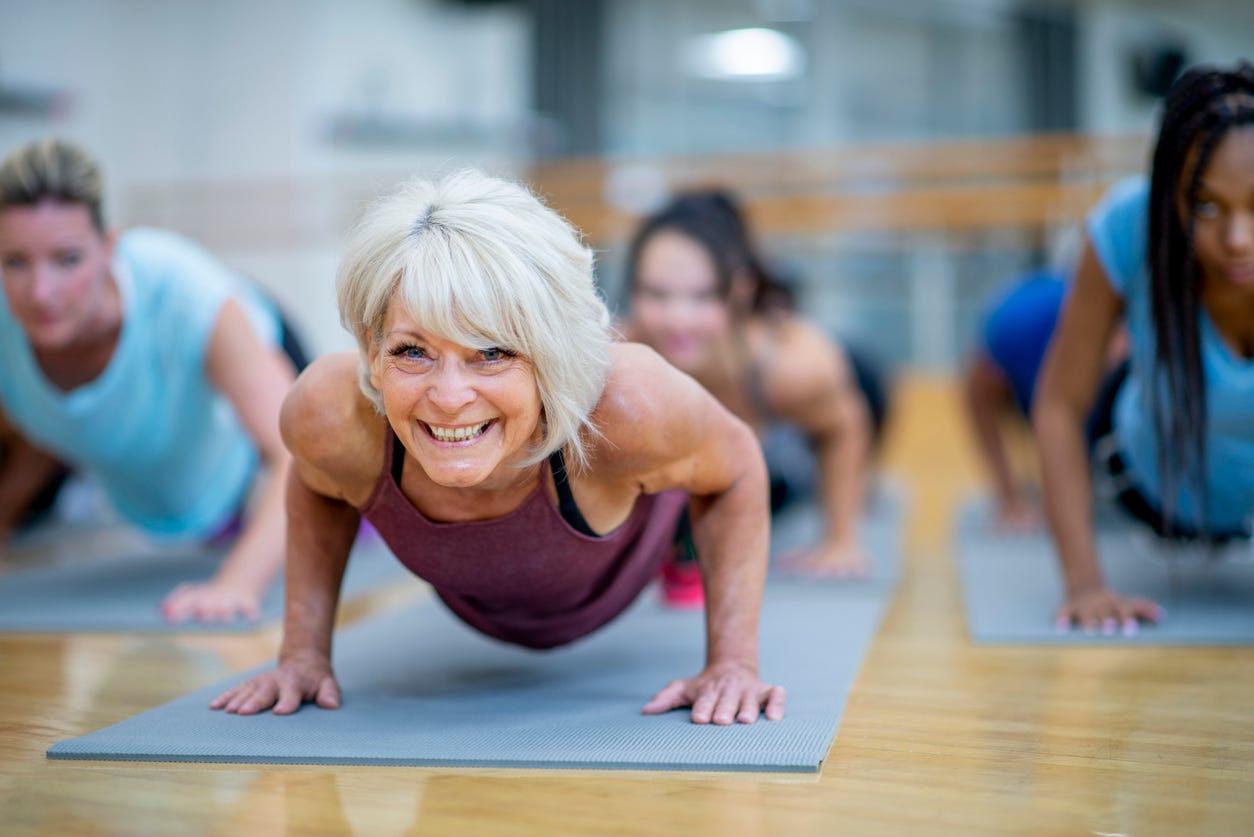
If I could choose one upper-body exercise that almost every active woman should learn, it would be the push-up.
Why?
Because the push-up is far more than a chest exercise. It is a full-body movement that challenges strength, stability, coordination, and muscular endurance all at the same time. Best of all, it can be modified for every fitness level—from the beginner performing wall push-ups to the elite athlete performing deficit or plyometric variations.
What Is a Push-Up?
A push-up is a bodyweight pressing exercise performed from a plank position. During the movement, the body lowers toward the floor by bending the elbows and then pushes back to the starting position.
The primary muscles involved include:
Pectoralis major (chest)
Triceps
Anterior deltoids (shoulders)
Serratus anterior
Core musculature
Glutes and hips for stabilization
Because multiple muscle groups work together, the push-up is considered a compound exercise rather than an isolation movement. It develops strength while also training the body to transfer force through a stable trunk.
How to Perform a Push-Up
Begin in a plank position with hands slightly wider than shoulder width.
Maintain a straight line from head to heels.
Brace the core and glutes.
Lower the body until the chest approaches the floor.
Push through the palms and return to the starting position.
**Avoid allowing the hips to sag
Making Push-Ups Accessible for Everyone
One of the biggest misconceptions about push-ups is that they are an all-or-nothing exercise.
In reality, push-ups exist on a continuum:
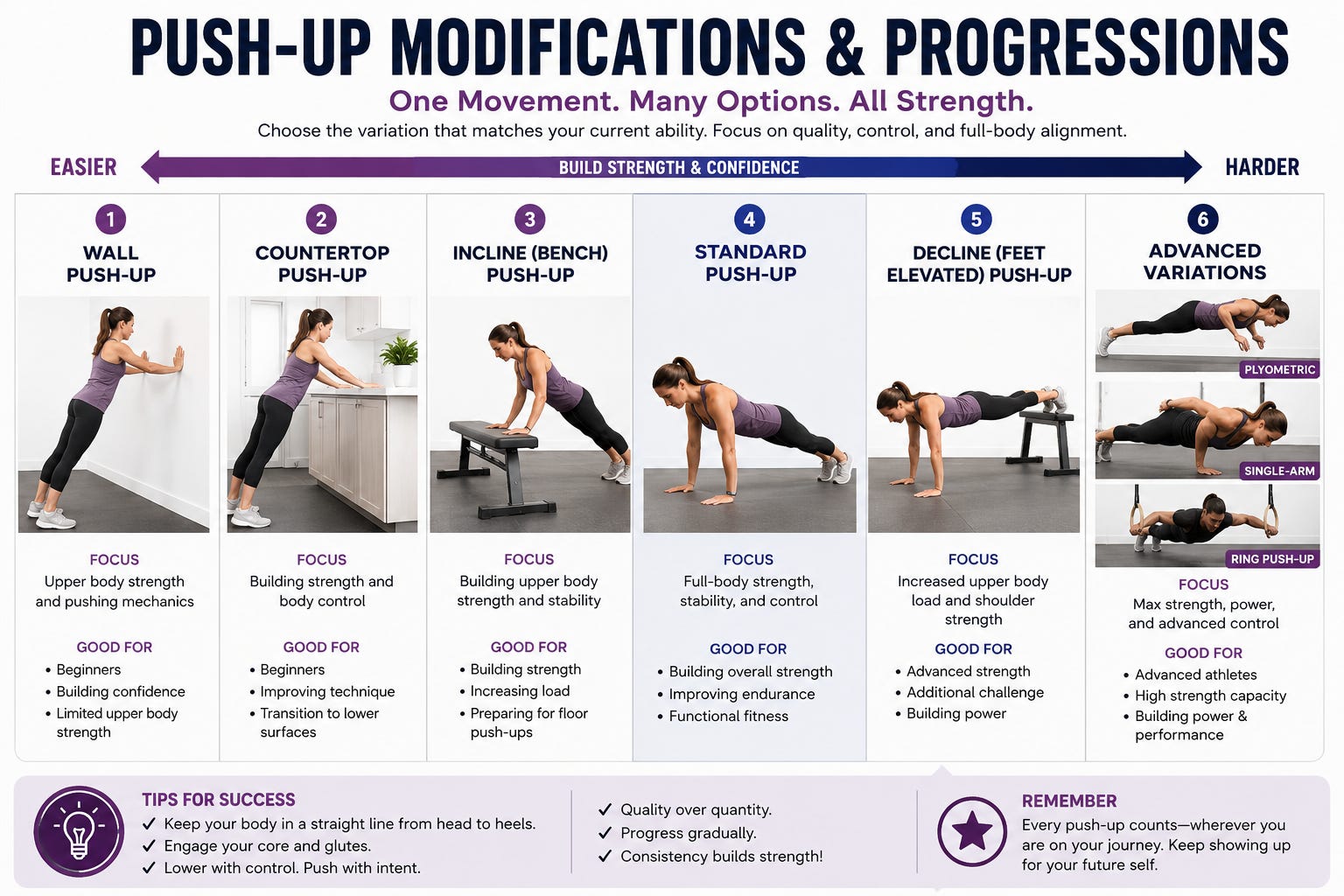
Beginner: Wall push-ups, Countertop push-ups, Incline push-ups using a bench or box
Intermediate: Lower incline push-ups, Full floor push-ups, Tempo push-ups with a slow lowering phase
Advanced: Deficit push-ups, Ring or suspension push-ups, Plyometric push-ups, Single-arm progressions
For most women, incline push-ups are often a better starting point than knee push-ups because they preserve the full-body plank position and movement pattern while reducing the amount of body weight being lifted.
Why Push-Ups Matter for Midlife Women
1. Preserve Upper-Body Strength
Women naturally possess less upper-body muscle mass than men, and muscle loss accelerates during and after the menopausal transition. Regular resistance training helps offset these changes and supports long-term physical function.
2. Build Functional Strength
Push-ups train a movement pattern used in daily life: pushing yourself off the floor, getting up from a fall, moving objects, and supporting body weight through the arms.
Research consistently shows that maintaining strength and functional fitness is associated with better mobility, independence, and quality of life as we age.
3. Strengthen the Core
A properly performed push-up is essentially a moving plank. The abdominal muscles, spinal stabilizers, and glutes work continuously to maintain alignment throughout the exercise.
4. Support Bone Health
While push-ups are not a substitute for lower-body impact training, they provide weight-bearing loading through the wrists, arms, and shoulders. Maintaining upper-body strength and loading becomes increasingly important as estrogen declines and osteoporosis risk rises.
5. Provide a Simple Measure of Fitness
Push-up performance reflects a combination of strength, endurance, stability, and body composition. Research has even shown that greater push-up capacity is associated with better long-term health outcomes and lower cardiovascular risk, although this relationship has primarily been studied in men.
Safety Considerations
Push-ups are generally safe, but technique matters!
Be cautious if you have:
Significant shoulder pain
Acute wrist injuries
Uncontrolled osteoporosis affecting the upper extremities
Recent surgery involving the shoulder, chest, or wrist
Common technical errors include:
Sagging hips
Excessive neck extension
Flaring elbows excessively outward
Incomplete range of motion
If full push-ups are not yet accessible, elevate the hands and focus on perfect movement quality. Progressing gradually is far more effective than forcing repetitions with poor form.
The Bottom Line
The push-up is one of the most scalable exercises available. Whether you’re performing push-ups against a wall or knocking out sets on the floor, you’re building strength, stability, and resilience.
For active and athletic midlife women, the goal isn’t necessarily to perform the most push-ups. The goal is to continue developing the strength and confidence to do hard things—and the push-up is a great place to start.
For this week’s workout, the main block focuses solely on the push-up, followed by a core training accessory, and finishing with a short yoga segment focused on the chest and shoulders.
This simple approach has 2 goals:
Finding a push-up option that allows a pain-free range of motion
Finding a push-up variation that is challenging, opening the door to building strength and functionality in this movement.
Warm Up
TABATA – 20-sec work/10sec off; 12 rounds, 6 minutes. Perform each movement sequentially for 20 seconds of work, then 10 seconds of rest for a total of 4 rounds of all 3 movements.
Jumping jacks 20 seconds of work/10 seconds of rest, then…..
Mountain Climbers 20 seconds of work/10 seconds of rest… then…
Easy push-up option (select a variation that is easier than your workout option) 20 seconds of work/10 seconds of rest) .. then back to the jumping jacks!
Movement Practice
Watch this video closely, paying close attention to the instruction on the mechanics of execution. I cannot overstate the importance of this step! Once you have reviewed this video, select an option from the above “Modifications and Progressions”.
Practice different options and select one that achieves pain-free range of motion, where you can perform 5 repetitions unbroken, but becomes challenging for repetitions 4 and 5.
Workout
EMOM 3 minutes (Every minute on the minute for 3 minutes)
5-5-5-5-5
5 sets of 5 reps
Options: Find one challenging option for all 5 sets, or progressively challenge yourself by choosing a more challenging option/elevation height with each set.
CORE ACCESSORY
TABATA
Perform each movement in sequence for 20 seconds of work then 10 seconds of rest for 4 rounds of all 4 movements, a total of 8 minutes.
:20s Superman hold/10s rest.
:20s Flutter kicks/10s rest
:20s Oblique Twists/10s rest
:20s Hollow hold/10s rest
Cool Down
15-minute Yoga for Chest and Shoulders
REFERENCES
Yang J, Christophi CA, Farioli A, et al. Association Between Push-up Exercise Capacity and Future Cardiovascular Events Among Active Adult Men. JAMA Network Open. 2019;2(2):e188341.
Mayer F, Scharhag-Rosenberger F, Carlsohn A, Cassel M, Müller S, Scharhag J. The Intensity and Effects of Strength Training in the Elderly. Dtsch Arztebl Int. 2011;108(21):359-364.
Brogno B, et al. Aging With Strength: Functional Training to Support Healthy Aging. Sports Medicine - Open. 2025.
Chulvi-Medrano I, et al. Comparison of the Effects of an Eight-Week Push-Up Program Performed on Stable and Unstable Surfaces. International Journal of Sports Physical Therapy. 2012.
Alizadeh S, Daneshjoo A, Zahiri A, et al. Push-Ups vs. Bench Press: Differences in Repetitions and Muscle Activation. Frontiers in Physiology. 2020.
NOW TAKING NEW CLIENTS!
If you are an active woman or competitive midlife athlete who feels abandoned by mainstream medicine, I’m here for you!

It is with great excitement that after more than 2 years of preparation, I have FINALLY launched my Telehealth Consultation Medical practice focusing on the Reproductive Endocrine needs and Menopausal Care for active, athletic, and high-performing women.
Active and athletic midlife women have needs and risk profiles that are different from the general population. These needs often go unmet by the mainstream medical community due to a lack of understanding of fitness and sport and their impact on mid-life hormonal physiology or even a lack of acknowledgment that this dynamic exists. We put your health, fitness, and performance at the center of the equation so that you can achieve your healthiest, highest-performing self!
You will find all my service offerings on my website including a link to my calendar so that you can reserve your place in my schedule!
From the Archives….

Inside Sports Nutrition Podcast: Hormones and Female Physiology with Dr. Carla DiGirolamo - Ep. #69 – Dina Griffin/Bob Seebohar

Fit Womens Weekly Podcast: Should Workouts Change As You Get Older? Dr. Carla DiGirolamo Breaks It All Down - Kindal Boyle
Push-ups, along with bodyweight lunges and squats, are the best travel or exercise snacks. You can get very fit just doing these.
I love your progressions chart in the article. I have to push myself to push up, lol, but I agree that they are an essential exercise for women.