

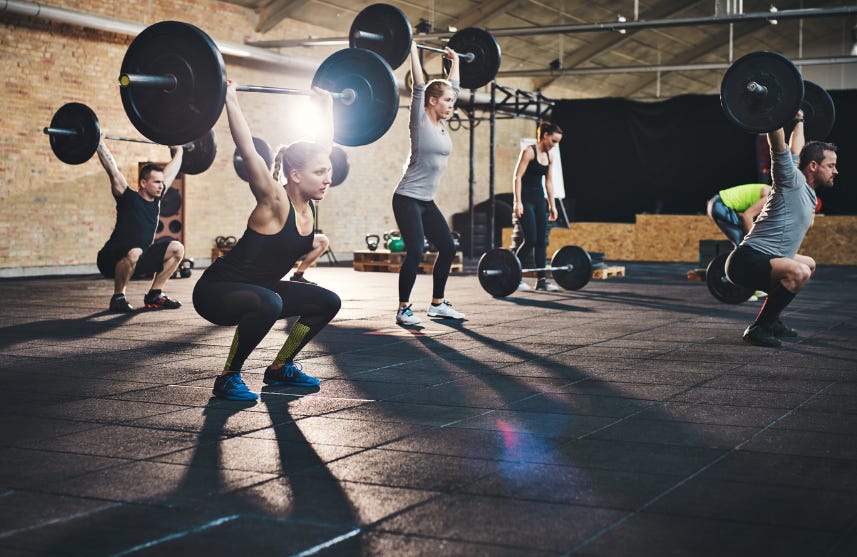
The overhead squat is one of the most technically demanding squat variations, and for good reason. Unlike a traditional squat, this movement requires coordinated mobility through the shoulders, upper back, hips, and ankles while the core works to maintain stability beneath an overhead load.
It’s a movement that reveals not only how well we move, but how effectively we control that movement.
How to Do the Overhead Squat
Start with a PVC pipe or broomstick before progressing to a barbell.
Stand with feet approximately shoulder-width apart and take a wide grip on the PVC pipe.
Press the pipe overhead with arms extended, maintaining active shoulder engagement.
Brace your core and begin squatting by bending at the hips and knees.
Keep the pipe balanced over your midfoot as you descend, maintaining a stable trunk and controlled spinal position.
Squat only as deeply as your mobility allows without compromising technique, then drive through your feet to return to standing.
Technique matters! Even experienced athletes benefit from reviewing the mechanics of this complex movement. Watch this overhead squat video tutorial before beginning today’s workout.
Make the Movement Your Own
The overhead squat is highly scalable. The goal isn’t necessarily to squat deeper or lift heavier, but to develop mobility and stability while maintaining excellent mechanics.
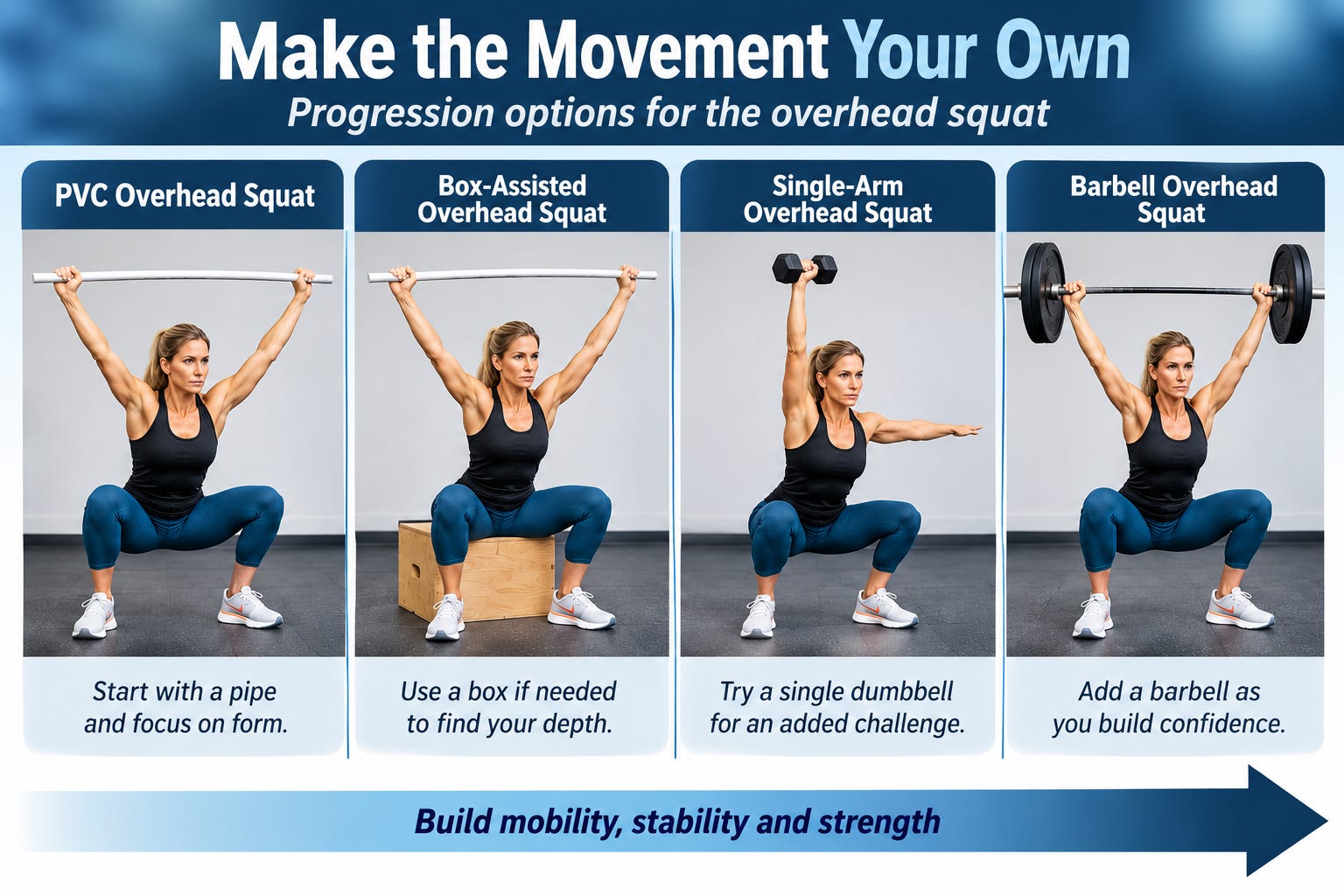
Start with a PVC pipe or broomstick. Practice the movement without additional loading, focusing on shoulder positioning, trunk stability, and squat mechanics.
Reduce the range of motion. Squat to a box or bench to establish a depth at which you can maintain proper overhead positioning.
Try a single-arm overhead squat. A lightweight dumbbell allows each shoulder to move independently and introduces an additional anti-rotation challenge for the core.
Progress to a barbell. Once mobility and control are consistent, begin with an empty barbell and gradually increase the load.
Bottom Line
For women navigating midlife and beyond, the overhead squat offers an opportunity to train several important components of physical performance simultaneously: joint mobility, postural control, core stability, and whole-body coordination.
The real value of this movement isn’t how much weight you can hold overhead. It’s the ability to maintain control and stability while moving through a challenging range of motion. Developing these qualities supports the movement capacity and strength we want to preserve as we age.
Today’s workout puts these principles into practice, combining overhead squats with dynamic kettlebell work and a dedicated core challenge.
This workout is worth spending some time on. It is critical to watch the short video tutorial on performing the overhead squat - whether this is your first time doing this movement or if you are proficient. Technique can always be fine-tuned with a complex movement such as this.
Once you feel confident performing this movement, we bring it to life in today’s workout that focuses on shoulder, hip, and ankle mobility as well as core strength and shoulder stabilization.
Warm-Up
TABATA (20 seconds of work/10 seconds of rest) - 6 minutes.
Perform each movement sequentially until you have completed each round of 3 movements 4 times.
Up-downs (20s work/10s rest), then..
Push-ups (easy option) (20s work/10s rest), then..
Jumping air squats (20s work/10s rest), then back to the Up-downs
After you finish the TABATA, perform 12 PVC Pass-throughs with your broomstick or PVC pipe.
Movement Practice
WATCH THIS VIDEO TUTORIAL ON THE OVERHEAD SQUAT!
If you have never done this movement before PLEASE use just a broomstick or PVC pipe. This is a COMPLEX MOVEMENT, so until you feel ultra-confident and consistent with superb form, stick with a broomstick or PVC pipe.
Take 5-10 minutes to practice the overhead squats - Try 3-5 sets of 5 repetitions until you feel confident in performing this movement in the workout.
If you are familiar with the overhead squat, please watch the video tutorial and fine-tune your technique using an empty bar. Add weight as appropriate maintaining solid technique.
Movement alternatives:
Use a box to squat to as shown in the video tutorial above if you cannot achieve sound mechanics and bar/pipe/stick position in a full squat.
Single arm overhead dumbbell squat. If the restriction of a broomstick/PVC pipe makes this movement difficult to achieve with good form, try a single-arm overhead squat instead. Start with a lightweight object and work up to a dumbbell during practice.
Take another 5-10 minutes to practice the movements in Workout Part 1 and select your kettlebell weight. Select a weight that allows you to perform 12 repetitions unbroken for all rounds. This is a moderate weight where the last 3-4 reps become challenging.
Workout
Part 1
AMRAP 12 minutes (As many rounds as possible in 12 minutes)
12 Kettlebell swings (overhead or eye-level) (Alternatives: double dumbbell swing or a single dumbbell swing keeping reps even between sides)
24 Mountain Climbers (right + left = 1 repetition)
Part 2
Core TABATA - (20 seconds of work/10 seconds of rest) - 6 minutes.
Perform each movement sequentially until you have completed each round of 3 movements 4 times.
Oblique Twists - weighted
Sit-ups (Ab mat style: Use an ab mat or rolled towel supporting your lower back. Alternatively, perform sit-ups with knees bent/feet anchored).
Cool-Down
15-minute Back Bending Yoga. Take 15 minutes to cool down and rebalance your back and front body.
This just dropped….

Check out my latest piece with Crossfit.com where I make the case for CrossFit methodology as an effective training approach for menopausal women.
NOW TAKING MEDICAL CLIENTS FROM COLORADO, CONNECTICUT, AND NEW HAMPSHIRE!
..in addition to MA, NY, NJ, PA, CA, FL, OH
If you are an active woman or competitive midlife athlete who feels abandoned by mainstream medicine, I’m here for you!

Active and athletic midlife women have needs and risk profiles that are different from the general population. These needs often go unmet by the mainstream medical community due to a lack of understanding of fitness and sport and their impact on mid-life hormonal physiology or even a lack of acknowledgment that this dynamic exists.
To speak to this need, I launched my Telehealth Consultation Medical practice focusing on the Reproductive Endocrine needs and Menopausal Care for active, athletic, and high-performing women.
We put your health, fitness, and performance at the center of the equation so that you can achieve your healthiest, highest-performing self!
You will find all my service offerings on my website including a link to my calendar so that you can reserve your place in my schedule!