

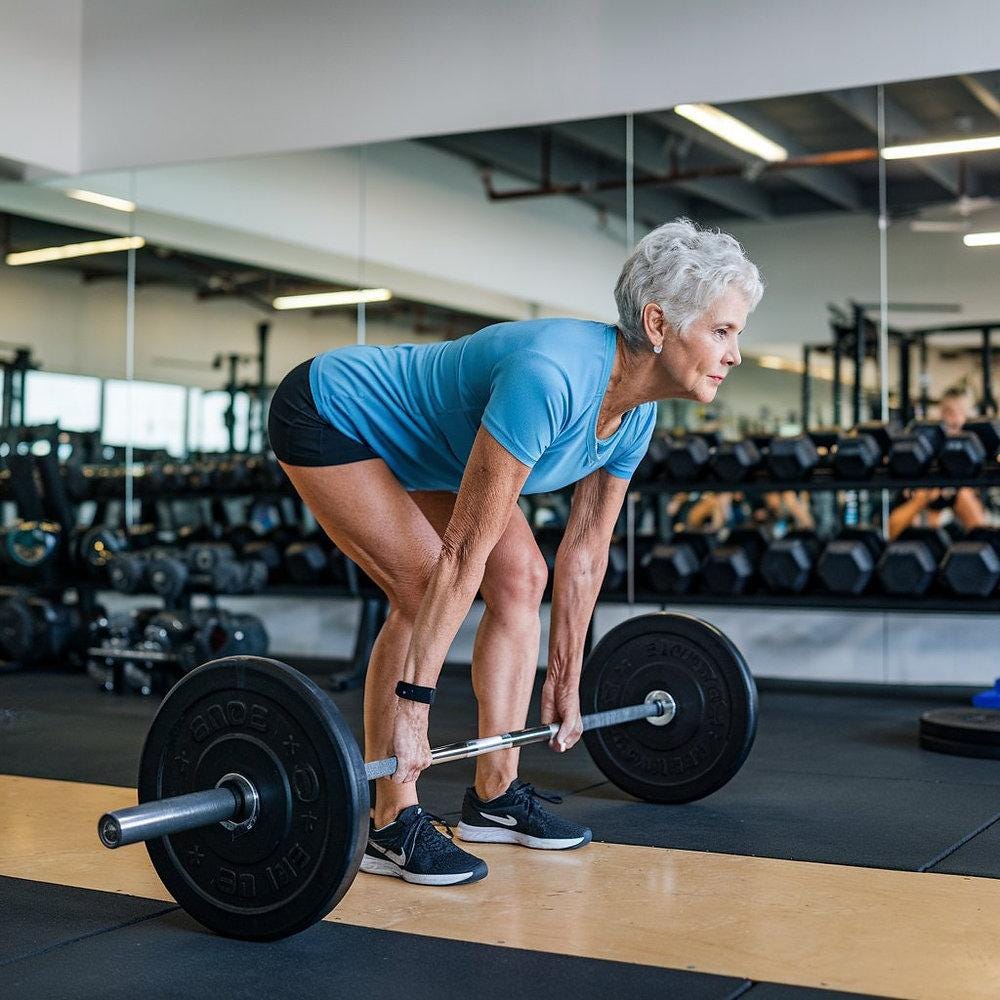
The deadlift is one of the most functional strength movements we can train. Every time we pick up a grocery bag, lift a suitcase, or retrieve something from the floor, we’re using the same fundamental movement pattern. The deadlift strengthens the glutes, hamstrings, back, and core while developing the coordination needed to lift objects efficiently and confidently.
How to Deadlift: It Starts with the Hip Hinge
The foundation of a good deadlift is the hip hinge—bending primarily at the hips rather than the waist.
Hips back: With feet about hip-width apart and knees slightly bent, push your hips backward.
Brace your core: Keep your trunk engaged and your spine in a comfortable, controlled position.
Keep the weight close: Hold the weight near your legs as you lower and lift.
Stand tall: Push through your feet and extend your hips to return to standing without leaning backward.
Start without weight. Practice the hinge until you can perform it consistently. When adding resistance, begin with a light weight elevated off the floor and progress gradually. A short demonstration or guidance from a qualified coach can be especially helpful for beginners.
Make the Movement Your Own
The deadlift can be adapted to virtually any experience level
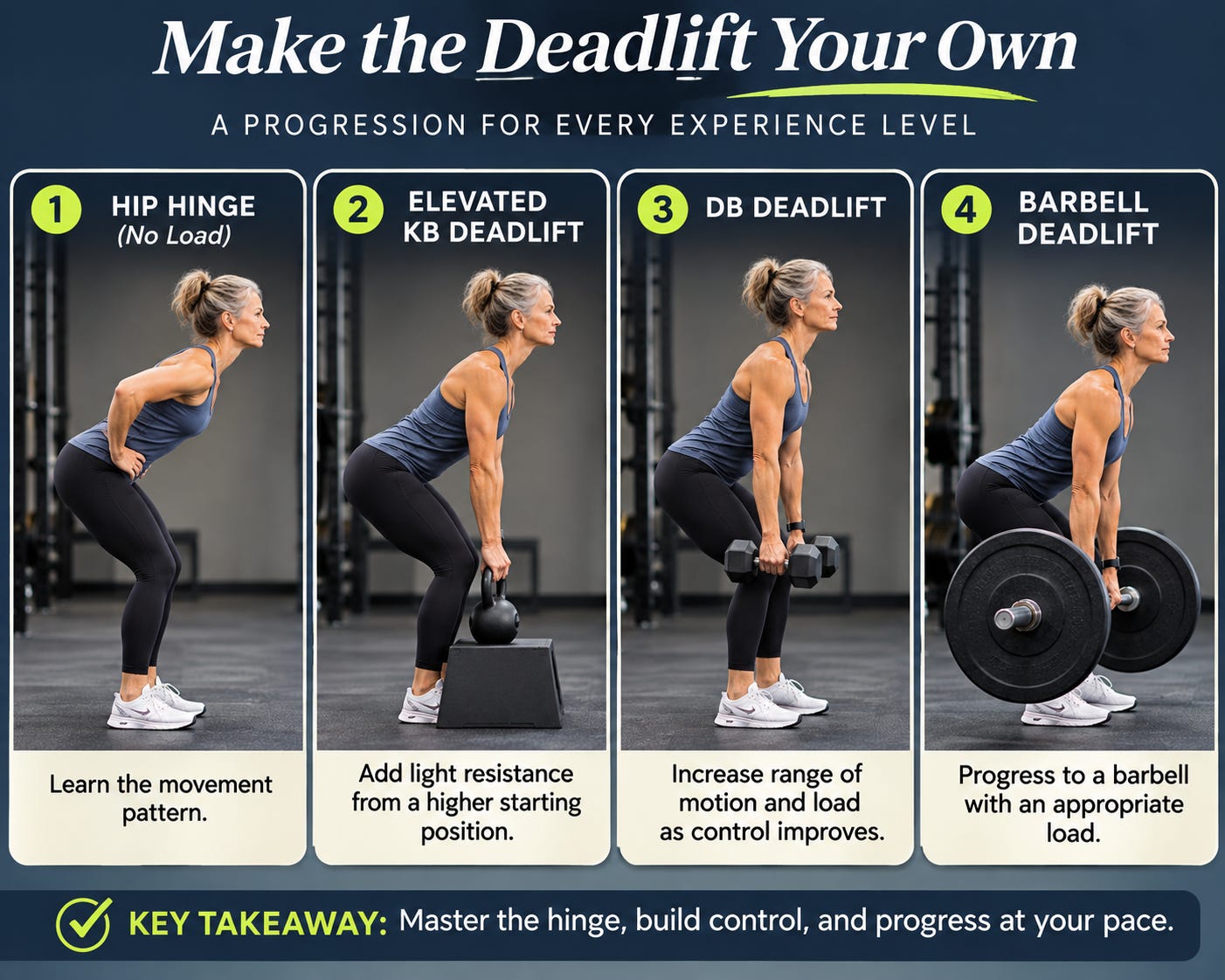
Unloaded hip hinge: Learn the movement without resistance.
Elevated kettlebell deadlift: Add light resistance with a shorter range of motion.
Dumbbell deadlift: Increase the range of motion and resistance as control improves.
Barbell deadlift: Progress to a barbell with an appropriate load and range of motion.
Remember: Your range of motion should be determined by your ability to maintain control—not by how close you can get to the floor. Stop if you experience sharp or worsening back pain.
The Bottom Line
For women in midlife and beyond, maintaining the strength to lift objects from the ground is an important part of preserving physical independence. The deadlift trains more than muscle strength—it develops the ability to coordinate multiple muscle groups to perform one of life’s most essential movements.
The goal isn’t simply to lift more weight. It’s to build the strength and confidence to keep doing the things that matter to you.
Today’s workout is a simple couplet (two movements) that allows us to build proficiency and strength with the deadlift alongside short segments that target the cardiopulmonary “engine”. Switching between these two energy systems over the course of the workout builds neurologic resiliency and takes fitness to a higher level compared to doing either of these movements individually.
Warm Up
3 minutes on your cardiovascular modality of choice (Row, run, or bike)
then….
AMRAP 5 minutes (As many rounds as possible in 5 minutes). Perform each movement in sequence for as many rounds of these 3 movements as you can do in 5 minutes. Target low to moderate intensity - this is the warm-up afterall!
10 Air Squats
10 Alternating lunges (walking or alternating in place)
Movement Practice
Review the above videos demonstrating the hip hinge and the deadlift. Choose your option for the workout from the “Make the Movement Your Own” section. Take 5-10 minutes to practice your option and weight selection (Using no weight to become profient with the mechanics is always an option).
For the cardiovascular option, select a distance of the row, run, or bike that has you moving at a moderate to fast pace for approximately 2 minutes.
Workout
5 rounds for time
8 deadlifts (your selected option)
400m run or row or 800m bike (scale to achieve 2 minutes at moderate to fast pace)
Cool-Down
Let’s show our back, hips and hamstrings some love with this 7-minute follow-along stretch segment from Train FTW.
This just dropped…..

Check out my latest article with CrossFit.com; CrossFit and Menopause: The Case for Training for Life, where I make the case that CrossFit training methodology has everything a menopausal woman needs to thrive!
NOW TAKING MEDICAL CLIENTS FROM COLORADO, CONNECTICUT, AND NEW HAMPSHIRE!
..in addition to MA, NY, NJ, PA, CA, FL, OH
If you are an active woman or competitive midlife athlete who feels abandoned by mainstream medicine, I’m here for you!

Active and athletic midlife women have needs and risk profiles that are different from the general population. These needs often go unmet by the mainstream medical community due to a lack of understanding of fitness and sport and their impact on mid-life hormonal physiology or even a lack of acknowledgment that this dynamic exists.
To speak to this need, I launched my Telehealth Consultation Medical practice focusing on the Reproductive Endocrine needs and Menopausal Care for active, athletic, and high-performing women.
We put your health, fitness, and performance at the center of the equation so that you can achieve your healthiest, highest-performing self!
You will find all my service offerings on my website including a link to my calendar so that you can reserve your place in my schedule!