

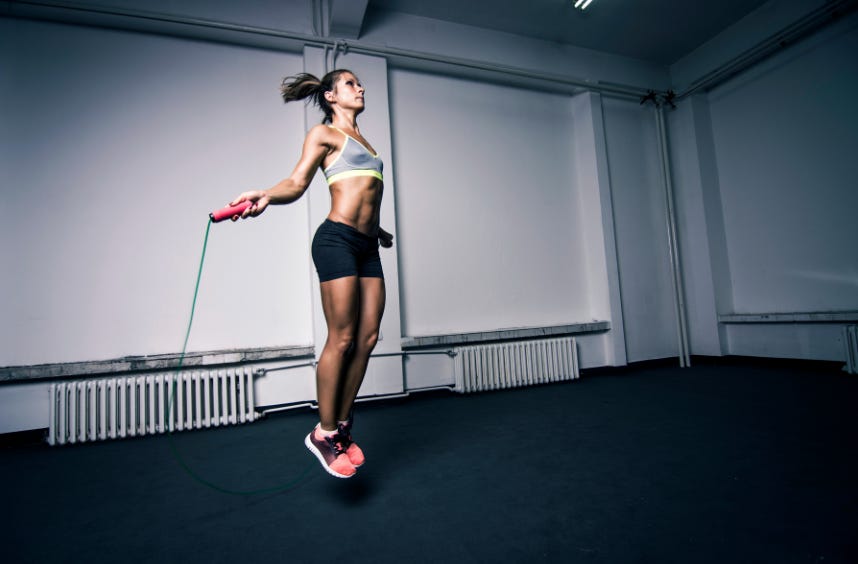
Some of the greatest “gems” in physical fitness are the simplest things. Jumping rope is a functional movement we have been doing since we were children, and a wealth of research has demonstrated the benefits of jumping rope for musculoskeletal health:
Provides a bone-loading stimulus that is favorable for bone mineral density
Improved cardiovascular fitness in time-efficient doses
But there is another level of musculoskeletal benefit that gets less attention, and that is the “Stretch-shortening cycle” a.k.a. your built-in “spring”.
When you land from a jump:
Muscles and tendons lengthen slightly (eccentric phase)
Elastic energy is briefly stored
You immediately rebound upward (concentric phase)
This rapid “load → release” sequence improves neuromuscular coordination and lower-limb stiffness — qualities linked to athleticism and functional performance across the lifespan (Markovic & Mikulic, 2010; Ramirez-Campillo et al., 2023).
Why this matters after 40
Tendon stiffness and power decline faster than maximal strength
Light plyometric work helps maintain elastic efficiency
Short ground contact times stimulate bone and connective tissue
Jump rope trains this spring system in a controlled, repeatable way. A jump rope is an inexpensive piece of equipment that fits easily in your gym bag (or your purse) and can be performed with minimal space.
But what if I can’t jump rope?
Jumping - even the smallest distance off the ground - has benefits. If you don’t have a rope (or the coordination), a simulated jumprope (and other rope-free modifications) are beneficial (see below).
How to Jump Rope
Mechanics
Hold hands slightly in front of the hips.
Jump a few inches off the ground, keeping torso upright and body straight.
Spin wrists so that the rope passes under the feet once with every jump.
For women over 40, this “small bounce” strategy:
Reduces joint stress
Maintains tendon reactivity
Preserves impact stimulus for bone without excessive load
Mechanical Progression for Beginners
If someone hasn’t jumped in years:
Step 1: March in place while turning rope
Step 2: Low pogo hops without rope
Step 3: 10–20 second rope intervals
This allows connective tissue adaptation before higher volumes.
Muscle Groups Primarily Involved
Jump rope emphasizes:
Calves (gastrocnemius & soleus)
Achilles tendon
Quadriceps
Glutes (stabilization)
Core musculature (anti-extension stability)
Intrinsic foot muscles
Because the movement is repetitive and elastic, it also enhances:
Proprioception
Ankle stiffness
Intermuscular coordination
These qualities are strongly associated with power maintenance and fall resilience in aging populations.
Rope-Free modification options:
Why Mechanics Matter for Bone and Connective Tissue
Bone responds to:
Strain magnitude
Strain rate
Novel loading patterns
Jump rope provides repeated low-amplitude loading at relatively high strain rates — a stimulus shown in impact-exercise literature to support bone health when appropriately dosed.
However, tissue adaptation takes time. Tendons adapt more slowly than cardiovascular fitness — which is why conservative progression is key in midlife athletes.
Purchasing a Jump Rope
Having a favorable experience with jumping rope requires the right equipment.
Step 1 - Select your rope based on your skill level and training goals
Step 2 - Be sure to size your rope appropriately! This is KEY to productive rope-training. The links below all have guides to sizing your rope.
For beginners:
Budget-friendly beginner ropes
More experienced athletes may prefer a speed rope for higher-volume jump rope training and double-under practice. RPM speed ropes are my personal favorite and is what I use for my workouts
Today’s workout is a modification of a Mahem-inspired workout I did at CrossFit Pompano Beach. It is a simple couplet that involves jumping rope and the dumbbell push-press. In addition to the benefits of jumping rope, the push press targets core and upper-body strength, and hip extension. When the push-press is performed under the fatigue of the jump rope segment, this further builds strength and resilience. Enjoy!
Warm Up
AMRAP 8 (As many rounds as possible in 8 minutes0
10 jumping jacks (Low impact option: March in place)
10 Air squats
10 Mountain Climbers (right + left = 1 repetition)
Movement Practice
Take 5-10 minutes to select your weights and practice your options for the workout.
Dumbbell Push Press: Review the linked video for proper form and mechanics. Select a weight where you can do 7-10 repetitions confidently and unbroken.
Jump Rope
Alternatives:
No rope? Do a simulated jump rope
Too many reps? Reduce the jump rope repetitions by 1/3 to 1/2.
Workout
How To: Perform 21 dumbbell push presses, then 100 single unders (it is ok to break up larger sets into 2-3 smaller sets with a few breaths of rest in between). Then perform 18 push presses and 90 single unders, then 15 push-presses and 80 single unders, and so on, until you have completed the repetition scheme.
For Time
Dumbbell Push Press
21 - 18 - 15 - 12 - 9 - 6
Single Under Jump Rope
100 - 90 - 80 - 70 - 60 - 50
Advanced option: Double Unders: 50 - 45 - 40 - 35 - 30 - 25
Cool Down
We can never overstate the need for an effective cool-down to jump-start your recovery - especially after an intense session like this one. Show your legs and shoulders some love with these two, 10-minute stretch sequences. #dontskiptheyoga
10-minute Yoga for Calves and Shins
TAKING NEW CLIENTS!

If you are an active woman or competitive midlife athlete who feels abandoned by mainstream medicine, I’m here for you!
It is with great excitement that after more than 2 years of preparation, I have FINALLY launched my Telehealth Consultation Medical practice focusing on the Reproductive Endocrine needs and Menopausal Care for active, athletic, and high-performing women.
Active and athletic midlife women have needs and risk profiles that are different from the general population. These needs often go unmet by the mainstream medical community due to a lack of understanding of fitness and sport and their impact on mid-life hormonal physiology or even a lack of acknowledgment that this dynamic exists. We put your health, fitness, and performance at the center of the equation so that you can achieve your healthiest, highest-performing self!
You will find all my service offerings on my website, including a link to my calendar so that you can reserve your place in my schedule online! Looking for a more Human encounter? Call Mary, my awesome and amazing assistant at 754-262-5674 (M-F 9a-5p ET)
This Just Dropped……

Hard Conversations in the Menopause Transition: Hormones, Testing, GLP-1s and what’s “Ideal” Now
This week we welcome back our resident reproductive endocrinologist and menopause specialist, Dr. Carla DiGirolamo, for another candid conversation. We pull back the curtain on Carla’s own menopause experience—how she navigates her symptoms, what she’s learned, and what she practices herself. We also dig into the hard conversations so many of us are having as we navigate this ever-evolving space, and how years of working closely with active midlife women have shaped her thinking on hormone therapy, GLP-1 medications, testosterone, hormone testing, and what actually moves the needle for athletic women in the transition.
Great info. It's time to get my jump rope out!