


Weight training has never been more important than during midlife. There is a wealth of research and evidence of the benefits for bone, muscle, and metabolic health during a time of our lives when the effects of hormonal changes impact so many aspects of our health.
The LIFTMOR randomized controlled trial, published in 2017 in the Journal of Bone and Mineral Research by a group from Queensland, Australia, is a high-quality study in menopausal women in their 60s that demonstrates the benefits of heavier, basic lifts such as deadlifts, squats, overhead presses, and high-impact jumps. Study subjects showed improvements in bone mineral density, physical functioning, and a favorable impact on posture and fracture risk.
For many, however, barriers exist to implementing this type of training into one’s regular exercise routine. Access to equipment and instruction on proper form requires cost, time, and resources. Many women of this generation today have never even picked up a barbell, so there is also an intimidation factor.
What can be helpful is a segway to gain confidence with moving weight. Something that is accessible, easy to use at home, and scalable for every fitness level - even for competitive athletes who are proficient with heavy lifts, who want to add variety and coordinated performance benefits to their resistance training.
Enter the kettlebell.
What Is a Kettlebell?
A kettlebell is a cast-iron or steel weight shaped like a cannonball with a single handle. Unlike a dumbbell, the center of mass sits below and behind the handle. This “offset load” changes how the body must stabilize and control the weight.
Because of this design, kettlebells:
Challenge grip and forearm strength
Increase demand on the core and stabilizing muscles
Allow for smooth, ballistic (dynamic, explosive) movements
Flow naturally between exercises
The shape enables movements like swings, cleans, snatches, and Turkish get-ups—patterns that blend strength and athleticism rather than isolating single muscles.
Evidence-Based Benefits of Kettlebell Training
Strength and Explosive Power: Kettlebell swing training has been shown to significantly improve maximal strength and lower-body explosive performance. (Lake & Lauder, 2012). Because power declines earlier and more rapidly than maximal strength with age, incorporating ballistic hip-dominant movements like swings may be especially valuable for women over 40 who want to preserve athleticism.
Importantly, these improvements can occur without maximal barbell loading, offering a joint-friendly way to train force production.
Cardiovascular Fitness: Kettlebells can simultaneously challenge the muscular and cardiovascular systems. Short-interval ballistic training can elevate heart rate quickly, providing a time-efficient conditioning stimulus without repetitive impact stress.
Musculoskeletal Health and Pain Reduction: A randomized controlled trial examining kettlebell training in working adults demonstrated improvements in strength alongside reductions in neck, shoulder, and low back pain (Jay et al., 2011). When properly coached, kettlebell movements emphasize hip-driven mechanics and trunk stability, which may contribute to improved movement efficiency and resilience.
Functional Capacity and Healthy Aging: In older adults (ages 59–79), progressive hardstyle kettlebell training improved grip strength and multiple functional performance measures, with high adherence and monitored safety (Meigh et al., 2022). Grip strength in particular is strongly associated with overall health and longevity, making loaded carries and dynamic kettlebell work especially relevant for long-term vitality.
For the Advanced Athlete
For the advanced athlete, kettlebells offer more than general fitness—they provide a powerful tool for refining force production, work capacity, and movement efficiency.
Ballistic lifts like heavy swings and snatches train rapid hip extension and rate of force development, qualities that underpin sprinting, cutting, and jumping performance. Because kettlebells allow for unilateral and offset loading (e.g., single-arm swings, rack carries, bottoms-up presses), they expose and correct asymmetries while increasing anti-rotational core demand.
Advanced athletes can also manipulate density (more work in less time), complex sequencing (clean → squat → press), and double-kettlebell variations to create high neuromuscular demand without the joint stress of maximal barbell loading. This makes kettlebells an excellent adjunct during in-season training, deload phases, or when preserving power with lower orthopedic cost is a priority.
OK! So let’s get into it. This week’s workout features (you guessed it) the kettlebell! We will use the kettlebell in 2 ways. First, with the kettlebell swing, and second, with the goblet walking lunge - and in between sets, your cardio movement of choice.
Here are some options for all fitness levels:
If running is not accessible to you, rowing (same distance as prescribed) and stationary bike (double the prescribed distance) may be substituted.
If no equipment, substitute 40 up-downs for the 800m run and 20 up-downs for the 400m run.
If this volume of repetitions is not accessible to you or you are a beginner, cut all repetitions and distances in half.
If you do not have a kettlebell, substitute a dumbbell.
Warm Up
Run, bike, or row for 5 minutes. Each minute: :50 easy and :10 hard/fast. If you choose the up-down option, perform 20 easy-paced repetitions
Movement Practice
Select your movement options for the workout and practice 30 seconds of each movement in the sequence of the workout below at a low-intensity pace. Select a kettlebell or dumbbell that you can confidently perform 15 repetitions unbroken. Use that same kettlebell/dumbbell for the walking lunges. Alternatively, you can omit the weight for the lunges.
Movement Demo Videos:
Kettlebell Swing (Beginner/Intermediate: Swing to eye level. Advanced: Swing to the overhead position)
Walking Lunge - Perform the walking lunge holding the dumbbell/kettlebell to your chest like a “goblet”. An alternative is to omit the additional weight and perform the lunge with body weight only. No space? Instead of the walking lunge, you can stand in one place and step forward, alternating sides, with an alternating lunge.
Workout
Perform each movement in sequence until you have completed all 5 segments. Move at a steady pace breaking up sets as needed to maintain movement efficiency without tapping out too early!
For Time
800-meter run
60 kettlebell swings
400-meter run
60 kettlebell walking lunges
800-meter run
Cool Down
The high volume of swings in this workout puts your hamstrings and posterior chain to work! Show your hard-working body some love with this 15-Min Deep Stretch & Release for Hips & Hamstrings.
Recovery during this stage of life is critically important! So PLEASE #dontskiptheyoga
References
Falatic, J. A., et al. (2015). Effects of kettlebell training on aerobic capacity. Journal of Strength and Conditioning Research, 29(7), 1943–1947.
Jay, K., et al. (2011). Kettlebell training for musculoskeletal and cardiovascular health: A randomized controlled trial. Scandinavian Journal of Work, Environment & Health, 37(3), 196–203.
Lake, J. P., & Lauder, M. A. (2012). Kettlebell swing training improves maximal and explosive strength. Journal of Strength and Conditioning Research, 26(8), 2228–2233.
McGill, S. M., & Marshall, L. W. (2012). Kettlebell swing, snatch, and carry biomechanics. Journal of Strength and Conditioning Research, 26(1), 16–27.
Meigh, N. J., et al. (2022). Effects of hardstyle kettlebell training in older adults. BMC Geriatrics, 22, 286.
This Just Dropped……
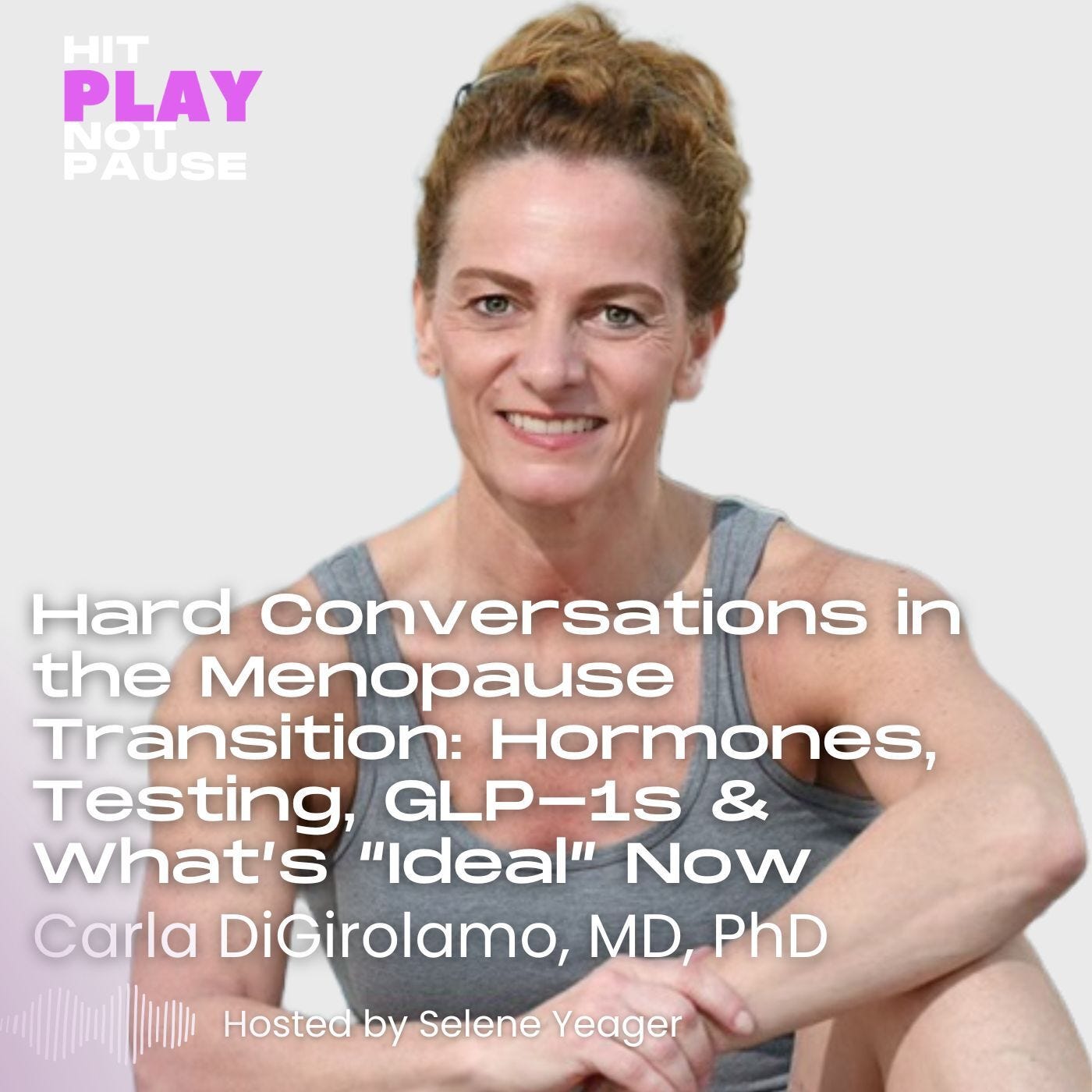
Hard Conversations in the Menopause Transition: Hormones, Testing, GLP-1s and what’s “Ideal” Now
This week we welcome back our resident reproductive endocrinologist and menopause specialist, Dr. Carla DiGirolamo, for another candid conversation. We pull back the curtain on Carla’s own menopause experience—how she navigates her symptoms, what she’s learned, and what she practices herself. We also dig into the hard conversations so many of us are having as we navigate this ever-evolving space, and how years of working closely with active midlife women have shaped her thinking on hormone therapy, GLP-1 medications, testosterone, hormone testing, and what actually moves the needle for athletic women in the transition.
TAKING NEW CLIENTS!

If you are an active woman or competitive midlife athlete who feels abandoned by mainstream medicine, I’m here for you!
It is with great excitement that after more than 2 years of preparation, I have FINALLY launched my Telehealth Consultation Medical practice focusing on the Reproductive Endocrine needs and Menopausal Care for active, athletic, and high-performing women.
Active and athletic midlife women have needs and risk profiles that are different from the general population. These needs often go unmet by the mainstream medical community due to a lack of understanding of fitness and sport and their impact on mid-life hormonal physiology or even a lack of acknowledgment that this dynamic exists. We put your health, fitness, and performance at the center of the equation so that you can achieve your healthiest, highest-performing self!
You will find all my service offerings on my website, including a link to my calendar so that you can reserve your place in my schedule online! Looking for a more Human encounter? Call Mary, my awesome and amazing assistant at 754-262-5674 (M-F 9a-5p ET)