


The strict shoulder press and the push press are movements that start with weight at the shoulders and finish overhead.
But what happens between those two positions makes them very different exercises — and both deserve a place in an Athletic Aging toolbox.
THE STRICT PRESS: Build the engine
In a strict shoulder press, the lower body stays quiet. No dip. No drive. No help from the legs.
The shoulders and arms have to do the work.
The strict press primarily trains the deltoids and triceps, while the upper back and trunk stabilize the body, and the shoulder blade must move appropriately as the arm travels overhead.
Because you can’t borrow momentum from your legs, the strict press is an excellent way to develop upper-body pressing strength and control.
Think: STRENGTH + CONTROL
THE PUSH PRESS: Connect the engine to the whole system
Now add the legs.
The push press begins with a short, controlled dip of the knees and hips followed by an explosive leg drive. That force travels from the floor, through the legs and trunk, into the arms and ultimately into the weight overhead.
Your shoulders are still working — but they are now part of a coordinated, whole-body movement.
That changes the training stimulus.
The push press develops power, coordination, and force transfer between the lower and upper body. It also allows you to move more weight than you typically could with a strict press.
Think: POWER + INTEGRATION
SAME FINISH. DIFFERENT JOB.
Strict Press
No assistance from the legs
Greater emphasis on upper-body strength
Slower, controlled force production
Requires trunk stability and overhead control
Push Press
Legs initiate the movement
Integrates lower and upper body
Develops speed and power
Trains coordinated force transfer through the body
Neither is the “better” exercise.
They simply ask your body to solve the same problem — getting something overhead — in different ways.
HOW TO DO THEM
For both movements, begin standing tall with the weight at shoulder level. Brace your trunk and keep the weight balanced over your base of support.
Strict Press:
Without bending your knees, press the weight overhead until your arms are extended. Finish with the weight stacked over your shoulders and body — not drifting forward.
Push Press:
Make a shallow, controlled dip by bending the knees and hips slightly while keeping your torso upright. Drive forcefully through the floor, extend the legs and use that momentum to help send the weight overhead. Finish in the same strong overhead position.
MAKE IT YOUR MOVEMENT
You don’t need a barbell — or a heavy weight — to benefit from either exercise
• Dumbbells — allow each arm to find a comfortable pressing path
• Lighter weights — practice mechanics before adding load
• Seated strict press — reduces lower-body contribution and balance demands
• Reduce the range of motion — work within the range you can control comfortably
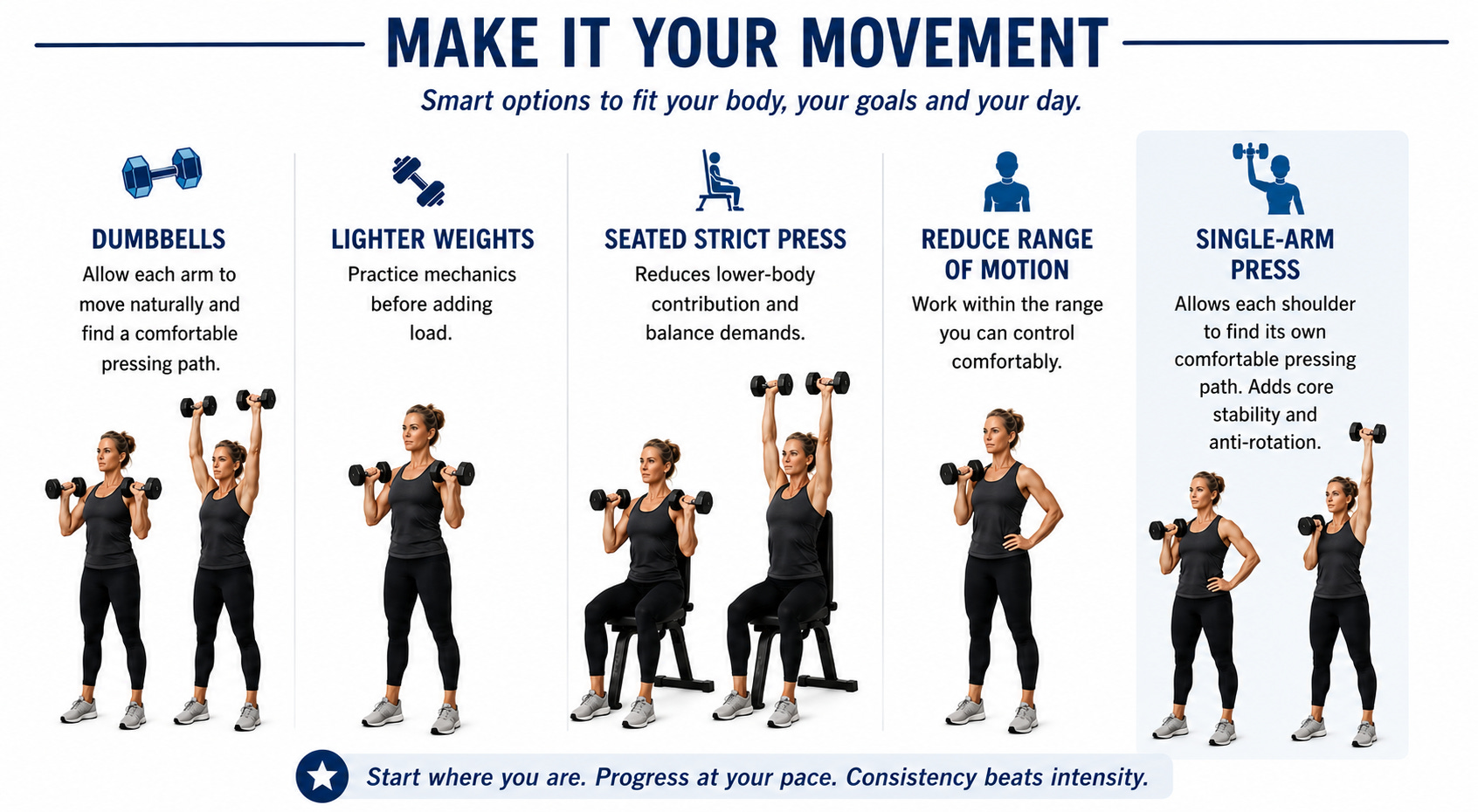
And if an overhead position causes pain, don’t force it. Shoulder mobility, previous injuries, and individual anatomy can all influence which pressing variation feels best.
WHY TRAIN BOTH?
As we get older, maintaining strength matters. Maintaining power matters, too.
The strict press develops the strength to produce force with the upper body.
The push press teaches the body to generate force quickly and transfer it efficiently through multiple joints and muscle groups.
One builds the pieces. The other teaches the pieces to work together.
Strength gives us capacity.
Power and coordination teach us how to use it.
Today’s workout provides the opportunity to practice the strict shoulder press and the push-press with accessory work before the main training set, followed by the push-press alternating with a cardiovascular stimulus.
Warm-Up
AMRAP 5 (As many rounds as possible in 5 minutes)
10 Up-downs
10 Mountain climbers (Right + left - 1 repetition)
Movement Practice
Today’s movement practice is an Accessory segment where you will practice the strict and push press movements.
To appreciate the greatest benefit from this accessory, watch the demo videos above for these two movements and pay close attention to the mechanics of these movements.
Select a light weight to start, building incrementally over the 3 sets.
Accessory Work
3 sets
5 strict press + 5 push press: Perform 5 strict presses, then without putting the weight down, go straight into the 5 push presses.
Rest 2 minutes between sets.
Workout
TIP! Break up the sets of dumbbell push presses into 2-3 sets. If you can do them unbroken, you have gone too light! (Recommended weights: 15lb dumbbells (beginner) to 35# dumbbells (advanced).
For Time:
21 Dumbbell Push Press
30 Calorie Row
15 Dumbbell Push Press
21 Calorie Row
9 Dumbbell Push Press
15 Calorie Row
Movement Options:
Substitute a kettlebell swing (eye level or if advanced, swing to overhead) if no access to a rower or jumping air squats if no access to a rower.
Cool-Down
Jump-start your recovery with this 15 minute Quick Escape Yoga sequence from Five Parks Yoga
Housekeeping…
This is something you don’t want to miss. Check out this workshop featuring the awesome and amazing sports psychologist, Erin Ayala! Register HERE

NOW TAKING MEDICAL CLIENTS FROM COLORADO, CONNECTICUT, AND NEW HAMPSHIRE!
..in addition to MA, NY, NJ, PA, CA, FL, OH
If you are an active woman or competitive midlife athlete who feels abandoned by mainstream medicine, I’m here for you!

Active and athletic midlife women have needs and risk profiles that are different from the general population. These needs often go unmet by the mainstream medical community due to a lack of understanding of fitness and sport and their impact on mid-life hormonal physiology or even a lack of acknowledgment that this dynamic exists.
To speak to this need, I launched my Telehealth Consultation Medical practice focusing on the Reproductive Endocrine needs and Menopausal Care for active, athletic, and high-performing women.
We put your health, fitness, and performance at the center of the equation so that you can achieve your healthiest, highest-performing self!
You will find all my service offerings on my website including a link to my calendar so that you can reserve your place in my schedule!
What do you think the best exercise is for triceps?