

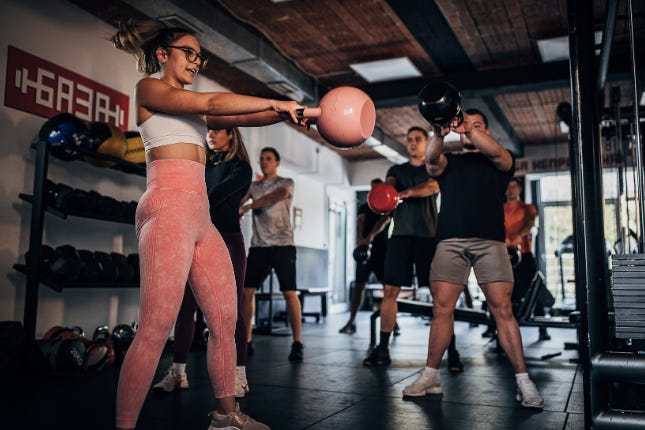
Muscle power is essential during midlife and beyond. One of the greatest power-generators exists through hip extension.
Power declines with age - especially during the menopause transition - often faster than maximal strength. This matters because power is what allows strength to show up quickly.
Strength helps you lift.
Power helps you react, jump, accelerate, climb, catch yourself, and move dynamically.
How do we tap into this power reservoir? Enter the kettlebell swing.
The kettlebell swing is one of the most useful “bridge” movements in strength and conditioning: simple enough to learn with good coaching, but powerful enough to train strength, coordination, conditioning, and athletic power in one pattern.
Its value is that it trains hip extension—the ability to drive the hips forward forcefully—which underlies so many athletic and daily movements: climbing stairs, jumping, sprinting, hiking uphill, lifting from the floor, getting out of a chair, and generating whole-body power.
What Is the Kettlebell Swing?
The kettlebell swing is a ballistic hip-hinge movement. The bell travels backward between the legs as the hips flex, then forward as the hips extend explosively. In the classic shoulder-height swing, the bell rises to approximately chest or shoulder level—not because the arms lift it, but because the hips project force into the bell.
That distinction matters.
A good swing is not a squat with a front raise. It is a loaded hinge followed by rapid hip extension. Biomechanical research shows that kettlebell swings create a hip-hinge pattern with rapid muscle activation and relaxation cycles, involving substantial low-back and hip muscle activity.
The Mechanics: Hinge, Load, Snap, Float
The swing can be thought of in four phases:
1. Hinge: The hips move back while the spine stays neutral. The knees bend slightly, but the movement is not knee-dominant.
2. Load: The hamstrings, glutes, and posterior chain lengthen under tension as the bell moves behind the body.
3. Snap: The athlete drives the floor away and extends the hips powerfully.
4. Float: The bell rises from momentum. The arms guide the bell; they do not lift it.
This is why the swing is so useful as a teaching tool. It reinforces the difference between hip flexion/extension and squatting, and it teaches force transfer from the lower body through a braced trunk into the upper body.
Female-specific biomechanics research supports the idea that swing style and load influence hip extension demands. In trained young women, kettlebell mass and swing variation affected hip joint kinetics, reinforcing that the swing is meaningfully loaded through the hip when performed correctly.
Physiologic Benefits
The swing offers several benefits that are particularly relevant for active and athletic women in midlife and beyond.
Posterior chain strength. The glutes, hamstrings, spinal erectors, and upper back all contribute to the swing. This helps build strength in the muscles that support posture, lifting, running mechanics, and hip stability.
Power development. Because the bell accelerates through hip extension, the swing trains explosive strength in a relatively accessible way compared with Olympic lifts.
Metabolic conditioning. Kettlebell swings can create a significant cardiovascular demand. Research on the oxygen cost of kettlebell swings shows that they can be metabolically challenging, especially when performed in intervals.
Grip and trunk integration. The swing requires the hands, lats, trunk, hips, and legs to coordinate as one system. This makes it more “athletic” than many isolated machine-based exercises.
Functional carryover. The hinge-to-hip-extension pattern shows up everywhere: deadlifting, jumping, hiking, picking up heavy objects, and transitioning from low to high positions.
Safety and Movement Modifications
The swing is powerful, but it should be earned. Common errors include squatting the bell, lifting with the arms, overextending the lower back at the top, letting the bell drop too low, or losing trunk tension.
For beginners or anyone with back sensitivity, check out this kettlebell swing progression video. Start with a kettlebell deadlift, then a hike pass, then short sets of swings. The goal is crisp mechanics, not fatigue-driven volume.
Other movement modifications include:
Use a light kettlebell: Kettlebells are available in weights starting at 5 pounds.
Adjust the height of the swing: The “Russian" swing takes the bell to eye level, where the “American” Swing takes the bell overhead - this is an advanced level option. The swing can further be modified to swing to the level of the abdomen or chest.
Practical Takeaway
The kettlebell swing is foundational because it teaches one of the most important athletic skills: generating power from the hips.
For midlife women, this is not just about performance in the gym. It is about preserving the ability to move with strength, speed, confidence, and resilience in real life.
Before progressing to more complex movements, the kettlebell swing builds the base: hinge mechanics, hip extension, trunk stiffness, posterior-chain power, and whole-body coordination.
In Part 2 of this series, we will increase the complexity with the sumo-deadlift high-pull. Stay tuned!
Today’s workout targets hip extension with the jump and the kettlebell swing. The overhead alternating lunge creates fatigue in the legs and targets core stability. There are several movement alternatives to choose from if any of these movements is not completely accessible to you. Enjoy!
Warm Up
AMRAP 7 Perform each movement in sequence for as many rounds of the 3 movements as you can in 7 minutes.
10 air squats
10 light kettlebell swings
10 box step-ups
Movement Practice
Take 5-10 minutes to select weights/options and practice the movements you will do for the workout. Select options/weights that allow you to confidently do 5-10 repetitions unbroken.
For the box jump, select a STABLE box at a height where you can confidently jump and move at a steady pace with only a couple of breaths of rest after 5-10 repetitions. For experienced athletes, the suggested box height is 20 inches (50 cm).
For the kettlebell swing, select a moderately heavy weight and swing to eye level (“Russian”-style swing). For experienced athletes, the recommended kettlebell weight is 35 lbs (16kg).
For the single arm overhead alternating lunge. Select a weight that allows you to do 10 total repetitions (5 each side) unbroken. If this movement is new to you or challenging, select a light object to hold overhead such as a shoe or a can of beans. Holding a single arm in this position is more important than the weight used. For experienced athletes, the recommended dumbbell weight is 20-25lbs (12-14kg)
Movement Alternatives
Box jump alternative: Squat jumps for height. If you cannot tolerate any impact perform dumbbell or barbell thrusters.
** For this workout, the box step-up is not an optimal scale because the goal of this movement is to be “explosive” in the hip extension to train power in the muscles that execute this movement.
Kettlebell swing alternative: Double dumbbell swing. If you have a barbell and are proficient with Olympic weightlifting, substitute a hang power clean.
Single arm overhead alternating lunge: If holding a single arm without weight overhead is not accessible to you, perform the alternating lunges holding a single dumbbell by your side, switching arms as needed.
Workout
AMRAP 16 (As many rounds as possible in 16 minutes)
Repetition scheme: 2-4-6-8…. and so on adding 2 repetitions per round.
HOW TO: Perform 2 box jumps, 2 overhead lunges, 2 kettlebell swings, then 4 box jumps, 4 overhead lunges, 4 kettlebell swings, then 6 box jumps, and so on. Continue with as many rounds as you can on a 16-minute clock. Your score is the total rounds and repetitions. (Ex: completed the round of 14 and 15 repetitions into the round of 16.)
Box jumps
Single overhead dumbbell alternating lunges (Switch arms as needed. Alternate legs with each repetition)
Kettlebell swings
Cool Down
Show your hips and legs some love with this 20-minute Yoga Flow for Hips from Yoga with Adriene. The best results gained from training start with recovery. #dontskiptheyoga.
References
McGill SM, Marshall LW. Kettlebell swing, snatch, and bottoms-up carry: back and hip muscle activation, motion, and low back loads. J Strength Cond Res. 2012;26(1):16-27. Available at: https://pubmed.ncbi.nlm.nih.gov/21997449/
Lake JP, Lauder MA. Kettlebell swing training improves maximal and explosive strength. J Strength Cond Res. 2012;26(8):2228-2233. Available at: https://pubmed.ncbi.nlm.nih.gov/22580981/
Farrar RE, Mayhew JL, Koch AJ. Oxygen cost of kettlebell swings. J Strength Cond Res. 2010;24(4):1034-1036. Available at: https://pubmed.ncbi.nlm.nih.gov/20300022/
Watts CQ, McCarty CW, Keogh JWL, et al. Effects of kettlebell load on joint kinetics and global lower-extremity biomechanics during the kettlebell overhead swing. Sports (Basel). 2022;10(12):203. Available at: https://pubmed.ncbi.nlm.nih.gov/36548707/
NOW TAKING NEW CLIENTS!
If you are an active woman or competitive midlife athlete who feels abandoned by mainstream medicine, I’m here for you!

It is with great excitement that after more than 2 years of preparation, I have FINALLY launched my Telehealth Consultation Medical practice focusing on the Reproductive Endocrine needs and Menopausal Care for active, athletic, and high-performing women.
Active and athletic midlife women have needs and risk profiles that are different from the general population. These needs often go unmet by the mainstream medical community due to a lack of understanding of fitness and sport and their impact on mid-life hormonal physiology or even a lack of acknowledgment that this dynamic exists. We put your health, fitness, and performance at the center of the equation so that you can achieve your healthiest, highest-performing self!
You will find all my service offerings on my website including a link to my calendar so that you can reserve your place in my schedule!
In case you missed it…..

Tune in to my guest appearance with the awesome and amazing Selene Yeager where we review the latest medical literature addressing the the role of laboratory testing in managing menopausal hormone therapy.
Great info. I bought a kettlebell (25 lb) a few months ago and I keep it in my office. I try to use it daily. Keeping it in my office is a reminder.
The most important line A good swing is not a squat with a front raise. It is a loaded hinge followed by rapid hip extension. I cringe when I watch people make it a Squat , even worse is when I see Trainers who teach it are squatting in their demo . I have said you know it's called a"Swing" .
People watch me and say you do it so effortlessly I say because it's a swing Hip movement which is a natural movement , just relax ,