

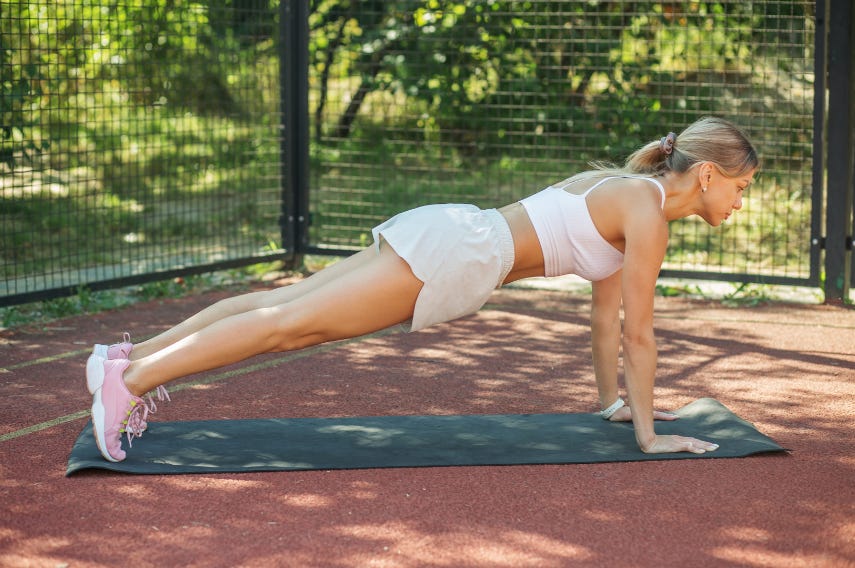
If there’s one movement that bridges the gap between performance, longevity, and injury prevention—it’s the plank.
At first glance, it looks simple. Static. Even passive.
But physiologically? The plank is anything but.
Plank variations offer one of the most efficient ways to build core strength, spinal stability, and movement resilience—all without excessive joint stress.
What the Plank Actually Trains
The “core” is not just your abs. It’s an integrated system of muscles that stabilize the spine and pelvis, including:
Transversus abdominis
Internal and external obliques
Rectus abdominis
Erector spinae
Pelvic floor and diaphragm
These muscles work together to control force transfer through the body, which is critical for everything from lifting weights to running to simply maintaining posture.
Planks train this system isometrically—meaning the muscles contract without changing length. That distinction matters.
Unlike dynamic core exercises, planks emphasize:
Endurance of stabilizing muscles
Neuromuscular coordination
Spinal control under sustained tension
Why Planks Matter for MidLife Women
As women move through perimenopause and menopause, several physiologic changes occur:
Loss of muscle mass (sarcopenia)
Decline in neuromuscular efficiency
Increased risk of low back pain and injury
Core stability becomes a limiting factor—not just strength.
Research consistently shows that core stabilization exercises like planks improve neuromuscular control and spinal stability, making them foundational in both performance training and rehabilitation settings (Hibbs et al., 2008).
A Brief but Important Distinction: Stability vs Movement
Planks are fundamentally different from dynamic core exercises like the kettlebell swing or hollow rocks. As an isometric exercise, the plank trains the core to resist movement—building sustained tension, spinal stability, and neuromuscular control. In contrast, dynamic movements involve repeated shortening and lengthening of muscle, emphasizing force production and movement efficiency.
Electromyographic research shows that isometric exercises like planks preferentially activate deep stabilizing muscles critical for spinal protection, while dynamic exercises generate higher peak forces but rely on that underlying stability to be performed safely (McGill, 2010; Ekstrom et al., 2007).
In practice, this means planks build the foundation, while dynamic core work expresses that strength through movement.
Why Isometric Strength Matters for Longevity
Isometric training—like planks—builds:
Postural strength
Joint stability
Tendon resilience
Time-under-tension endurance
Unlike repetitive flexion-based movements, planks:
Minimize excessive spinal loading
Train the body to resist unwanted motion (anti-extension, anti-rotation)
Reinforce safe mechanics under fatigue
This becomes increasingly important for reducing injury risk in both training and daily life.
The Power of Plank Variations
Here’s where planks become a true performance tool. Different variations shift demand across the core:
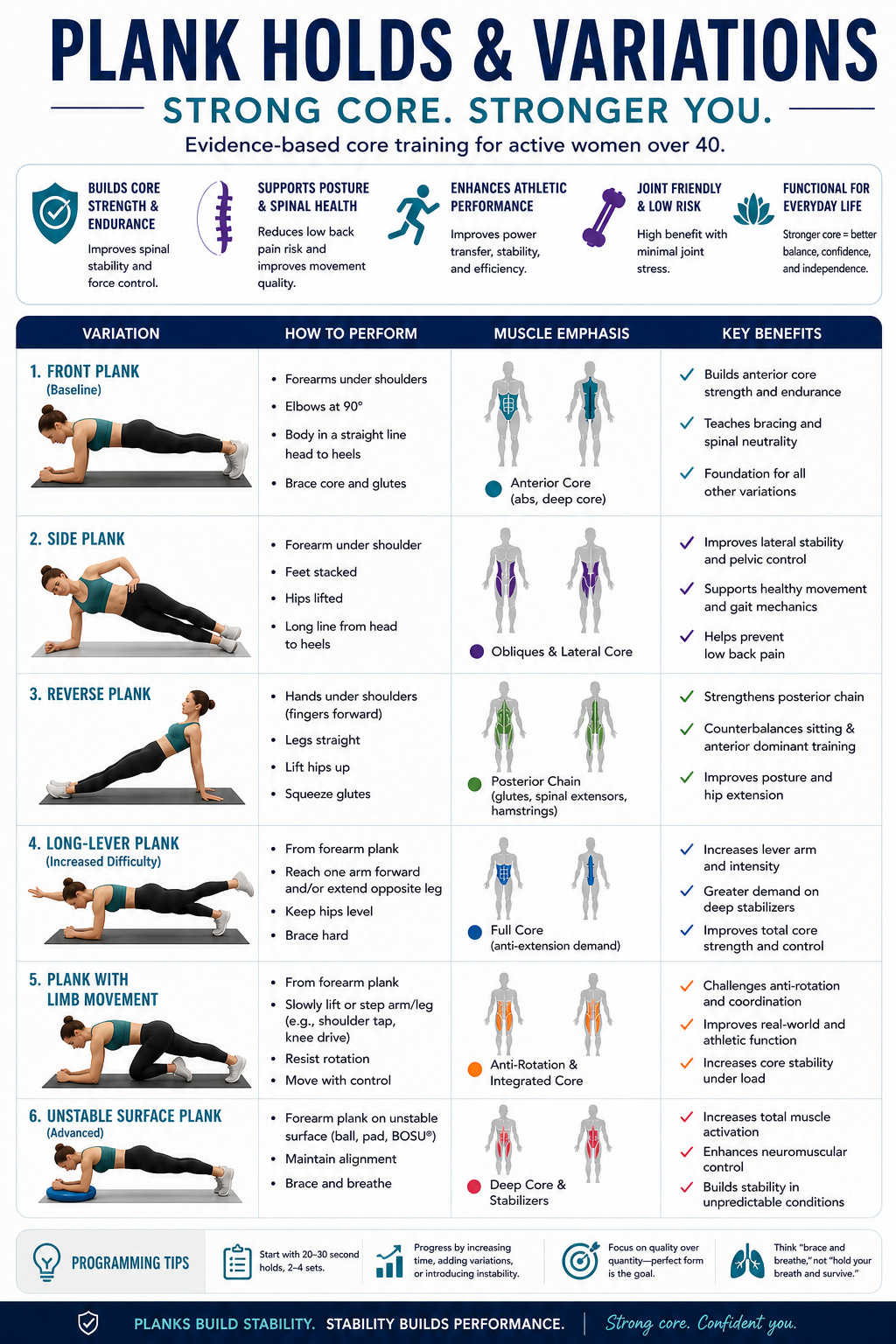
Research shows that these variations can increase muscle activation and neuromuscular demand, making them far more than a static hold.
How to Program Planks Effectively
For women over 40, the goal is not just “holding longer”—it’s building capacity with quality.
Start with:
20–30 second holds
2–4 sets
Progress by:
Increasing time (up to ~60 seconds)
Adding variations rather than just duration
Introducing instability or controlled limb movement
Key cue:
Think “brace and breathe,” not “hold your breath and survive.”
The Takeaway
Planks are not a filler exercise.
They are a high-value, low-risk, performance-enhancing tool—especially for women navigating the physiologic shifts of midlife.
They train what matters most:
Stability before power
Control before intensity
Endurance before output
Build the foundation well—and everything else gets stronger on top of it.
Today’s workout has a “Plank Challenge” integrated into a combination of dynamic movements that target the core musculature in different ways.
Warm Up
If running, rowing, or biking, perform 3 minutes at an easy pace.
Then….
TABATA (20 seconds work/10 seconds rest) x 3 rounds (6 minutes total)
Elevated Push ups (elevated or strict)
Ab mat or traditional sit Ups (knees bent, feet anchored)
Movement Practice
Watch the video links for the workout movements and alternatives and take 5-10 minutes to practice each movement in sequence for 4-6 repetitions at low intensity for 2 rounds. Select your options for the workout during this practice time.
Movement substitutions:
Run/Row substitution: 400m bike or10 up-downs or 60 single-under/30 double-under jump rope.
Dumbbell front squat substitution: Goblet squat with a single dumbbell or kettlebell or air squat.
Kettlebell swing substitution: double or single dumbbell swing, or 10 hip bridges with or without weight.
Workout
4 Rounds for time. Perform each movement in sequence. Note that there is 1 minute of rest between rounds.
200m run or row
10 strict or elevated push-ups
15 Kettlebell swings- eye level (advanced: overhead swing):
10 Hollow Rocks
Accumulate 1:00 plank hold
If you need to rest before the minute is up, the rest DOES NOT count toward the 1 minute. Resume timing when you resume the plank until you have accumulated 1 full minute of plank time.
REST 1 minute
SCORE: Total time to complete the 4 rounds plus the 1 minute of rest in between rounds.
Cool-Down
Jump-start your recovery with this 20-minute deep stretch yoga sequence from Five Parks Yoga
References
McGill SM. Core training: evidence translating to better performance and injury prevention. Strength & Conditioning Journal. 2010;32(3):33–46. doi: 10.1519/SSC.0b013e3181df4521.
Ekstrom RA, Donatelli RA, Carp KC. Electromyographic analysis of core trunk, hip, and thigh muscles during 9 rehabilitation exercises. J Orthop Sports Phys Ther. 2007;37(12):754–762.
Hibbs AE, Thompson KG, French D, et al. Optimizing performance by improving core stability and core strength. Sports Med. 2008;38(12):995–1008.
McGill SM, Marshall LW. Kettlebell swing, snatch, and bottoms-up carry: back and hip muscle activation, motion, and low back loads. Journal of Strength and Conditioning Research. 2012;26(1):16–27. doi: 10.1519/JSC.0b013e31823a4063.
Calatayud J, Casaña J, Martín F, Jakobsen MD, Colado JC, Gargallo P, Juesas Á, Muñoz V, Andersen LL. Trunk muscle activity during different variations of the supine plank exercise. Musculoskeletal Science and Practice. 2017;28:54–58. doi: 10.1016/j.msksp.2017.01.011.
TAKING NEW CLIENTS!

If you are an active woman or competitive midlife athlete who feels abandoned by mainstream medicine, I’m here for you!
It is with great excitement that after more than 2 years of preparation, I have FINALLY launched my Telehealth Consultation Medical practice focusing on the Reproductive Endocrine needs and Menopausal Care for active, athletic, and high-performing women.
Active and athletic midlife women have needs and risk profiles that are different from the general population. These needs often go unmet by the mainstream medical community due to a lack of understanding of fitness and sport and their impact on mid-life hormonal physiology or even a lack of acknowledgment that this dynamic exists. We put your health, fitness, and performance at the center of the equation so that you can achieve your healthiest, highest-performing self!
You will find all my service offerings on my website, including a link to my calendar so that you can reserve your place in my schedule online! Looking for a more Human encounter? Call Mary, my awesome and amazing assistant at 754-262-5674 (M-F 9a-5p ET)
In Case You Missed It…..

Check out this awesome podcast where the awesome and amazing Selene Yeager interviews Dr. Casey Francis, my personal Performance Physical Therapist from Pompano Beach, FL, about how this discipline of physical therapy can help women of all ages and athletic levels, but especially those in mid-life. Later in the show, I make a quick appearance to talk about my injury rehab and experience working with Dr. Casey.
Never heard of the reverse plank. I'm in for the challenge
Should these be done daily?