


If you want one movement that trains almost everything at once, the dumbbell thruster is hard to beat.
At its simplest, a thruster combines two familiar movements: a squat and an overhead press. Put them together, and the legs, hips, core, shoulders, and arms have to work as one coordinated system.
And your heart and lungs quickly get involved too.
Why Thrusters?
The dumbbell thruster develops several qualities that matter as we age:
Lower-body strength from the squat
Upper-body strength from the overhead press
Power as the legs and hips drive the dumbbells upward
Core stability while transferring force from the lower to upper body
Coordination as multiple joints work together
Cardiovascular fitness when repetitions are performed continuously
That combination makes the thruster remarkably efficient: strength, power, and conditioning in the same movement.
How To:
Hold a dumbbell in each hand at shoulder height, with your feet approximately squat-width apart.
Descend into a squat while keeping your torso controlled and your feet firmly planted.
Then stand aggressively.
As you extend your knees and hips, use that momentum to help drive the dumbbells overhead. Finish standing tall with the weights controlled overhead, then return them to your shoulders and begin the next repetition.
Think: Squat → Drive → Press.
The movement should feel connected—not like a squat followed by a completely separate shoulder press.
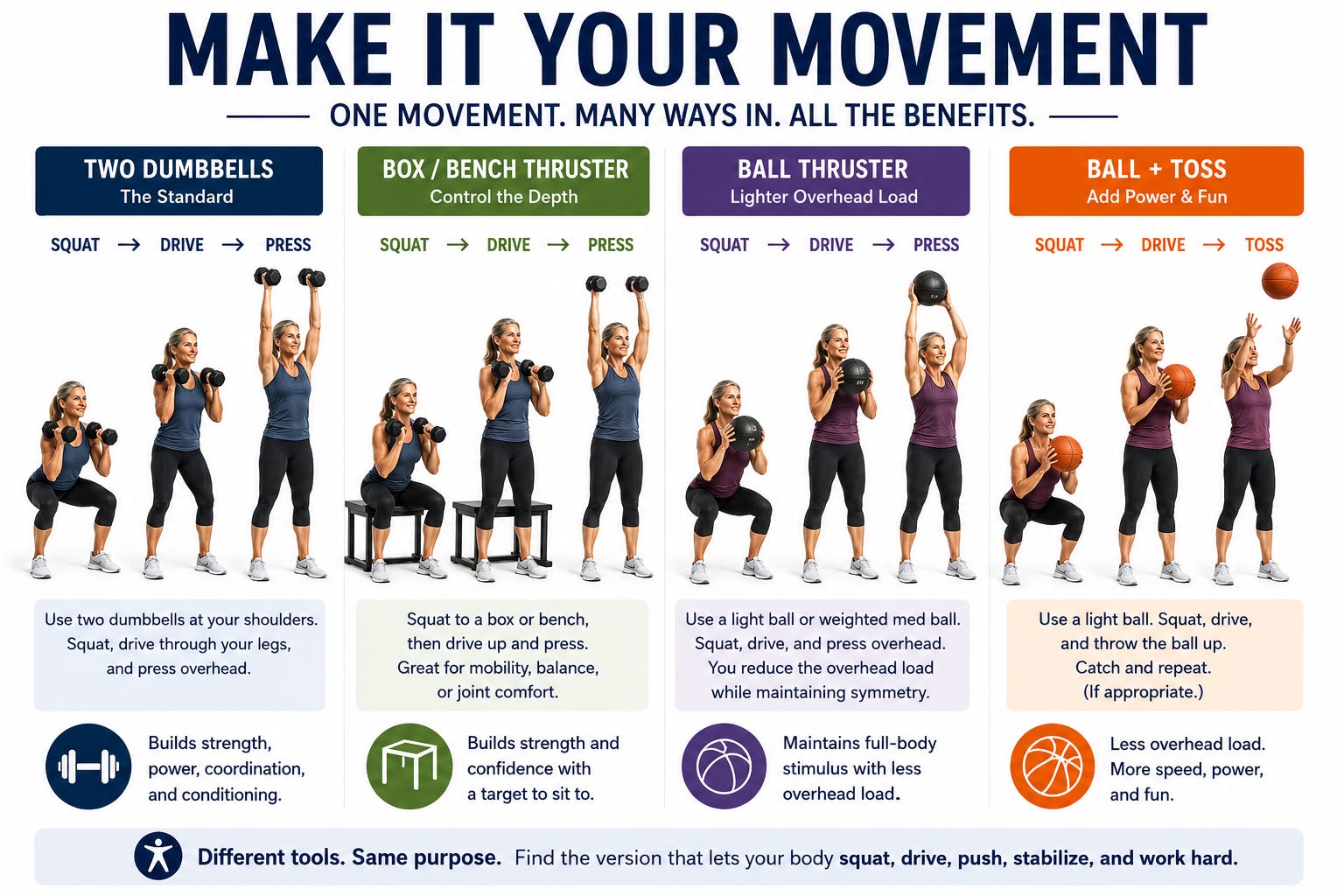
You don’t need heavy dumbbells—or even a full-depth squat—to get the benefits of a thruster.
Two dumbbells: Adjust the load.
The traditional thruster uses a dumbbell in each hand, but you choose the weight. Lighter dumbbells reduce the strength requirement while preserving the full movement pattern.Box or bench thruster: Adjust the depth.
Find your pain-free squat range of motion. Use a box or bench as a TARGET (not to sit down, but to define your pain-free squat depth), then drive up and press. This provides a consistent target for squat depth and can make the movement more accessible when mobility, balance, or joint tolerance is a consideration.Ball thruster: Lighten the overhead load.
Swap the dumbbells for a basketball, soccer ball, or weighted medicine ball held at the chest. Squat, drive through the legs, and press the ball overhead. This maintains the symmetrical, full-body movement pattern while allowing you to substantially reduce the overhead load.Ball + toss: Add some power—and fun.
Use a lightweight ball and, instead of stopping at the press, use your leg drive to propel the ball upward with a small toss. Catch, reset, and repeat. Less overhead load allows you to move faster, adding an element of speed, power, coordination, and play.
Different tools. Same purpose.
The goal isn’t to perform someone else’s version of a thruster. It’s to find the version that allows your body to squat, drive, push, stabilize, and work hard..
Today’s workout integrates the dumbbell thruster (or your selected modification) with a run. This workout will raise your heart rate while targeting full-body strength and power.
This is a highly efficient workout as it take you only ~20 minutes. Consider this workout while traveling or on a day when you are pressed for time. It will not disappoint!
Warm Up
AMRAP 5 min (As many rounds as possible in 5 minutes at low intensity)
1:00 Run, Row or Up Downs
10 Air Squats
5 Dumbbell strict press (light)
Movement Practice
Watch the dumbbell/barbell thruster movement video in the Feature Movement section and be mindful of keeping good form and mechanics with the thruster. Select a challenging weight that is moderately heavy that you can complete the 12 repetitions in 1-2 sets. Fatigue will set in particularly in the last 2 rounds, so it is ok to break up the thrusters into 2-3 sets as needed.
Tip! A great way to manage fatigue but keep moving is to slow the pace of your repetitions.
Workout – Part 1
5 Rounds for Time (1 round = run then thrusters)
400m Run, Row, or 800m bike (If no ability to run, row, or bike - try 20 burpees!)
12 Dumbbell or barbell thrusters (moderate weight where you can perform the thrusters in 1-2 sets).
** Goal Time: <20 min
**If you are new to fitness, substitute a brisk walk for the run and air squats for the thrusters.
Workout Part 2 - Core Accessory
Accumulate 5 min of a hollow hold.
Every time you break, pause the clock and do 20 Mountain Climbers (R+L = 1 repetition) ….then continue on that 5 min clock and go back to the hollow hold until you have completed a total of 5 min in the hollow hold position!
Cool Down:
5 min Yoga: Leg and Hip Stretch
Housekeeping…
This is something you don’t want to miss. Check out this workshop featuring the awesome and amazing sports psychologist, Erin Ayala! Register HERE
NOW TAKING MEDICAL CLIENTS FROM COLORADO, CONNECTICUT, AND NEW HAMPSHIRE!
..in addition to MA, NY, NJ, PA, CA, FL, OH
If you are an active woman or competitive midlife athlete who feels abandoned by mainstream medicine, I’m here for you!

Active and athletic midlife women have needs and risk profiles that are different from the general population. These needs often go unmet by the mainstream medical community due to a lack of understanding of fitness and sport and their impact on mid-life hormonal physiology or even a lack of acknowledgment that this dynamic exists.
To speak to this need, I launched my Telehealth Consultation Medical practice focusing on the Reproductive Endocrine needs and Menopausal Care for active, athletic, and high-performing women.
We put your health, fitness, and performance at the center of the equation so that you can achieve your healthiest, highest-performing self!
You will find all my service offerings on my website including a link to my calendar so that you can reserve your place in my schedule!
box/bench modification is helpful. makes it more accessible without losing the pattern. Trying this with a lighter set tomorrow.
Spot on, Carla. The dumbbell thruster really delivers so much bang for your buck when it comes to coordination, power, and conditioning all in one go. Terrific post!