


Hey Friends! I'm excited to bring you this special edition of Athletic Aging where I team up with Dr. Heather Hausenblas, author of the substack publication "Wellness Discovery" to discuss the barriers for women to training with weights and resources for overcoming these barriers. Enjoy! -Dr. Carla
Picture a typical gym on a Tuesday morning. Every cardio machine taken — treadmills, ellipticals, bikes — almost all by women, logging miles at a steady, determined pace.
The weight room: different story. Mostly men.
The numbers confirm it. Only 27% of women in the U.S. meet the guideline for strength training — two days a week of lifting or resistance work. For men, it’s 35%. Not great either, but better.
It gets worse with age. Among women 18–44, about 34% hit the mark. Ages 45–64, that drops to 24%. Women 65 and older: 17%.
That’s backwards.
The years women need strength most — for bones, joints, balance, metabolism, independence — are the exact years they’re least likely to do it.
Why women avoid the weight room
It’s not desire.
In a recent study, 87% of women aged 40–60 said they wanted to strength train for bone health. 72% were open to lifting heavy.
It’s the environment.
They feel watched, talked down to, out of place. Unfeminine. Unqualified. So they stay on the treadmill.
What the science says
In 2025, researchers reviewed dozens of resistance-training programs for postmenopausal women. The findings were boring in the best way.
Strength training builds muscle, improves body composition, and preserves independence. The typical program wasn’t fancy — three sets, eight to ten reps, moderate-to-heavy loads. Leg press, chest press, rows, squats.
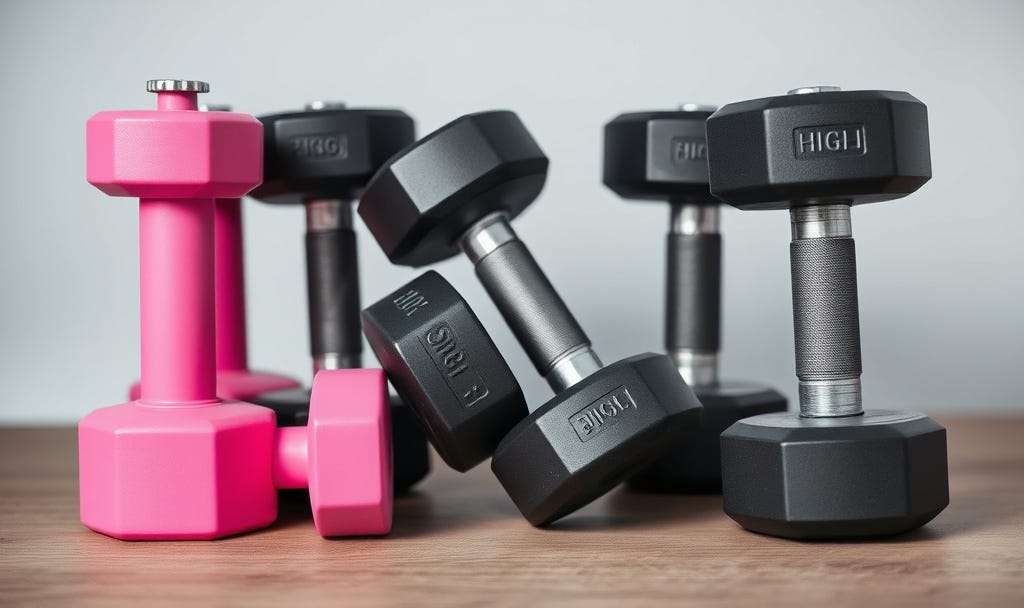
Not pink dumbbells. Not “toning.” Actual strength.
The “bulky” myth
Let’s kill this quickly. Women don’t have enough testosterone to get bulky from lifting. Building that kind of mass — on anyone — requires dedicated training, a caloric surplus, and often pharmaceutical help.
Women who lift actually get stronger, leaner, and more confident. Among older women who strength train, 90% report being satisfied with their bodies.
That’s not a small number.
What works
Lift heavy enough to feel it. This is the whole game. If the weight isn’t challenging, it isn’t doing much.
Eat like someone who trains. Muscle needs protein, carbs, and creatine.
Don’t do it alone. Women stick with strength training when they have support, coaching, and community. Isolation is where programs go to die.
Where to start
The simplest entry point: a 6–8 week program with a trainer at a local gym. Learn the basics — squats, deadlifts, presses. Build confidence with load and form.
If that feels like too much, or cost or convenience is a factor, solid online options exist:
Keys to Empowering Women in the Weight Room (Athletic Aging Archives)
Athletic Aging Weekly Workout Series
Empower by Dottir
The bottom line
Midlife doesn’t require women to become fragile. It requires them to become strong.
The science is clear: strength training isn’t optional.
It’s how we age on our feet.
Heather and Carla
So true, Silver! ... and what blows my mind repeatedly, is that in medical school and residency training, there is ZERO, meaningful, education on fitness and nutrition (unless you are a sports med doc)... the very foundations of good health... pretty ironic in a profession that is supposed to be focused on health and longevity!!!! Thanks for your comment and for reading! :)
Hi Sally! Thanks so much for your question! Yes, lifting weights is a much different stimulus to your muscles and bones compared to exercises like pilates and Barre. All are important, but they do different jobs. Lifting weights is about muscle strength, power, and mass, which become critically important as we age, and are not as easily achieved with Barre. Barre helps to develop body control, balance, flexibility, isometric strength and core conditioning and is a great adjunct to any weightlifting program.... just as weight training is a great adjunct to Barre and pilates. It's truly a powerhouse combo! -Dr. Carla