

Hey Team! Running has been front and center in my own training lately as I completed my very first road race: The 54th Annual Blessing of the Fleet Road Race in Narragansett, Rhode Island. Although I certainly wasn't breaking any records, it revealed some incredible new opportunities for me to take my fitness to the next level.

I hope you enjoy these next few posts on this movement that has gone from being my nemesis to my greatest fitness opportunity.
Enjoy! -Dr. Carla
You’ll find many posts about hip extension in Athletic Aging because it is one of the most fundamental movement patterns we perform—from everyday living to athletic performance.
When you think about improving your running, what comes to mind?
Better shoes?
More miles?
Speed work?
Probably not hip extension. Yet every stride depends on it.
The squat is an excellent illustration of hip extension. As we descend into the bottom of a squat, the hips hinge and the angle between the torso and thighs becomes more closed, or flexed. As we stand, that angle opens, or extends.
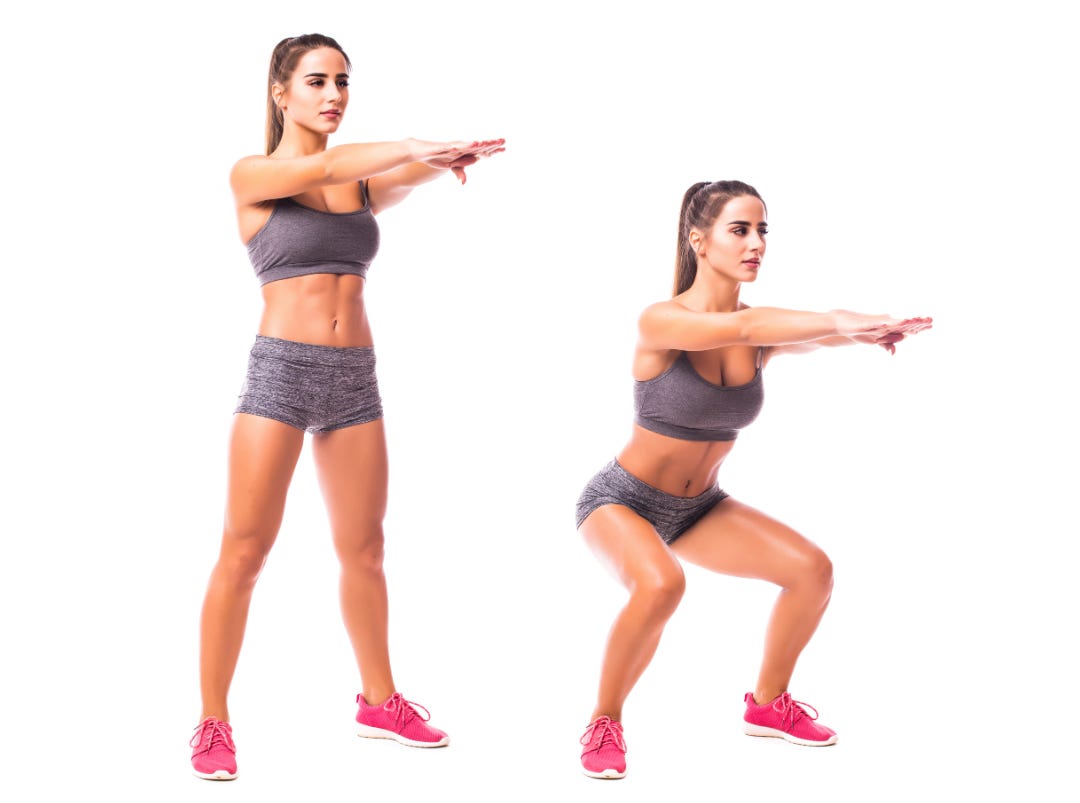
Now imagine a squat jump. The gluteal muscles, hamstrings, and quadriceps contract rapidly and in sequence to extend the hips, generating enough force to lift the body off the ground.
Running relies on this same movement pattern.
One way to think about running is as a series of controlled single-leg jumps, with each stride requiring the body to generate force and briefly become airborne. Each stride requires the coordinated extension of the hip, knee, and ankle—a movement known as triple extension.
Hip extension is the first link in that chain.
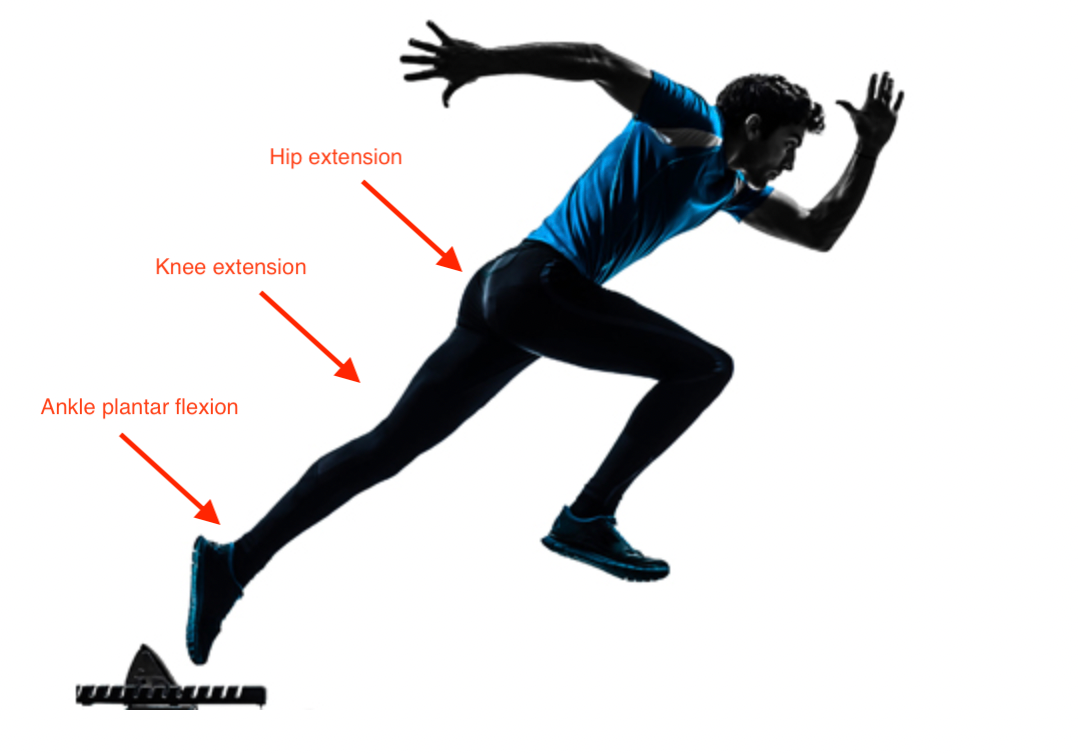
During push-off, the gluteal muscles and hamstrings generate force through the hip while the knee and ankle extend in sequence, helping propel the body forward. Efficient runners don’t simply move their legs faster—they transfer force into the ground more effectively. Hip extension plays a central role in making that happen.
This doesn’t mean that more hip extension automatically creates better running. Running economy depends on many factors, including cadence, posture, coordination, lower extremity stiffness, and force production. But without adequate strength and power at the hips, the push-off phase becomes less efficient and less force is available to propel the body forward.
For active adults, maintaining hip strength and power isn’t just about running. It also helps preserve stride quality, uphill walking ability, hiking performance, and the ability to accelerate when life unexpectedly asks you to.
If you’d like to learn more about the role of hip extension in running mechanics, check out these two articles: Improving Running Efficiency: Hip Extension and How Does Hip Extension Affect Your Running Technique?
Bottom Line
Every running stride begins with a powerful push into the ground. While many factors contribute to efficient running, hip extension is one of the fundamental movement patterns that helps generate forward propulsion.
Running may look effortless, but every stride is powered by a coordinated sequence of movements that begins at the hips. Understanding that simple concept can change the way you look at running—and the way you train for it.
This week’s workout develops hip extension through three movements: the kettlebell swing, box jump, and push press. As you watch the demo videos, pay attention to what they have in common. Although they look very different, each relies on the same powerful movement pattern—rapid hip extension—to generate force.
Warm Up
AMRAP 7 (As many rounds as possible in 7 minutes)
10 up-downs
10 air squats
10 easy push-ups (knees, toes or elevated on a stable box, bench or chair)
Movement Practice
Take 5-10 minutes to review the workout movement videos and options below and select your weights and movements for the workout.
The prescribed workout weight “RX” is noted below the workout for reference. These weights are for more advanced athletes. If you are a beginner or intermediate athlete, select movement options and weights that you can perform confidently where each set of 10 repetitions can be performed in no more than 2 sets with a brief rest in between. Once you have selected your weights/options, practice 3-5 repetitions of each movement in the order written in the workout to be sure you are comfortable with the flow between movements.
Movement options
Push Press (Alternative: dumbbell push press)
Kettlebell Swing (American) (Alternative: Swing to eye level; If no kettlebell, - Double dumbbell swing
Box Jump - (Alternative: Weighted box step-ups or dumbbell thrusters).
Workout
AMRAP 20 (As many rounds as possible in 20 minutes)
10 Push presses
10 Kettlebell Swings
10 Box jumps
Score: Number of completed rounds and repetitions.
(RX for women 75# barbell, 35# kettlebell, 20-inch box jump)
TIP! Manage fatigue by slowing down your repetitions. This allows you to achieve some “rest” while continuing to accumulate repetitions.
*Be sure to document your movement options and weight choices so that you can replicate the workout for your “re-test”.
Cool Down
As an expert in the hormonal physiology of the stress response system, I cannot overstate the importance of a thorough cool-down after an intense fitness benchmark workout. Yoga is my go-to because it promotes whole-body flexibility and mobility care as well as calming the mind and increasing the vagal tone needed for our stress response system to return to baseline.
Indulge yourself in this 15-minute full-body stretch yoga sequence to jumpstart your recovery! #dontskiptheyoga
This just dropped…..

Could you have PCOS and not know it? You sure can, says reproductive endocrinologist and menopause specialist Dr. Carla DiGirolamo, who is hopeful that the recent renaming of the condition from “polycystic ovary syndrome” (PCOS) to “polyendocrine metabolic ovarian syndrome” (PMOS) will help raise awareness—and improve care. This episode breaks down what PMOS actually is, why the new name matters, and how this androgen‑driven metabolic condition shows up across the lifespan, from irregular cycles and fertility struggles to increased cardiometabolic risk, especially once you hit the menopause transition. We also cover treatment options including metformin, inositol, and compelling new research on GLP‑1 receptor agonists, plus what all of this means for active midlife women when it comes to fueling, Reds/LEA risk, resistance training, and long‑term glucose control.
NOW TAKING MEDICAL CLIENTS FROM COLORADO, CONNECTICUT, AND NEW HAMPSHIRE!
..in addition to MA, NY, NJ, PA, CA, FL, OH
If you are an active woman or competitive midlife athlete who feels abandoned by mainstream medicine, I’m here for you!

Active and athletic midlife women have needs and risk profiles that are different from the general population. These needs often go unmet by the mainstream medical community due to a lack of understanding of fitness and sport and their impact on mid-life hormonal physiology or even a lack of acknowledgment that this dynamic exists.
To speak to this need, I launched my Telehealth Consultation Medical practice focusing on the Reproductive Endocrine needs and Menopausal Care for active, athletic, and high-performing women.
We put your health, fitness, and performance at the center of the equation so that you can achieve your healthiest, highest-performing self!
You will find all my service offerings on my website including a link to my calendar so that you can reserve your place in my schedule!
Squat-jump analogy is hepful. It clarified why hip extension matters for running. I'm going to trying thes workout with the box step-up alternative since I'm managing plantar fasciitis!