


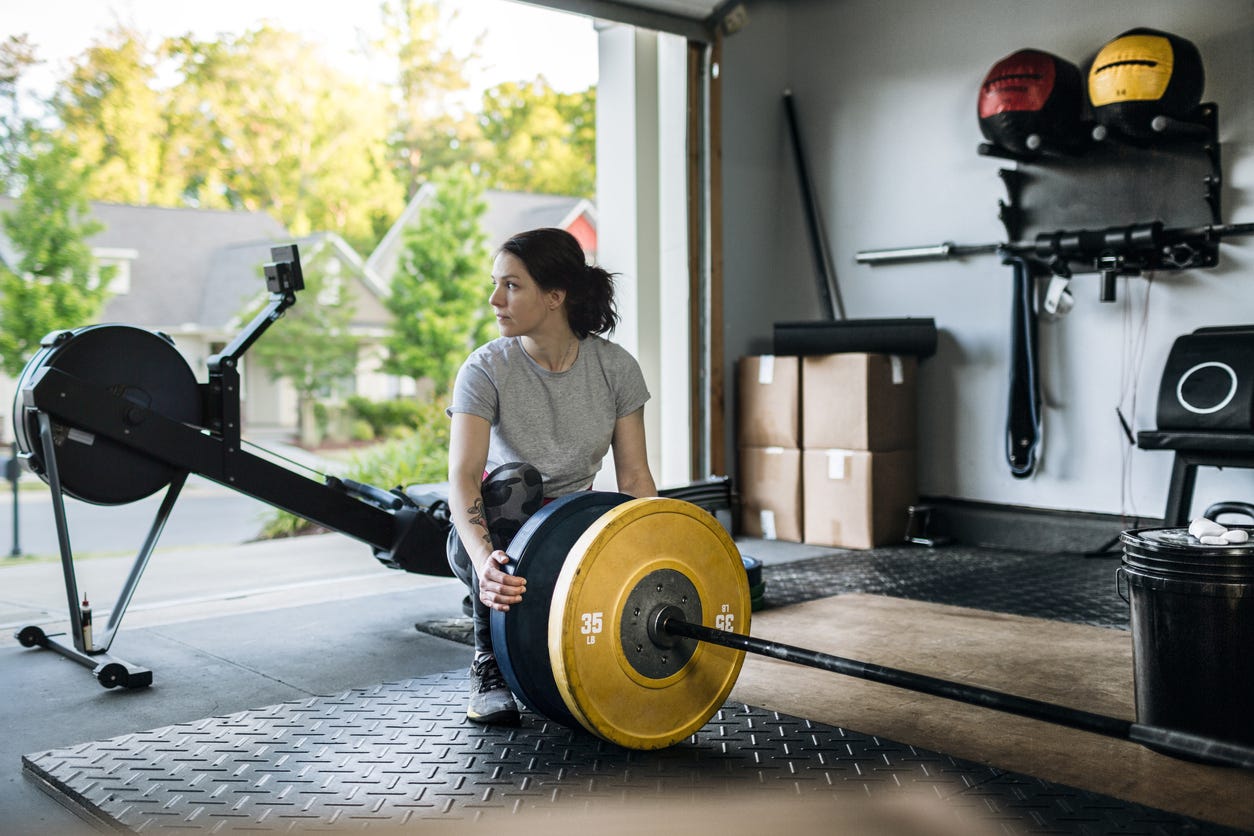
Hey Team! Welcome to another special edition of Athletic Aging, where I team up with Dr. Heather Hausenblas once again to discuss how training at home can be a great way for beginners to become familiar with weight training and serve as a bridge when other barriers prevent us from training with our fitness community. Enjoy this one! -Dr. Carla
In 2020, my gym closed. Like everyone, I adapted. I had no choice.
I cleared a corner of my garage, pulled up YouTube, and hit play. Bodyweight squats. Lunges. A lot of sweating in front of a laptop screen.
I tolerated it. I missed the gym. There was nowhere else to go.
Turns out, I wasn’t compromising as much as I thought.
For this one, I brought in Dr. Carla DiGirolamo again — she’s a physician, CrossFit trainer, and trains the way she prescribes. Here’s what we found.
Most people in the gym are guessing. A 2025 survey found that gym-goers correctly identified only 36% of basic resistance training facts.
Two myths most believed:
That men benefit more from lifting than women. They don’t — gains are similar.
That free weights beat machines for muscle growth. No meaningful difference.
More level than you’d expect.
The setting doesn’t matter much. The effort does.
The key driver of muscle growth is effort, not equipment. Heavier loads have a slight edge for maximum strength. But for most goals, how hard you push matters more than what you’re pushing.
The largest analysis of resistance training ever conducted — 137 systematic reviews, more than 30,000 participants — confirmed it. Resistance bands, free weights, bodyweight, home, gym. Equipment type didn’t consistently impact results.
Your garage qualifies.
The Real Barrier
The closer the gym, the more you go. Research consistently shows that easy access is one of the strongest predictors of whether people actually exercise. The program you do beats the perfect program you don’t.
For most people, home removes the biggest barrier: getting there.
But Community Matters
People who train with others stick with it longer. The research is consistent on this.
CrossFit figured this out early. During COVID, online fitness communities exploded. Many stuck around because the connection was real.
The home gym isn’t the end goal. For a lot of people, it’s where confidence gets built — before walking into a room full of people moving weight.
It’s a bridge.
And when life gets in the way — travel, bad weeks, no time — it’s what keeps the streak alive.
The Real Limitations
Home training works. But it has limits.
Progressive overload is harder. That means gradually adding more weight or resistance over time. Adding five pounds to a barbell is simple. Progressing a bodyweight squat means doing a harder version of it — like a single-leg squat.
Lower body is trickier. Bands alone don’t load the legs the way free weights do. Research shows lower muscle activation during band-only squats. Long-term, you need more. A kettlebell or adjustable dumbbells change that.
A trainer helps more than you think. A 2024 study found that trainer-guided training produced faster results, better injury prevention, and greater lower-body strength gains than solo training. You don’t need one every session — but following a structured program makes a real difference.
How to Set Up a Home Gym
You don’t need much. You need the right things.
If you only buy one thing: A single kettlebell. Squat, hinge, press, carry. Small space. Low cost. Surprisingly complete. Women, start at 12kg (26lb). Ready to be challenged? Go 16kg (35lb).
Starting out: Kettlebells — pairs of 5, 10, 15, and 20 pounds. A solid program. That’s it. Try Kettlebell Athletes.
Next level:
Adjustable dumbbells
Step box (6–18 inches)
Doorway pull-up bar + resistance bands
Jump rope
Flat bench
Advanced: All of the above, plus an Olympic barbell set and squat rack.
Programs Worth Knowing
Street Parking — Fitness for real life
Empower — Training for every stage of life
Power Happens — Built for midlife women
Athletic Aging Weekly Workout Series — Dr. Carla DiGirolamo
What the Research Recommends
The 2026 ACSM position stand is specific:
At least twice a week
2–3 sets per exercise
Heavy enough that you can only do 6–10 reps
Hit all major muscle groups
Stop 2–3 reps short of failure — grinding to failure doesn’t improve results and raises injury risk
Add load over time — whatever that looks like in your space
The zip code is optional.
The Bottom Line
Home or gym. Doesn’t matter much. Just lift.
References
https://pubmed.ncbi.nlm.nih.gov/39870800/
https://pubmed.ncbi.nlm.nih.gov/37133323/
https://pubmed.ncbi.nlm.nih.gov/37582807/
https://pmc.ncbi.nlm.nih.gov/articles/PMC8449772/
https://www.sciencedirect.com/science/article/pii/S2405844024046474
About the Co-Author:
Heather Hausenblas, PhD, is a health researcher, award-winning scientist, and best-selling author. She's ranked in the top 1% of the world’s most influential researchers. Her Substack, Wellness Discovery, is for people who want real health—grounded in science.
TAKING NEW CLIENTS!

If you are an active woman or competitive midlife athlete who feels abandoned by mainstream medicine, I’m here for you!
It is with great excitement that after more than 2 years of preparation, I have FINALLY launched my Telehealth Consultation Medical practice focusing on the Reproductive Endocrine needs and Menopausal Care for active, athletic, and high-performing women.
Active and athletic midlife women have needs and risk profiles that are different from the general population. These needs often go unmet by the mainstream medical community due to a lack of understanding of fitness and sport and their impact on mid-life hormonal physiology or even a lack of acknowledgment that this dynamic exists. We put your health, fitness, and performance at the center of the equation so that you can achieve your healthiest, highest-performing self!
You will find all my service offerings on my website, including a link to my calendar so that you can reserve your place in my schedule online! Looking for a more Human encounter? Call Mary, my awesome and amazing assistant at 754-262-5674 (M-F 9a-5p ET)
In case you missed it……
The Menopause Muscle Continuum….
Does the menopause transition directly impact muscle health and physiology?
This has been the subject of some very intense discussion recently. Join me and the awesome and amazing Selene Yeager for Hit Play Not Pause Episode 253 where we take a deep dive into the science behind this debate.

Hi Bryan... yes, the bridge is key.... even for me, with 4 years of CrossFit under my belt in 2020, the COVID isolation to my home gym allowed me to dial in on my olympic lifting mechanics and get stronger and more efficient in these lifts before going back into the CrossFIt community post covid. So many ways to bridge! Thanks so much for your comment and for reading! :)
Dark Horse rowing is THE reason why, at 55 yrs old, 5'4, and 130# I can actually keep up with the best of them in the CrossFit gym! If you don't have the physicality, technique is King and I got that from all the videos I watched for years from them. So glad they are still going strong!!! I highly recommend a Concept 2 rower for anyone's home gym - beginner or advanced. Thanks so much for comment and for reading!!! -Dr. Carla