

We spend a lot of time (and for good reason) talking about strength training. This week, I want to review something equally important for health, longevity, and performance: high-intensity interval training (HIIT).
What Is HIIT?
HIIT is a form of cardiovascular exercise that alternates:
Short bursts of near-maximal effort
With periods of low-intensity recovery or rest
A typical HIIT session may involve working at:
≥80–90% of maximum heart rate
or ≥85% of VO₂max
for intervals lasting from ~30 seconds to several minutes, repeated multiple times.
Unlike steady-state endurance exercise, HIIT produces repeated metabolic stress that stimulates muscular and cardiovascular adaptations in a relatively short amount of time.
How HIIT Works: The Physiology
1. Improved Mitochondrial Function
Mitochondria are the “batteries” that power all of the cells in our body. During exercise, mitochondrial function is critical for effectively meeting the physical challenge.
HIIT activates cellular signaling pathways that stimulate mitochondrial biogenesis — essentially increasing both the number and function of mitochondria in muscle cells.
This improves:
Aerobic energy production
Fat oxidation
Metabolic flexibility
(Burgomaster et al., 2008; Gibala et al., 2012)
2. Increased Skeletal Muscle Glucose Uptake
HIIT improves insulin sensitivity through:
Increased GLUT-4 transporter expression (Estrogen INDEPENDANT pathway)
Enhanced glycogen (storage form of glucose) storage capacity
Improved muscle capillary density
3. Reduction in Visceral Adipose Tissue
Visceral fat — the deep abdominal fat that tends to increase during perimenopause — is strongly associated with:
Cardiovascular disease
Chronic inflammation
Metabolic syndrome
HIIT increases:
Catecholamine release
Growth hormone response
Lipolytic enzyme activity
leading to increased mobilization of fatty acids from visceral adipose tissue.
4. Improved Cardiovascular Efficiency
HIIT improves:
Stroke volume (The amount of blood the heart pumps with each beat)
Endothelial (lining of the blood vessels) function
VO₂max
often more effectively than moderate-intensity continuous training.
Implications for Hormone Health
Glucose Control: Randomized controlled trials show that postmenopausal women can significantly improve peripheral insulin sensitivity after ~12 weeks of high-intensity exercise training — to the same extent as premenopausal women.
Body Composition: Randomized trials in postmenopausal women demonstrate that HIIT performed three times per week for 12 weeks produces:
Significant reductions in total body fat
Greater reductions in visceral adiposity than moderate continuous training
Improvements in inflammatory markers
Heart Health: HIIT improves cardiovascular efficiency often more effectively than moderate-intensity continuous training. This is especially important because menopause is associated with accelerated decline in cardiorespiratory fitness and increased cardiovascular risk.
Worried About “Cortisol”? - Don’t. To make gains in your physical fitness, you need to push limits. This requires activation of your “fight or flight” response system (Sympathetic Nervous System) - This is what Mother Nature designed this endocrine system to do for the survival of the Human race. But what’s essential is the cool-down and recovery. To learn more about the truth behind cortisol and why it’s your friend, check out: Stop Demonizing Cortisol from the Athletic Aging archives.
References
Burgomaster, K. A., Howarth, K. R., Phillips, S. M., Rakobowchuk, M., MacDonald, M. J., McGee, S. L., & Gibala, M. J. (2008).
Sprint interval training increases muscle oxidative capacity and endurance performance in humans. The Journal of Physiology, 586(1), 151–160.
https://pubmed.ncbi.nlm.nih.gov/17991697/
Gibala, M. J., Little, J. P., Macdonald, M. J., & Hawley, J. A. (2012).
Physiological adaptations to low-volume, high-intensity interval training in health and disease. The Journal of Physiology, 590(5), 1077–1084.
https://pubmed.ncbi.nlm.nih.gov/22289907/
Ramos, J. S., Dalleck, L. C., Tjonna, A. E., Beetham, K. S., & Coombes, J. S. (2017).
The impact of high-intensity interval training versus moderate-intensity continuous training on vascular function: A systematic review and meta-analysis. Journal of Clinical Endocrinology & Metabolism.
https://pubmed.ncbi.nlm.nih.gov/28953212/
Nunes, P. R. P., Martins, F. M., Souza, A. P., et al. (2019).
Effect of high-intensity interval training on body composition and inflammatory markers in obese postmenopausal women: A randomized controlled trial. Menopause, 26(3), 256–264.
https://pubmed.ncbi.nlm.nih.gov/30277921/
Weston, K. S., Wisloff, U., & Coombes, J. S. (2014).
High-intensity interval training in patients with lifestyle-induced cardiometabolic disease: A systematic review and meta-analysis. British Journal of Sports Medicine, 48(16), 1227–1234.
https://pubmed.ncbi.nlm.nih.gov/24144531/
Dupuit, M., Maillard, F., Pereira, B., et al. (2020).
Effect of high-intensity interval training on body composition in women before and after menopause: A meta-analysis. Experimental Physiology, 105(9), 1470–1490.
https://pubmed.ncbi.nlm.nih.gov/32613697/
This week’s workout is a modification of a Mahem-inspired sequence that I did, myself, at CrossFit Pompano Beach. It is a classic HIIT workout with 1:15 - 1:30 of near maximal effort work with 1:00 of rest in between, for 7 rounds. I did this workout earlier this week
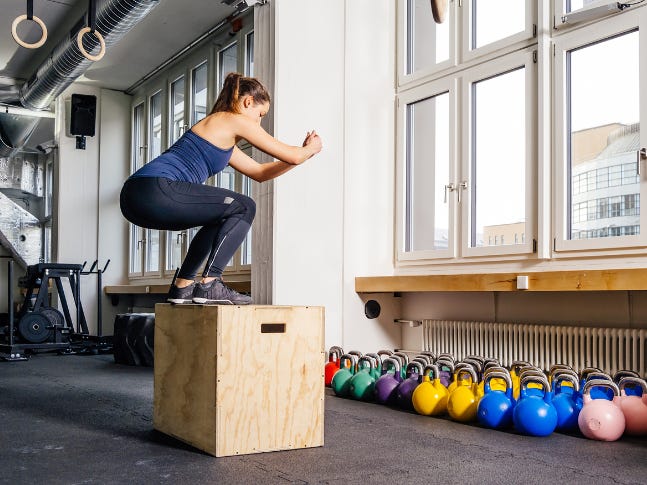
But here’s the twist: The movements that achieve this stimulus also build bone (plyometrics), muscle power (box jump), and nervous system coordination (double unders) - this is not just sprint intervals on a bike or other singular movement. While monostructural (single movement) HIIT is effective, coordinating different movements that target strength and plyometrics adds another level of stimulus.
The box height and weights noted in the workout section are designed for the intermediate to advanced athlete. As always, there are movement options for all fitness levels, so pick what works best for you.
Warm Up
AMRAP 7 minutes (As many rounds as possible in 7 minutes)
5 Up downs
10 Mountain climbers (right + left = 1 repetition)
10 Air squats
20 single under jump rope (or movement substitution)
10 good mornings (no weight) -** You should feel your hamstrings engaging.
Movement Practice
Movement Substitutions
Box jumps - Substitute jumping air squats or dumbbell thrusters (moderately weight where the 7 repetitions can be done unbroken)
Kettlebell swings - Substitute single or double dumbbell swing. Swing to eye level (Russian swing) instead of overhead (American swing).
Double unders - Substitute 45 single unders or 5 burpees
** The working rounds are SPRINTS. These are near maximal effort at an RPE 8-9. When selecting your options, ensure that the time it takes to do 1 round of the workout is no longer than 1:20.
Take 5-10 minutes to select your movement options. Select options where the goal is to complete all sets unbroken for all 7 rounds. (Except for some occasional trip-ups on the jump rope).
Workout
7 Rounds
7 box jumps (20-24 inches)
14 kettlebell swings (25-35 lbs, American swing)
21 or 28 double unders
Rest 1:00 between sets
SCORE: Total time (including rest) to complete all 7 rounds.
Cool Down
Because HIIT workouts require multiple rounds of near-maximal effort, your musculoskeletal, cardiovascular, and nervous systems will be firing on all cylinders. I cannot overstate how ESSENTIAL an effective cool-down is for recovery, stress management, and staying safe from injury. Enjoy this 25 minute restorative yoga stretch session from Five Parks
25-minute Stretch and Release Restorative Yoga by Five Parks
TAKING NEW CLIENTS!

If you are an active woman or competitive midlife athlete who feels abandoned by mainstream medicine, I’m here for you!
It is with great excitement that after more than 2 years of preparation, I have FINALLY launched my Telehealth Consultation Medical practice focusing on the Reproductive Endocrine needs and Menopausal Care for active, athletic, and high-performing women.
Active and athletic midlife women have needs and risk profiles that are different from the general population. These needs often go unmet by the mainstream medical community due to a lack of understanding of fitness and sport and their impact on mid-life hormonal physiology or even a lack of acknowledgment that this dynamic exists. We put your health, fitness, and performance at the center of the equation so that you can achieve your healthiest, highest-performing self!
You will find all my service offerings on my website, including a link to my calendar so that you can reserve your place in my schedule online! Looking for a more Human encounter? Call Mary, my awesome and amazing assistant at 754-262-5674 (M-F 9a-5p ET)
This Just Dropped……
Hard Conversations in the Menopause Transition: Hormones, Testing, GLP-1s and what’s “Ideal” Now
This week we welcome back our resident reproductive endocrinologist and menopause specialist, Dr. Carla DiGirolamo, for another candid conversation. We pull back the curtain on Carla’s own menopause experience—how she navigates her symptoms, what she’s learned, and what she practices herself. We also dig into the hard conversations so many of us are having as we navigate this ever-evolving space, and how years of working closely with active midlife women have shaped her thinking on hormone therapy, GLP-1 medications, testosterone, hormone testing, and what actually moves the needle for athletic women in the transition.
Hi Suzanne... thank you for your comment and for reading. Yes, you are absolutely correct that there are risks to every intervention and every THING that we do, and your comment is a great reminder to everyone that the "risk" part of the equation is important to consider every time we start a training session. The risks from training are typically from doing movements inappropriately, insufficient warm-up and cool-down and training beyond your fitness abilities. To speak to all of these risks, I provide a warm-up which is not just the 7 minute AMRAP, but also the movement practice... and just like with any fitness program, CrossFit or fitness class with structure, if anyone feels they need additional warm-up, they can take whatever time they need to do that. There are movement videos in every single one of my posts to demonstrate proper technique as well as multiple options for a wide range of fitness levels and limitations. And yes, the cool-down is a 22 minute yoga segment because activating the parasympathetic nervous system after sub-maximal efforts is essential... and if you want more information on the physiology of the endocrine systems that involve cortisol, I have linked a post that goes into depth about this. So, although I do not explicitly state the risks of HIIT training in this post, I do go to great lengths to help mitigate the risks that go along with any structured exercise program. Thank you again for the reminder for all of us of the importance of risk mitigation during training.
This is my first comment, And it’s my first thought on reading this: where are the downsides to HIIT? There is a long list of benefits and an assurance to not worry about cortisol. Every intervention has risks, something that can go wrong and harm. Benefit/Risk analysis should be in every review or, like this piece, sales pitch. I’m not a doctor, so don’t take my medical advice. But what leaps out at me are strains and pulls. The “warm up” was 7 minutes of high energy actions. And, just to be snarky, HIIT is often touted for a person’s ability to not have to spend 30 - 60 minutes at the gym. But you are suggesting a 45 minute cool down, medication and yoga??? So much for time conservation.