

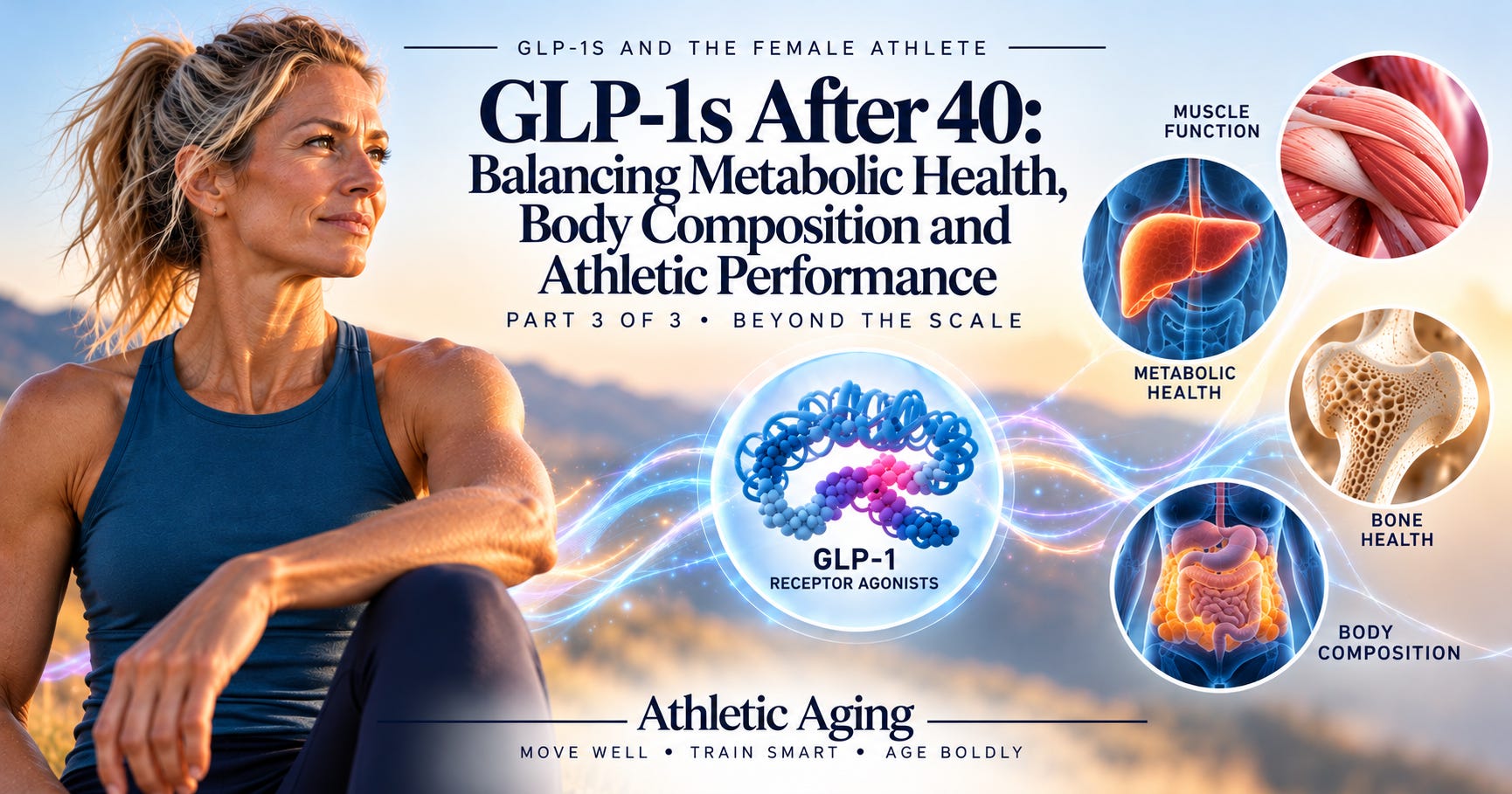
Throughout this series, we’ve explored how GLP-1 receptor agonists intersect with the physiologic demands of female athletes, from energy availability and fueling to the preservation of muscle, bone and athletic performance.
For women over 40, the hormonal and metabolic changes of the menopause transition add another layer of complexity to decisions about GLP-1 therapy. Understanding these changes is essential to balancing metabolic health with the demands of training and long-term athletic function.
Menopause changes the metabolic landscape
During perimenopause and menopause, declining estrogen levels contribute to changes in body composition, including increased visceral adiposity, as well as impacts on skeletal muscle mass and function, bone remodeling, and glucose regulation.
For some midlife women, GLP-1 receptor agonists may offer meaningful benefits when obesity or other metabolic indications are present. Improvements in weight, glycemic regulation and cardiometabolic risk can contribute to long-term health.
However, the clinical priorities of an athletic woman may extend beyond weight reduction.
Preserving skeletal muscle, supporting bone health, maintaining adequate energy availability and sustaining training capacity are equally important considerations.
And while the benefits of GLP-1 therapies have been demonstrated in several metabolic populations, studies specifically examining their use in menopausal athletes remain lacking.
When body weight doesn’t tell the whole story
Body mass index (BMI) does not fully capture body composition or metabolic health, particularly in athletic populations. A normal BMI does not necessarily exclude metabolic dysfunction, just as a higher BMI does not necessarily reflect poor metabolic health.
However, identifying metabolic concerns and determining whether GLP-1 therapy is appropriate are separate clinical considerations. Most clinical trials supporting GLP-1 medications for weight management have enrolled relatively sedentary individuals with overweight or obesity, leaving important evidence gaps regarding their use in female athletes with normal metabolic function.
This distinction is particularly relevant when GLP-1 medications are being considered for body-composition optimization or athletic performance rather than established medical indications.
What about microdosing?
The growing interest in using very low doses of GLP-1 medications introduces another area of uncertainty.
The concept of “microdosing” is sometimes presented as a way to achieve modest appetite suppression or body-composition changes while potentially minimizing adverse effects.
However, there are no clinical trials establishing the safety or effectiveness of GLP-1 microdosing in normal-BMI athletes.
Evidence from lower-dose regimens studied in other populations cannot simply be extrapolated to lean, highly active women with different nutritional and physiologic demands.
Without these data, we cannot determine whether such approaches provide meaningful benefits or introduce risks that outweigh them.
An individualized approach for the midlife athlete
For an athletic woman considering or using GLP-1 therapy, the discussion should begin with the clinical indication and the individual’s broader health and performance goals.
Important considerations include metabolic health, body composition, training volume, nutritional intake, recovery, skeletal health and the potential for low energy availability.
When treatment is appropriately indicated, monitoring should extend beyond changes in body weight to include whether the individual is maintaining adequate fueling, strength, physical function and training capacity.
Resistance training, appropriate skeletal loading and sufficient protein and total energy intake remain important components of preserving muscle and bone health during midlife, but especially if an athlete has chosen to use GLP-1 therapy.
These principles are supported by broader exercise and nutrition research, although specific GLP-1 treatment and monitoring protocols for midlife female athletes have not been established.
The Bottom Line
GLP-1 receptor agonists represent an important advance in the treatment of obesity and metabolic disease. Their potential benefits should not be dismissed simply because a woman is physically active or participates in competitive athletics.
At the same time, athletic women have physiologic demands and performance goals that are not adequately represented in existing clinical trials.
The question is not whether GLP-1 medications are inherently good or bad for female athletes. It is whether their use has a clinical indication and how their potential benefits can be balanced with the demands of training, recovery, and long-term musculoskeletal health.
For women over 40, successful aging is not defined by body weight alone. It is reflected in the preservation of metabolic health, strength, skeletal integrity, and the physical capacity to continue doing the activities we value.
Beyond the scale, the goal is not simply to weigh less. It is to remain healthy, strong, and capable for the years ahead.
This just dropped…..

Check out my latest article published with CrossFit.com where I review the current peer-reviewed literature about how menopause impacts muscles, bones, and metabolism, and what types of training have been shown to benefit women in this stage of life.
NOW TAKING MEDICAL CLIENTS FROM COLORADO, CONNECTICUT, AND NEW HAMPSHIRE!
..in addition to MA, NY, NJ, PA, CA, FL, OH
If you are an active woman or competitive midlife athlete who feels abandoned by mainstream medicine, I’m here for you!

Active and athletic midlife women have needs and risk profiles that are different from the general population. These needs often go unmet by the mainstream medical community due to a lack of understanding of fitness and sport and their impact on mid-life hormonal physiology or even a lack of acknowledgment that this dynamic exists.
To speak to this need, I launched my Telehealth Consultation Medical practice focusing on the Reproductive Endocrine needs and Menopausal Care for active, athletic, and high-performing women.
We put your health, fitness, and performance at the center of the equation so that you can achieve your healthiest, highest-performing self!
You will find all my service offerings on my website including a link to my calendar so that you can reserve your place in my schedule!