

My Friends!
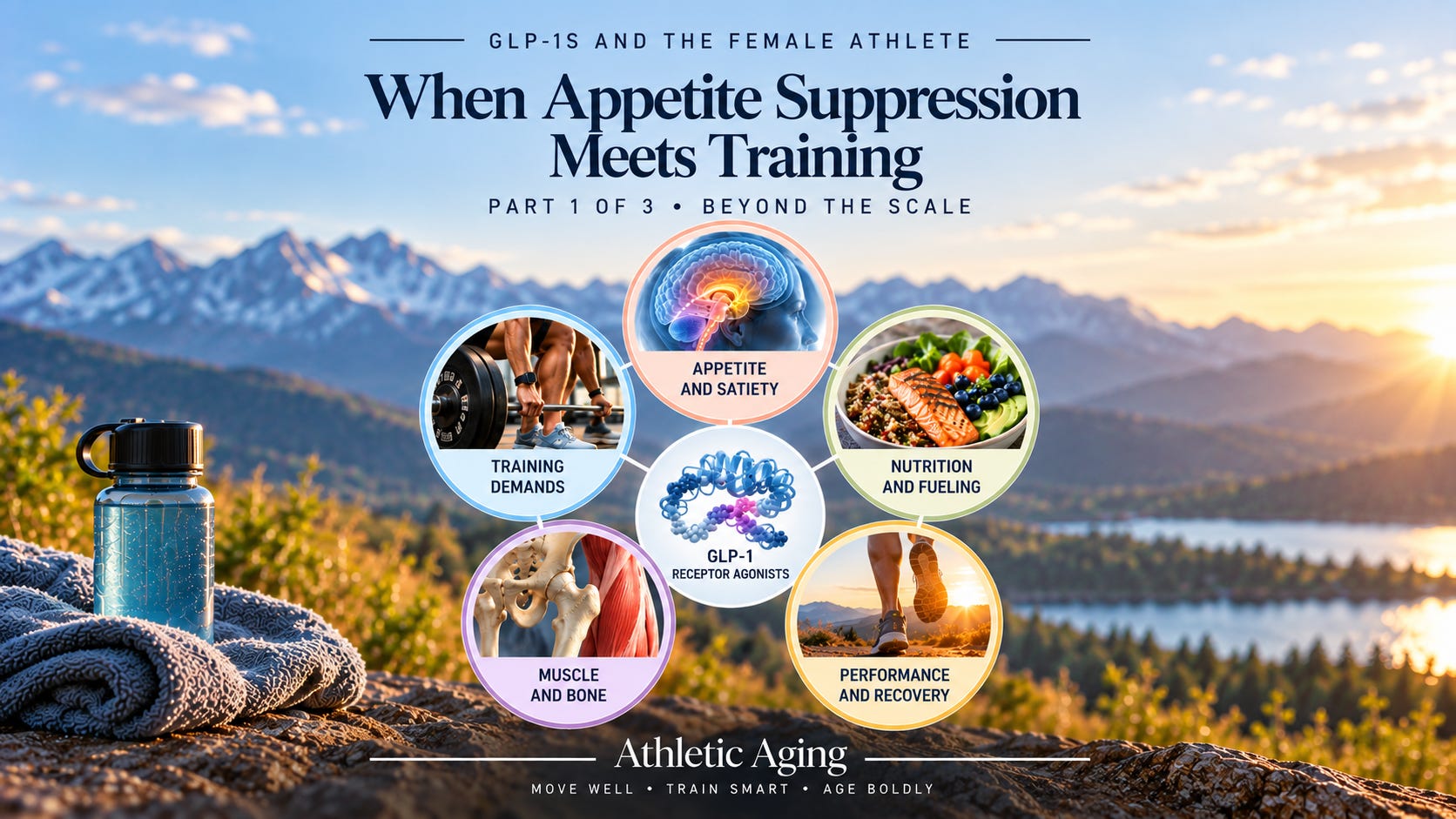
This is a topic that has been getting a lot of attention in the athlete space, and we are going to review it here. My goal is to present you with unbiased, evidence-based information on this topic that cuts through all the social media noise. Join me for Part 1 of this 3-part series.
Enjoy!
-Dr. Carla
GLP-1 receptor agonists have transformed the treatment of obesity and metabolic disease. By acting on pathways involved in glucose regulation, gastric emptying and appetite, these medications can produce substantial weight loss and meaningful improvements in metabolic health.
But what happens when the person taking them is also an athlete?
That question is surprisingly difficult to answer. Despite the rapidly expanding use of GLP-1 receptor agonists, there are currently no published studies specifically investigating their use in female athletes. We also have no studies specifically examining normal-BMI athletes and no athlete-specific data addressing VO₂max, power, sport performance, body-composition optimization or the risk of Relative Energy Deficiency in Sport (RED-S).
Most of what we know comes from populations with overweight, obesity or diabetes—populations whose metabolic, nutritional and training demands may look very different from those of an active or competitive woman.
For the female athlete, one particular effect of these medications deserves more attention: appetite suppression.
Training changes the energy equation
Exercise increases the body’s energy demands, and those demands rise with training volume, intensity and duration. For an athlete, energy needs can also fluctuate considerably from day to day depending on the training stimulus, making adequate and responsive fueling an important part of supporting both performance and recovery.
Normally, food intake can increase in response to those demands. But GLP-1–based medications are specifically designed to reduce appetite and increase satiety. They may also produce nausea, early fullness or other gastrointestinal symptoms that make eating more difficult.
For someone trying to lose weight, eating less is part of the therapeutic effect. For someone simultaneously asking her body to train, recover, build muscle and maintain bone, however, the equation becomes more complicated.
The concern isn’t simply weight loss. It is whether energy intake remains sufficient to support both exercise and normal physiology.
Enter energy availability
This is where the concept of energy availability becomes important.
Energy availability describes the amount of dietary energy remaining for normal physiologic functions after accounting for the energy expended during exercise. When intake becomes insufficient relative to training demands, an athlete can develop low energy availability (LEA).
Importantly, LEA doesn’t require an eating disorder or intentional food restriction. Athletes can simply under-fuel because training demands increase faster than food intake—or because appetite doesn’t adequately reflect how much energy they actually need.
Pharmacologic appetite suppression introduces another potential pathway to that mismatch.
When energy availability becomes sufficiently low, the body begins adapting to conserve resources. Research on LEA has demonstrated changes in endocrine signaling, impaired bone formation, altered substrate availability and reduced protein synthesis. Prolonged or substantial LEA can contribute to the broader clinical syndrome known as Relative Energy Deficiency in Sport, or RED-S, which can affect multiple physiologic systems as well as athletic performance.
This doesn’t mean that GLP-1 medications cause RED-S. We don’t have evidence demonstrating that.
But it does raise an important question.
What happens when pharmacologic appetite suppression is layered onto a physiology already vulnerable to inadequate energy availability?
Why this may matter even more after 40
For the midlife female athlete, adequate fueling becomes particularly important.
Maintaining skeletal muscle, supporting bone health and recovering from training are already priorities as women navigate the physiologic changes of perimenopause and menopause. The goal of training during this stage of life isn’t simply to burn calories. We are asking exercise to provide the mechanical and metabolic stimulus necessary to preserve—or ideally build—muscle, strength, power, cardiorespiratory fitness and skeletal resilience.
Those adaptations require resources.
An athlete can perform all the “right” training, but the body still needs sufficient energy and nutrients to respond to that stimulus. If appetite suppression makes it difficult to meet those needs, the intended benefit of training could potentially become harder to achieve.
That doesn’t mean that an athletic woman should never use a GLP-1–based medication. These medications can provide substantial health benefits when appropriately indicated.
It means that the therapeutic goal may need to look different in an athlete. The number on the scale cannot be the only outcome that matters.
The Bottom Line
GLP-1 medications and exercise are not inherently incompatible. But athletes bring a variable to the equation that traditional weight-loss studies weren’t designed to address: the energetic demands of training.
For the female athlete using a GLP-1–based medication, the important question isn’t simply, “Am I losing weight?”
It is also:
Am I eating enough to support the work I’m asking my body to do?
That means paying attention not only to weight, but also to fueling, recovery, training quality, strength, performance and other potential signs that energy availability may be inadequate.
And it leads us to the next question in this series: When weight is lost, what exactly are we losing?
In Part 2, we’ll look beyond the scale at what GLP-1–associated weight loss may mean for muscle, bone and athletic performance.
NOW TAKING MEDICAL CLIENTS FROM COLORADO, CONNECTICUT, AND NEW HAMPSHIRE!
..in addition to MA, NY, NJ, PA, CA, FL, OH
If you are an active woman or competitive midlife athlete who feels abandoned by mainstream medicine, I’m here for you!

Active and athletic midlife women have needs and risk profiles that are different from the general population. These needs often go unmet by the mainstream medical community due to a lack of understanding of fitness and sport and their impact on mid-life hormonal physiology or even a lack of acknowledgment that this dynamic exists.
To speak to this need, I launched my Telehealth Consultation Medical practice focusing on the Reproductive Endocrine needs and Menopausal Care for active, athletic, and high-performing women.
We put your health, fitness, and performance at the center of the equation so that you can achieve your healthiest, highest-performing self!
You will find all my service offerings on my website including a link to my calendar so that you can reserve your place in my schedule!