


Strength helps us move.
Power helps us move quickly.
And as we age, power declines faster than strength, making it one of the most important qualities to train if we want to remain athletic for decades to come.
The box jump is one of the simplest ways to develop lower-body power. Far more than “jumping onto a box,” it teaches the body to produce force rapidly through explosive hip extension while improving coordination, balance, and confidence.
Why It Matters
For active women, power training offers benefits that extend well beyond the gym.
Research shows explosive training can improve:
Lower-body power and rate of force development
Balance and neuromuscular coordination
Functional performance in daily activities
Athletic performance for hiking, pickleball, tennis, skiing, CrossFit®, and running
The impact created during jumping and landing also provides mechanical loading that helps stimulate bone remodeling—an important consideration as bone density naturally declines after menopause.
How to Perform the Box Jump
Stand facing a stable box with your feet about hip-width apart.
Begin with a small hip hinge while swinging your arms naturally behind you. Drive explosively through the hips, knees, and ankles, using your arms to help generate upward momentum.
Land softly with your entire foot on the box, knees tracking over your toes and hips slightly bent to absorb the landing. Stand fully before stepping back to the floor under control.
The goal isn’t to jump onto the highest box possible—it’s to move with speed, control, and confidence.
Safety & Modifications
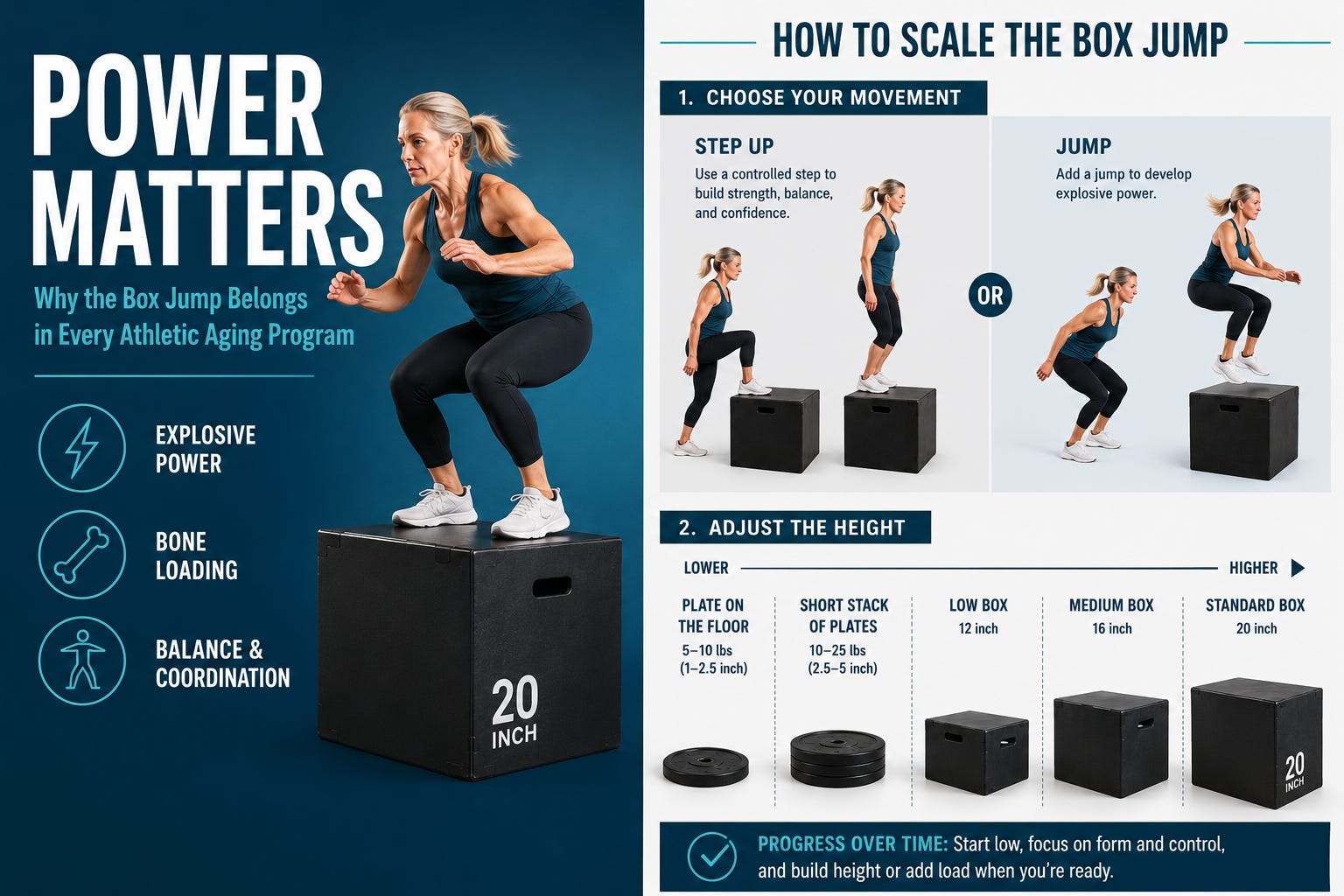
Power training should always match your current abilities.
If jumping isn’t appropriate yet, perform step-ups instead. Focus on a strong, controlled drive through the working leg, and progress by adding a dumbbell or kettlebell as your strength improves.
You can also adjust the challenge by changing the height of the target. Start with a single 45-pound bumper plate or a short stack of plates before progressing to a low box and eventually a standard-height box.
Choose a height that allows you to land softly without having to pull your knees excessively toward your chest. If your landing becomes noisy or your technique deteriorates, reduce the height or return to stepping until your power and confidence improve.
Remember: quality always comes before height.
The Bottom Line
The box jump isn’t about proving how fearless you are.
It’s about preserving one of the physical qualities we lose most rapidly with age: power.
Whether you’re stepping onto a plate or confidently jumping to a higher box, you’re training the same movement pattern. Progress gradually, prioritize good mechanics, and remember:
The goal isn’t the highest box. It’s building the power to keep doing the things you love for decades to come.
I was inspired to write about the box jump this week because I have spent some time doing them at my own CrossFit gym, CrossFit Peacedale. It has reminded me of what a key longevity hack this simple movement is, because it targets power and plyometrics in one, simple movement and is infinitely scalable for every fitness level. Enjoy this week’s workout!
Warm Up
AMRAP 7 Perform each movement in sequence for as many rounds of the 3 movements as you can in 7 minutes.
10 air squats
10 light kettlebell swings
10 box step-ups
Movement Practice
Take 5-10 minutes to select weights/options and practice the movements you will do for the workout. Select options/weights that allow you to confidently do 5-10 repetitions unbroken.
For the box jump, select a STABLE box or stack of plates at a height where you can confidently jump and move at a steady pace with only a couple of breaths of rest after 5-10 repetitions. For experienced athletes, the suggested box height is 20 inches (50 cm).
If jumping onto an object at any height is a limitation, perform box step-ups instead. You can choose to hold a pair of light dumbbells or kettlebells for some extra intensity, or simply use your body weight.
For the kettlebell swing, select a moderately heavy weight and swing to eye level (“Russian”-style swing). For experienced athletes, the recommended kettlebell weight is 35 lbs (16kg).
For the single arm overhead alternating lunge. Select a weight that allows you to do 10 total repetitions (5 each side) unbroken. If this movement is new to you or challenging, select a light object to hold overhead such as a shoe or a can of beans. Holding a single arm in this position is more important than the weight used. For experienced athletes, the recommended dumbbell weight is 20-25lbs (12-14kg)
Movement Alternatives
Box jump alternative: Squat jump for height is a great option if you can jump but are not comfortable jumping onto an object. Otherwise, a box step-up as described above is another appropriate scale.
Kettlebell swing alternative: Double dumbbell swing. If you have a barbell and are proficient with Olympic weightlifting, substitute a hang power clean.
Single arm overhead alternating lunge: If holding a single arm without weight overhead is not accessible to you, perform the alternating lunges holding a single dumbbell by your side, switching arms as needed.
Workout
AMRAP 16 (As many rounds as possible in 16 minutes)
Repetition scheme: 2-4-6-8…. and so on adding 2 repetitions per round.
HOW TO: Perform 2 box jumps, 2 overhead lunges, 2 kettlebell swings, then 4 box jumps, 4 overhead lunges, 4 kettlebell swings, then 6 box jumps, and so on. Continue with as many rounds as you can on a 16-minute clock. Your score is the total rounds and repetitions. (Ex: completed the round of 14 and 15 repetitions into the round of 16.)
Box jumps
Single overhead dumbbell alternating lunges (Switch arms as needed. Alternate legs with each repetition)
Kettlebell swings
Cool Down
Show your hips and legs some love with this 20-minute Yoga Flow for Hips from Yoga with Adriene. The best results gained from training start with recovery. #dontskiptheyoga.
NOW TAKING MEDICAL CLIENTS FROM COLORADO, CONNECTICUT, AND NEW HAMPSHIRE!
..in addition to MA, NY, NJ, PA, CA, FL, OH
If you are an active woman or competitive midlife athlete who feels abandoned by mainstream medicine, I’m here for you!

Active and athletic midlife women have needs and risk profiles that are different from the general population. These needs often go unmet by the mainstream medical community due to a lack of understanding of fitness and sport and their impact on mid-life hormonal physiology or even a lack of acknowledgment that this dynamic exists.
To speak to this need, I launched my Telehealth Consultation Medical practice focusing on the Reproductive Endocrine needs and Menopausal Care for active, athletic, and high-performing women.
We put your health, fitness, and performance at the center of the equation so that you can achieve your healthiest, highest-performing self!
You will find all my service offerings on my website including a link to my calendar so that you can reserve your place in my schedule!
I love these simple exercises. Are these good for osteoporosis and osteopenia?
Hi Carla - Box jumps are underrated for exactly this reason. Power fades faster than strength, but nobody trains for it. Adding step-ups as makes this usable for where people are, not just the fittest reader. Trying this at my own gym this week. As always, great info - Heather