

Most exercises challenge us evenly.
A barbell squat loads both legs equally. A bench press uses both arms together.
But life rarely does.
You carry a suitcase in one hand. Reach overhead to place luggage in an overhead bin. Walk across uneven ground while carrying groceries. Catch yourself after a stumble on one leg before the other.
These everyday moments require your body to stabilize against forces that want to pull you out of position—not simply produce force.
That ability to resist movement is one of the hallmarks of functional strength, and it becomes increasingly important as we age.
One of the simplest—and most effective—ways to train it is the single-arm farmer carry, also known as the suitcase carry.
What is the suitcase carry?
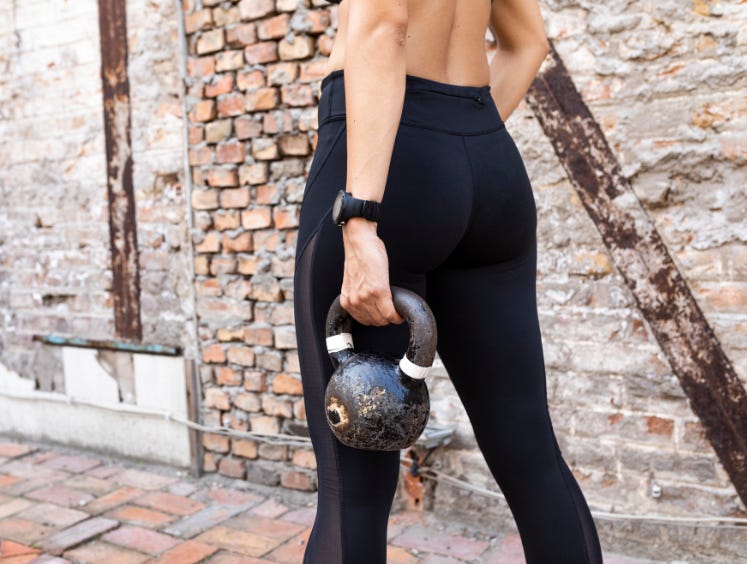
The suitcase carry is exactly what it sounds like: hold a dumbbell or kettlebell in one hand at your side and walk.
Because the weight is carried on only one side, your body naturally wants to lean toward it. Your core, hips, shoulders, and legs must work together to keep you upright.
This is known as asymmetrical loading. Rather than simply producing force, your muscles learn to resist unwanted movement—an essential skill for both athletic performance and everyday life.
Why it matters
Research shows that asymmetrical exercises can improve much more than strength alone. They challenge the muscles responsible for posture and stability while enhancing balance, coordination, and single-leg control.
The suitcase carry also develops grip strength, which has emerged as one of the strongest indicators of healthy aging and long-term physical function.
Perhaps most importantly, asymmetrical training exposes side-to-side differences that often go unnoticed during traditional bilateral exercises. Identifying and improving these imbalances can enhance movement efficiency and reduce unnecessary compensation patterns.
Whether you’re hiking, lifting a grandchild, carrying groceries, or simply navigating uneven ground, these are the qualities that help you move with confidence.
How to perform it
Stand tall holding a dumbbell or kettlebell in one hand.
Keep your shoulders level and your eyes forward. Brace your abdominal muscles gently and imagine balancing a book on your head.
Walk with slow, controlled steps without leaning toward or away from the weight.
Continue until you notice your posture beginning to change, then switch hands and repeat.
**Quality matters far more than distance or weight.
Safety considerations and scaling
Start with a weight that allows you to maintain perfect posture throughout the carry.
If balance is a concern, begin by simply holding the weight while standing before progressing to walking.
As your strength improves, increase the load before increasing the distance.
Other excellent examples of asymmetrical training include:
Single-kettlebell step-ups
Single-arm overhead press
Offset front squats
Single-arm rows
Single-arm overhead lunges
Front-rack and overhead carries
The principle remains the same: don’t let the weight pull you out of position.
Bottom line
Life isn’t symmetrical. Neither should your training be.
Adding asymmetrical movements to your workouts teaches your body to stay balanced, stable, and resilient while performing the tasks you encounter every day.
The suitcase carry may be one of the simplest exercises in the gym, but don’t let its simplicity fool you.
Sometimes the movements that look the easiest are the ones preparing us best for real life.
This week we are “doubling down” on building functional capacity by developing the strength, skill, and stability that allow us to carry loads in multiple ways. Today’s workout targets core and shoulder strength and stability, inserts a component of coordination and balance and challenges these movements under the fatigue of short, high-intensity sprint segments.
Warm Up
AMRAP 7 (As many rounds as possible in 7 minutes). Perform all three movements in sequence for as many rounds of the three movements as you can on a 7 minute clock.
5 Burpees (Watch the linked video for options for all skill levels)
10 Mountain Climbers (Right + Left = 1 repetition)
10 Air squats
Once you have completed the 7-minute AMRAP, perform this follow-along core-activation sequence from Train FTW.
Movement Practice
Take 5-10 minutes to choose your weights/options for the workout.
All but the suitcase carry require 2 dumbbells. Choose the same weight for all carries where you can carry the dummbells for 100m with no more than 1-2 stops along the way to rest.
For the sprints, see the options below for the sprint intervals. As the name implies, this is a SPRINT, meaning that this is a short duration of high intensity (RPE of 8-9) for 30-45 seconds. Choose one modality for all the sprints or try more than one! Choose your own adventure! Whatever you choose, bring your A-Game to every sprint interval.
Movement options
Sprint (30-45 seconds at RPE 8-9): 200m row or run, 400m bike, 75 single-under (35 double-under) jump rope, or 15 burpees
Carries: For best results, perform all carries as prescribed. However, if overhead shoulder mobility limits you, substitute the bear crawl and/or the Farmer’s Carry for the overhead carries.
Workout
200m Sprint (row or run, 400m bike, jump rope, or 15 burpees)
50 m Suitcase Carry (SINGLE DUMBBELL)
200m Sprint
50 m Double Dumbbell Overhead Carry
200m Sprint
50 m Front Rack Carry
200m Sprint
50m Waiter Carry (Switch arms after the first 25 yards)
200m Sprint
50 m Bear Crawl (For an advanced level option, bear crawl with your 2 dumbbells)
Cool Down
Show your shoulders some love and jump-start your recovery with this 15 minute shoulder and upper body yoga sequence. #dontskiptheyoga
This just dropped…..

Could you have PCOS and not know it? You sure can, says reproductive endocrinologist and menopause specialist Dr. Carla DiGirolamo, who is hopeful that the recent renaming of the condition from “polycystic ovary syndrome” (PCOS) to “polyendocrine metabolic ovarian syndrome” (PMOS) will help raise awareness—and improve care. This episode breaks down what PMOS actually is, why the new name matters, and how this androgen‑driven metabolic condition shows up across the lifespan, from irregular cycles and fertility struggles to increased cardiometabolic risk, especially once you hit the menopause transition. We also cover treatment options including metformin, inositol, and compelling new research on GLP‑1 receptor agonists, plus what all of this means for active midlife women when it comes to fueling, Reds/LEA risk, resistance training, and long‑term glucose control.
NOW TAKING MEDICAL CLIENTS FROM COLORADO, CONNECTICUT, AND NEW HAMPSHIRE!
..in addition to MA, NY, NJ, PA, CA, FL, OH
If you are an active woman or competitive midlife athlete who feels abandoned by mainstream medicine, I’m here for you!

Active and athletic midlife women have needs and risk profiles that are different from the general population. These needs often go unmet by the mainstream medical community due to a lack of understanding of fitness and sport and their impact on mid-life hormonal physiology or even a lack of acknowledgment that this dynamic exists.
To speak to this need, I launched my Telehealth Consultation Medical practice focusing on the Reproductive Endocrine needs and Menopausal Care for active, athletic, and high-performing women.
We put your health, fitness, and performance at the center of the equation so that you can achieve your healthiest, highest-performing self!
You will find all my service offerings on my website including a link to my calendar so that you can reserve your place in my schedule!
Perfect reminder that physical strength is ultimately about freedom and vitality in daily life. I have just been introduced to the asymmetrical carry. Can't say I love them but I do them. Thanks for putting out such an empowering piece.