

Last week, we introduced the LIFTMOR trial, a landmark study demonstrating that supervised high-intensity resistance and impact training could safely improve bone mineral density and physical function in postmenopausal women with low bone mass.
But perhaps the most important lesson from LIFTMOR isn’t simply that lifting weights is good for bone.
It’s that the stimulus matters.
Bone is listening to how you move
Bone may look like an inert structural framework, but it is living, metabolically active tissue that is constantly being remodeled.
When we place force on the skeleton, bone bends and deforms ever so slightly. Cells within bone sense these mechanical strains and translate them into biological signals that can influence the balance between bone formation and resorption. This process is broadly known as mechanotransduction.
In other words, our bones are paying attention to the forces we place upon them.
But here’s the important part:
Not all loading sends the same signal.
Bone appears particularly responsive to loading that is relatively high in magnitude, applied rapidly, or different from the loading it routinely experiences. Because bone adapts to habitual activity, repeatedly exposing it to the same relatively modest forces may eventually provide less stimulus for further adaptation.
To give bone a reason to become stronger, we generally need to challenge it beyond what it has already learned to tolerate.
This is what made LIFTMOR different
The LIFTMOR investigators didn’t simply tell women to “exercise more.”
They created a very specific mechanical stimulus.
Participants performed heavy compound resistance exercises—including the deadlift, back squat and overhead press—at greater than 80–85% of their one-repetition maximum (1RM). These movements generate substantial muscular forces that are transmitted through the skeleton.
The program also incorporated impact loading through jumping chin-ups followed by drop landings, adding a different type of rapid skeletal loading.
The result was a training program deliberately designed to give bone a strong and unusual mechanical signal.
After eight months, women performing the high-intensity program increased lumbar spine bone mineral density by approximately 2.9%, while the low-intensity comparison group lost about 1.2%. At the femoral neck, bone density was essentially maintained in the high-intensity group while declining by approximately 1.9% in the comparison group.
That distinction matters.
What about walking?
Walking is excellent exercise. It supports cardiovascular health, mobility, metabolic health, mental well-being and overall physical activity—and I would never suggest giving it up.
But walking and resistance training are not interchangeable when our goal is specifically to stimulate bone.
Because our skeleton becomes accustomed to the forces it experiences regularly, walking may not provide a sufficiently novel or high-magnitude stimulus to substantially increase bone density, particularly at clinically important sites such as the hip and spine.
That doesn’t make walking ineffective.
It means different forms of exercise accomplish different things.
The takeaway for midlife women
As we move through perimenopause and menopause, preserving bone becomes increasingly important. This is also why simply asking, “Am I exercising enough?” may not be the most useful question.
Instead, consider asking:
“Am I giving my bones a sufficient reason to adapt?”
That doesn’t mean everyone should immediately put a heavily loaded barbell on her back. High-intensity resistance training requires appropriate technique, progressive loading and, particularly for women with osteoporosis or other medical or orthopedic considerations, appropriate supervision.
But the principle applies at every level.
Start where you are. Learn the movements. Build strength. Progress the load. And continue giving your body a reason to adapt.
That may be one of the most valuable lessons LIFTMOR has given us about exercise and bone health.
Warm-Up
AMRAP 7 (As many rounds as possible in 7 minutes). Perform each movement in sequence for as many rounds as you can in 7 minutes.
10 Air squats
10 alternating lunges (in place) – body weight
20 single-under jump rope or simulated jump rope.
Movement Practice
Test out 15-20 sec of each movement sequentially for 2 rounds. Use this time to select your options/rep numbers for the workout. Select a lighter thruster weight where you can do 15-20 reps in 30-45 seconds. Plan to work between 30-45 sec each minute and rest for the remaining 15-30 sec. Your score at the end is the number of reps you accomplish. So pick rep numbers/movement options and do your best to stick to them!
Workout
EMOM 30 (Every minute on the minute for 30 minutes)
HOW TO: Perform 30-50 single-under jump rope (30-45 seconds), rest for the remainder of the minute. Then perform 30-45 seconds of dumbbell thrusters, rest 15-30 seconds, then perform 30-45 seconds of box jumps, rest 15-30 seconds, then start again with the jump rope. Continue moving through all three movements in sequence, every minute on the minute for a total of 30 minutes. Pace yourself! This is a long grind!
Minute 1 – 30-50 single-under jump rope or simulated jump rope reps. (Advanced option: 35 double-under jump rope)
Option: 30 jumping jacks or high-knee run in place (R+L = 1 rep)
Minute 2 – 15-20 dumbbell thrusters
Option: Grounded air squat
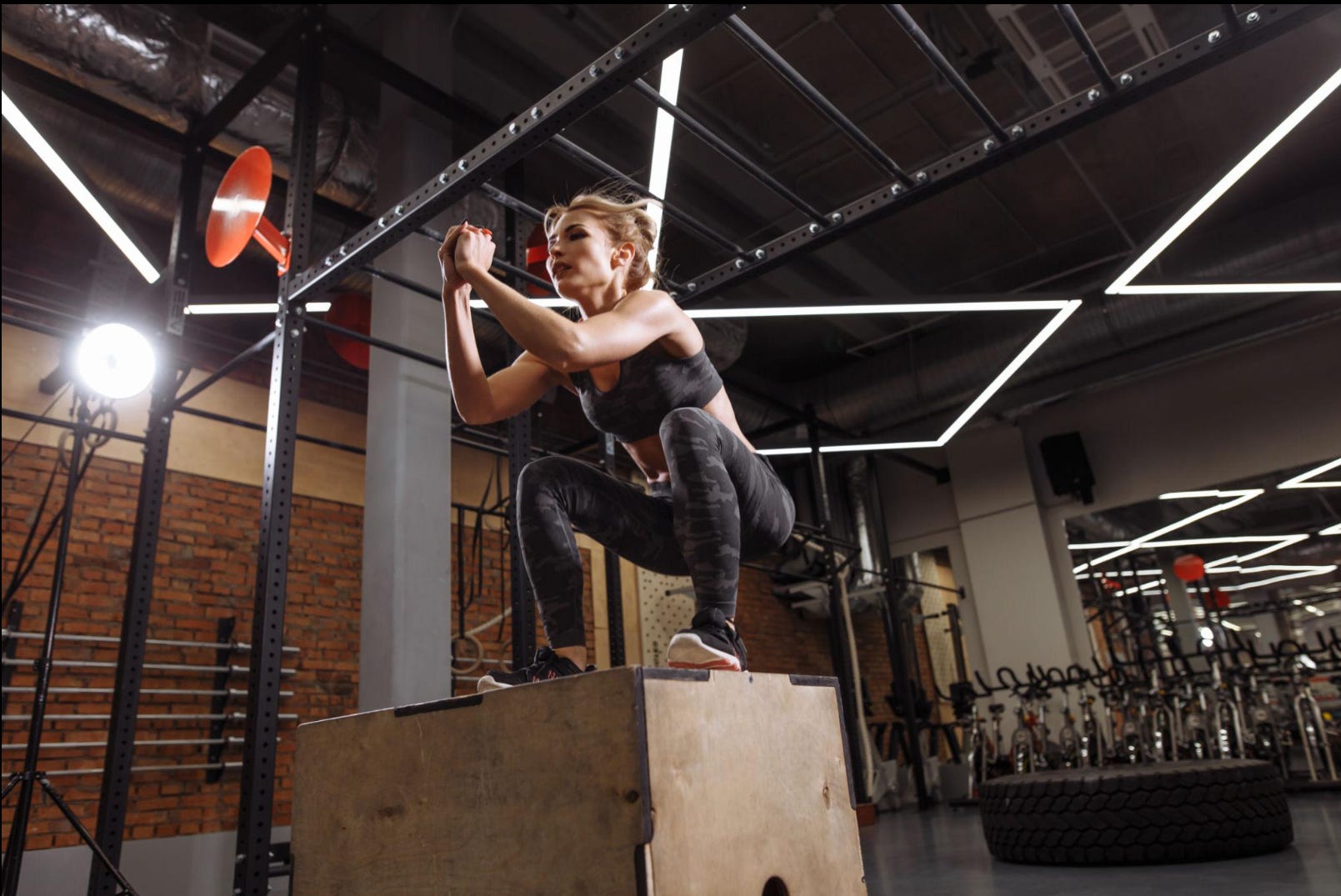
Minute 3 – 8-12 Box jumps
Option: weighted box step-ups (Alternative: Body weight box step-up)
See you on the other side!
Cool Down
Show your body some love and jump-start your recovery with this 20-minute gentle yoga stretch sequence from Five Parks.
This just dropped…..

You did the workout, you ate “clean,” and your body still isn’t responding the way it used to. So what changed? In this episode, I sit down with Dr. Carla DiGirolamo, a double Board-Certified Obstetrician/Gynecologist and Reproductive Endocrinologist specializing in caring for active and high-performing women, to unpack what’s really happening to active women’s bodies in mid-life and beyond.
We get into why hypothyroidism can be misdiagnosed because of chronic underfueling, what LEA and RED-S are (and why most doctors have never heard of them), hot takes on microdosing GLP-1s and muscle/bone loss for midlife women, and how HRT, testosterone therapy, and IUDs actually fit together. This isn’t a decline — it’s a detour, and it comes with a new playbook.
NOW TAKING MEDICAL CLIENTS FROM COLORADO, CONNECTICUT, AND NEW HAMPSHIRE!
..in addition to MA, NY, NJ, PA, CA, FL, OH
If you are an active woman or competitive midlife athlete who feels abandoned by mainstream medicine, I’m here for you!

Active and athletic midlife women have needs and risk profiles that are different from the general population. These needs often go unmet by the mainstream medical community due to a lack of understanding of fitness and sport and their impact on mid-life hormonal physiology or even a lack of acknowledgment that this dynamic exists.
To speak to this need, I launched my Telehealth Consultation Medical practice focusing on the Reproductive Endocrine needs and Menopausal Care for active, athletic, and high-performing women.
We put your health, fitness, and performance at the center of the equation so that you can achieve your healthiest, highest-performing self!
You will find all my service offerings on my website including a link to my calendar so that you can reserve your place in my schedule!