

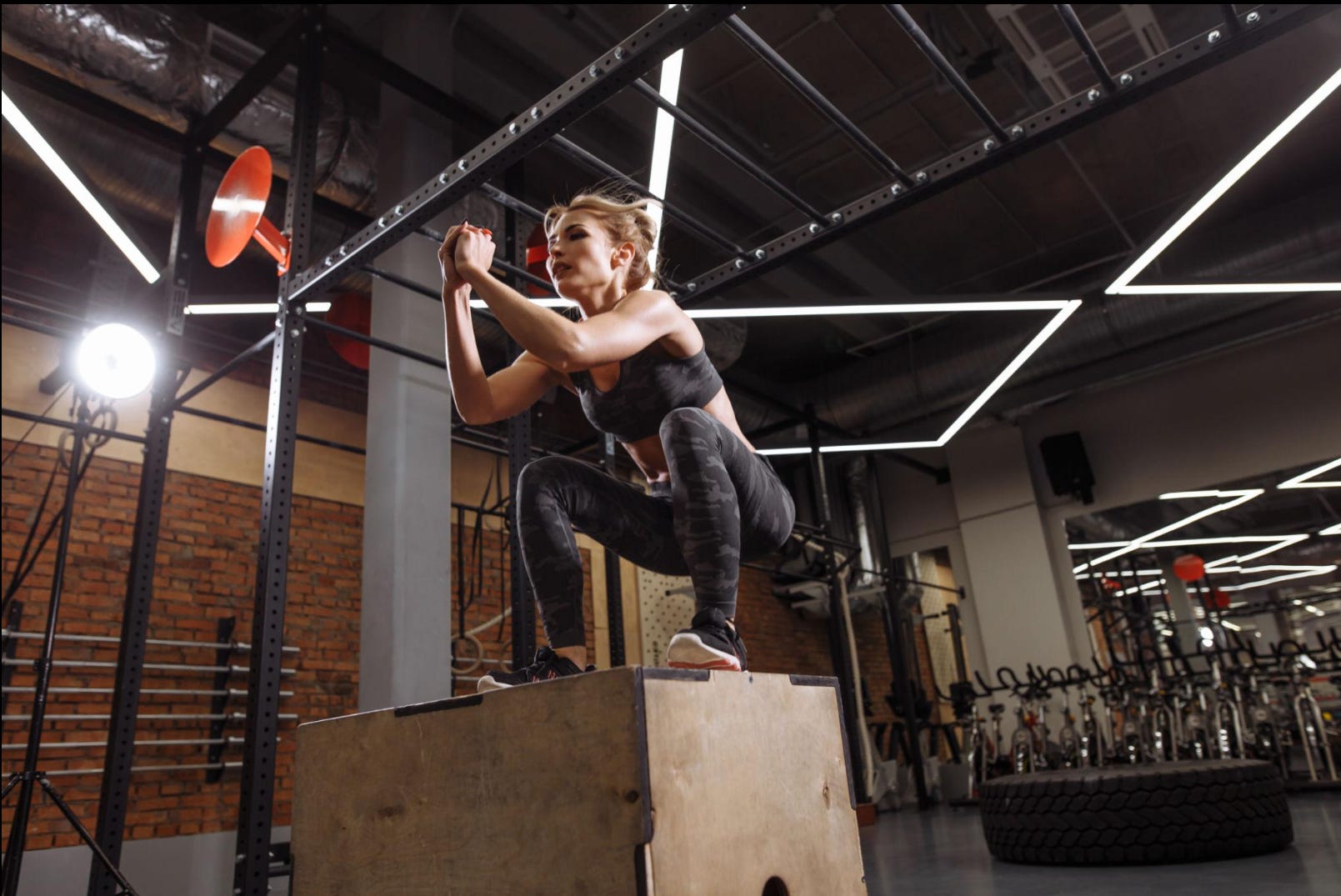
The masses (including myself) spend a lot of time discussing the benefits of weight training. As often happens when something goes viral, we can get caught up in an implied narrative that we need to DO THIS AT THE EXCLUSION OF everything else and lose sight of the other valuable fitness modalities that we have available to us.
Now, please make no mistake. There is no substitute for the stimulus we receive from weight training. But females are masters of physical adaptation, and our bodies crave variation to improve fitness. So the more variations we have, the more opportunities we have to supplement our weight training efforts with other modalities, and promote the adaptations required for fitness gains.
Enter body weight training.
Bodyweight training is having a well-deserved moment—and for good reason. For midlife women, it represents an effective, accessible, and sustainable way to build strength, preserve muscle, and support long-term health.
But to fully appreciate its value, we need to define it more broadly than most people do.
What Is Bodyweight Training?
Bodyweight training includes any exercise where your own body mass provides the primary resistance. While many people think of push-ups and squats, the reality is much more comprehensive.
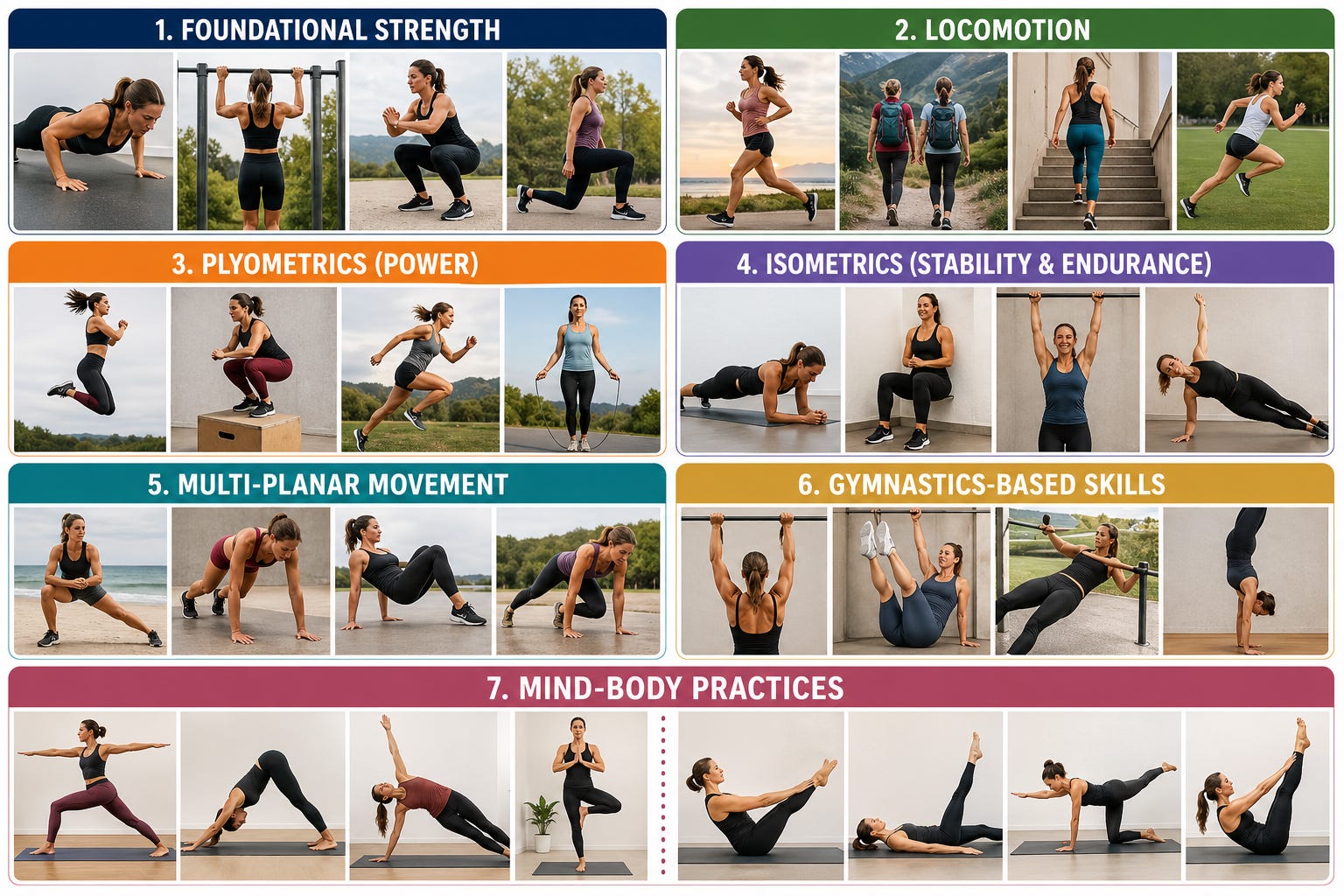
A well-rounded bodyweight training system includes:
Strength movements: push-ups, pull-ups, squats, lunges
Locomotion: walking, running, hiking, stair climbing
Power-based movements: jumping, hopping, bounding, skipping
Isometric control: planks, wall sits, hangs
Multi-planar movement: lateral lunges, crawling, rotational patterns
Skill and control work: yoga flows, Pilates-based core training, balance work
Together, these movements train strength, power, coordination, mobility, and control—qualities that become increasingly important as we age.
Why Bodyweight Training Matters More After 40
As physiology shifts in midlife, our training priorities evolve. Bodyweight training aligns exceptionally well with what we need most.
It builds real-world strength
Bodyweight training improves your ability to move your own mass through space. Getting up from the floor, climbing stairs, catching yourself during a misstep—these are all expressions of functional strength.
It preserves lean muscle mass
Muscle loss (sarcopenia) begins as early as the fourth decade. Bodyweight exercises—especially when progressed appropriately—can provide sufficient resistance to stimulate and maintain muscle.
It supports bone health
Movements that involve impact—such as running and jumping—create mechanical loading that is particularly effective for maintaining bone density. This becomes critical in the peri- and postmenopausal years.
It enhances joint health and mobility
Bodyweight movements require joints to stabilize through natural ranges of motion while simultaneously producing force. This integrated demand supports both mobility and long-term joint resilience.
It improves neuromuscular coordination
Many bodyweight exercises are skill-based. Whether it’s controlling a pull-up, stabilizing in a plank, or transitioning through a yoga flow, these movements reinforce the connection between the nervous system and muscular system—an essential component of balance and fall prevention.
It emphasizes relative strength
Your ability to move your own body is one of the most meaningful indicators of function and longevity. Push-ups, pull-ups, and controlled squats often tell us more about real-world capability than machine-based strength measures.
A Complete System, Not Just a Few Exercises
One of the most common misconceptions is that bodyweight training is limited or “basic.” In reality, it is a highly adaptable and scalable system.
For example:
A push-up can range from a wall variation to a deficit or single-arm version
A squat can progress from a box squat to a single-leg squat
Jumping can evolve from low-impact step-offs to more dynamic, reactive movements
A plank can become a highly demanding full-body stability challenge
Even yoga and Pilates—often thought of as separate disciplines—fit naturally into this system by developing control, stability, and movement precision. These elements enhance the effectiveness of more strength- and power-based movements, creating a more complete and resilient athlete.
What Does the Research Show?
The literature consistently supports the benefits of bodyweight and resistance-based training, particularly in women and aging populations:
Bodyweight resistance exercises can produce significant improvements in strength and muscle hypertrophy, comparable to traditional resistance training when properly progressed
Resistance training improves muscle mass, metabolic health, and cardiovascular outcomes, all of which are critical for long-term health
Impact-based and resistance training strategies improve bone mineral density and physical function, especially in postmenopausal women
Calisthenics-based training enhances neuromuscular function, balance, and coordination, which are key for maintaining independence with age
Importantly, these adaptations remain robust well into midlife and beyond.
The Bottom Line
Bodyweight training is not a simplified version of training—it is a foundational system for strength, movement, and longevity that offers:
Functional, transferable strength
Preservation of muscle and bone
Improved balance and coordination
Scalability across all fitness levels
Minimal equipment with maximal return
But if I’m weight training 3-4x per week, how do I fit it all in???
If you have never lifted weights before, body-weight training can build a great base of functionality to help you hit the ground running when you start training with weights.
It adds variety to your weight training program. If the bench press is part of your weight training routine, you can add push-up sessions and their many variations to your routine. Having a separate day of plyometrics sprinkled into your sessions or isometrics on a de-load day fits nicely with any weight training routine, as does running, hiking, and other options in the locomotion category.
It also provides great options if you are de-loading (active recovery days or weeks), traveling, or pressed for time, because many body weight movements can be done with no equipment and minimal space.
Provides a wide variety of scalable options during injury recovery.
The key is to think beyond isolated exercises and instead embrace the full spectrum:
strength, power, locomotion, stability, and control.
Train your body to move well, not just lift well.
Because ultimately, the goal isn’t just fitness—it’s capability, resilience, and longevity.
This week, we are featuring the classic, body-weight, CrossFit benchmark workout - “Cindy” and to that, I have added a twist with a locomotion movement of choice (walk with or without a weighted vest, run, bike, or row - or even swim if you are so inclined!)
Warm Up
3 minutes of your locomotion option of choice at an easy pace
then…
AMRAP 5 (As many rounds as possible in 5 minutes). Perform each movement in sequence for as many rounds and repetitions as possible in 20 minutes.
10 air squats
5 easy push-ups (Use an elevated push-up if strict push-ups are not accessible to you).
5 V-ups. See the linked video for modifications
Movement Practice
Select your options for the workout. For the air squats, be sure to identify your pain-free range of motion if you have knee or mobility issues. Set up a box or bench as a target, if needed. Otherwise, if you have no limitations, ensure that your hips break parallel and that you achieve this depth consistently.
Select your push-up option. If you cannot do strict push-ups easily, set up a stable box or bench at an elevation that allows you to do 5-10 unbroken repetitions confidently. ** Try to avoid doing push-ups from your knees, as this disengages the core muscles.
Select your pull-up option. Last week’s post, “Pull-Up Power,” reviewed the mechanics of the pull-up and the many options available for all fitness levels. Select an option where you can do 3-5 repetitions at a time confidently.
TIP! This is a very high-repetition volume workout. Fatigue will set in very quickly, so it is important to select movement options that you can do confidently and easily for several rounds. Take short rests as needed while pacing and as fatigue sets in. It is not unusual to be doing single repetitions at a time toward the end.
Workout
Pace yourself!
5 minutes of your locomotion choice at an RPE of 7-8. Note your total.
Proceed immediately into AMRAP 20 (As many rounds as possible in 20 minutes)
5 pull-ups (your selected option)
10 push-ups (your selected option)
15 Air squats
Immediately following the 20-minute AMRAP, go straight into another 5 minutes of your locomotion choice with the goal of meeting or exceeding your total prior to the AMRAP.
Your score: Total rounds and repetitions, including your locomotion total for both rounds.
MODIFICATION: If you wish to reduce the repetition volume, perform the AMRAP for 10 or 15 minutes instead of 20 minutes.
Cool Down
This workout was a long grind, so it deserves a thorough cool-down that helps return your stress response system back to baseline.
Try this 20-minute Quick Escape to “calm you down and reconnect you and yourself with your space”. Brough to you by Five Parks Yoga
REFERENCES
Kotarsky CJ, Christensen BK, Miller JS, Hackney KJ. Effect of progressive bodyweight squat training on muscle strength and hypertrophy. Int J Exerc Sci. 2018;11(3):965–978.
https://pmc.ncbi.nlm.nih.gov/articles/PMC10439966/
Kikuchi N, Nakazato K. Low-load bench press and push-up induce similar muscle hypertrophy and strength gain. J Exerc Sci Fit. 2017;15(1):37-42.
https://pubmed.ncbi.nlm.nih.gov/29541130/
Watson SL, Weeks BK, Weis LJ, Harding AT, Horan SA, Beck BR. High-intensity resistance and impact training improves bone mineral density and physical function in postmenopausal women (LIFTMOR trial). J Bone Miner Res. 2018;33(2):211–220.
https://asbmr.onlinelibrary.wiley.com/doi/10.1002/jbmr.3284
Nikander R, Sievänen H, Heinonen A, Daly RM, Uusi-Rasi K, Kannus P. Targeted exercise against osteoporosis: a systematic review and meta-analysis for optimising bone strength throughout life. BMC Med. 2010;8:47.
https://pubmed.ncbi.nlm.nih.gov/20663158/
Borde R, Hortobágyi T, Granacher U. Dose–response relationships of resistance training in healthy old adults: a systematic review and meta-analysis. Sports Med. 2015;45(12):1693–1720.
https://link.springer.com/article/10.1007/s40279-015-0385-9
Carter SE, Draijer R, Holder SM, Brown L, Thijssen DHJ, Hopkins ND. Breaking up sedentary time with calisthenics improves neuromuscular function: a randomized crossover study. Med Sci Sports Exerc. 2022;54(7):1155–1162.
https://pmc.ncbi.nlm.nih.gov/articles/PMC9653850/
TAKING NEW CLIENTS!

If you are an active woman or competitive midlife athlete who feels abandoned by mainstream medicine, I’m here for you!
It is with great excitement that after more than 2 years of preparation, I have FINALLY launched my Telehealth Consultation Medical practice focusing on the Reproductive Endocrine needs and Menopausal Care for active, athletic, and high-performing women.
Active and athletic midlife women have needs and risk profiles that are different from the general population. These needs often go unmet by the mainstream medical community due to a lack of understanding of fitness and sport and their impact on mid-life hormonal physiology or even a lack of acknowledgment that this dynamic exists. We put your health, fitness, and performance at the center of the equation so that you can achieve your healthiest, highest-performing self!
You will find all my service offerings on my website, including a link to my calendar so that you can reserve your place in my schedule online! Looking for a more Human encounter? Call Mary, my awesome and amazing assistant at 754-262-5674 (M-F 9a-5p ET)
This just dropped…..

Check out this awesome podcast where the awesome and amazing Selene Yeager interviews Dr. Casey Francis, my personal Performance Physical Therapist from Pompano Beach, FL, about how this discipline of physical therapy can help women of all ages and athletic levels, but especially those in mid-life. Later in the show, I make a quick appearance to talk about my injury rehab and experience working with Dr. Casey.