

Hey Team!
For the last few weeks, we have been taking a deep dive into the LIFTMOR trial. Today's post is the finale of this three-part series and kicks off our Thursday posts, dedicated to learning why we train the way we do, practical longevity-promoting tips, and anything else relevant to helping midlife women thrive.
Enjoy!
-Dr. Carla
For the past two weeks, we’ve been looking at the LIFTMOR trial and what it can teach us about exercise and bone health. First, we looked at the study itself: eight months of supervised high-intensity resistance and impact training improved bone mineral density in postmenopausal women with low bone mass. Then we explored why it worked—because bone doesn’t just need exercise; it needs a reason to adapt.
But there is one more important part of the LIFTMOR story: the benefits didn’t stop at the skeleton.
Stronger Bones. Stronger Women.
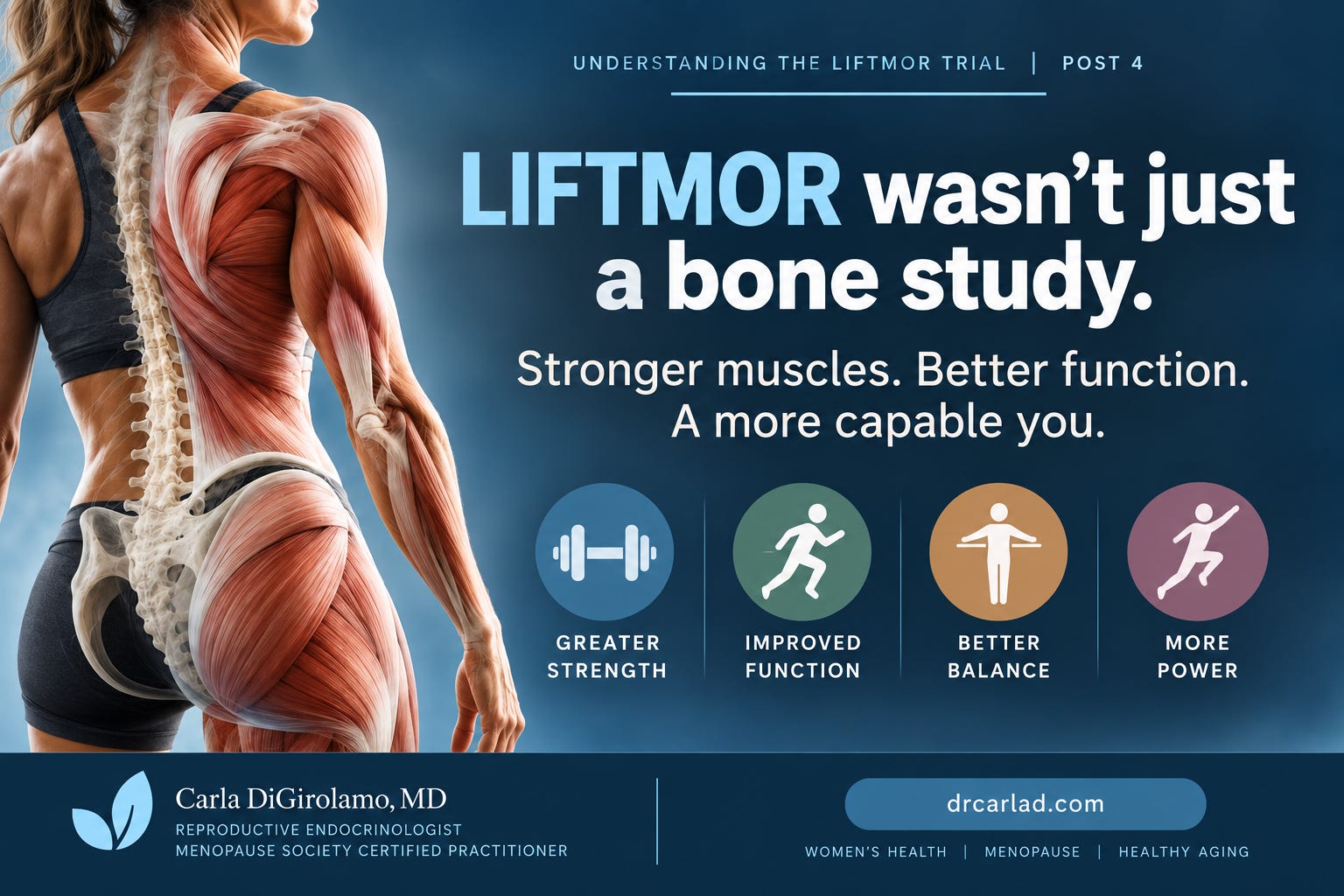
The LIFTMOR investigators didn’t measure bone density alone. They also looked at strength and physical function, and the changes were impressive. Women in the high-intensity resistance and impact training group increased leg strength by approximately 35% and back-extensor strength by approximately 36%. They also improved performance on measures including the timed-up-and-go, sit-to-stand, functional reach and vertical jump.
These measures may sound like research outcomes, but think about what they represent outside the laboratory: getting out of a chair, moving quickly and confidently, maintaining balance, producing power and controlling your body in space. These aren’t simply fitness metrics. They’re components of physical capacity, and maintaining that capacity becomes increasingly important as we age.
Bone Density Is Only Part of the Fracture Story
When we talk about osteoporosis, we understandably focus on the strength of the skeleton. But fractures don’t occur because of bone density alone. Many fractures occur because a vulnerable bone encounters a force it cannot tolerate, often during a fall.
That means preserving bone is important, but so is maintaining the physical abilities that may help us avoid the fall in the first place: strength, balance, coordination, reaction capacity and power. LIFTMOR was not designed or powered to demonstrate fewer falls or fractures, so we shouldn’t claim that it did. But its improvements in strength and physical function remind us why resistance training may matter well beyond what we see on a DXA scan.
We aren’t just trying to build a stronger skeleton. We’re trying to build a body capable of using it.
But What About Safety?
This is where an important nuance of LIFTMOR sometimes gets lost. The women in the study weren’t simply handed heavy barbells and told to start lifting. Participants were screened, they learned the movements, loads were progressed, technique mattered, and the sessions were closely supervised.
Across more than 2,600 supervised training sessions, the researchers reported only one minor adverse event. That’s reassuring, but it isn’t evidence that every woman with low bone mass should walk into a gym tomorrow and start deadlifting at 85% of her one-repetition maximum. The better lesson is that high-intensity training and appropriate training are not mutually exclusive. Heavy resistance training can be introduced thoughtfully, progressively and with appropriate instruction.
Don’t Copy the Program. Learn From the Principles.
You don’t need to reproduce the LIFTMOR protocol to learn from it. If you’re new to resistance training, your starting point may be learning a squat with your bodyweight, progressing to a goblet squat and eventually adding more load. If you’re already an experienced athlete, the challenge may be very different: continuing to progressively load movements rather than allowing years of training to become years of doing the same thing.
Impact can be scaled as well—from appropriately selected introductory jumping and landing drills to more demanding plyometric work in trained athletes. The movement changes, the load changes and the starting point changes, but the underlying principle doesn’t: give the body an appropriate challenge, allow it to adapt and then gradually ask it to do more.
The Bottom Line
Perhaps LIFTMOR’s greatest contribution isn’t simply showing us that postmenopausal women can improve bone density with high-intensity resistance and impact training. It’s challenging how we think about training as we age.
The goal isn’t simply to protect fragile bones by asking less of our bodies. It’s to appropriately prepare our bodies to do more—to build bone and muscle, develop strength, and preserve power and physical function. That means learning good movement, progressing thoughtfully and getting qualified guidance when needed.
Because ultimately, the goal of training isn’t simply a better number on a DXA scan.
It’s building the physical capacity to keep doing the things you want to do—for decades to come.
NOW TAKING MEDICAL CLIENTS FROM COLORADO, CONNECTICUT, AND NEW HAMPSHIRE!
..in addition to MA, NY, NJ, PA, CA, FL, OH
If you are an active woman or competitive midlife athlete who feels abandoned by mainstream medicine, I’m here for you!

Active and athletic midlife women have needs and risk profiles that are different from the general population. These needs often go unmet by the mainstream medical community due to a lack of understanding of fitness and sport and their impact on mid-life hormonal physiology or even a lack of acknowledgment that this dynamic exists.
To speak to this need, I launched my Telehealth Consultation Medical practice focusing on the Reproductive Endocrine needs and Menopausal Care for active, athletic, and high-performing women.
We put your health, fitness, and performance at the center of the equation so that you can achieve your healthiest, highest-performing self!
You will find all my service offerings on my website including a link to my calendar so that you can reserve your place in my schedule!