

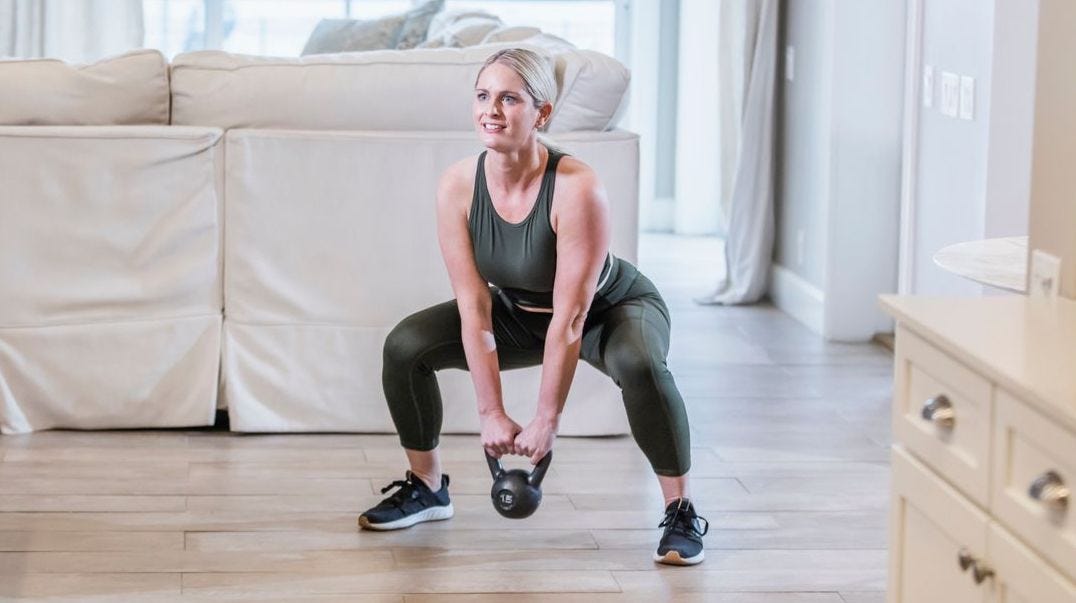
This week, I want to build upon last week’s introduction to hip extension through the kettlebell swing with a slightly more complex movement that expands hip extension into a total body movement. Enter the sumo-deadlift high-pull.
Part deadlift, part explosive pull, and part conditioning tool, the SDHP combines lower-body power with upper-body coordination in a single movement pattern. When coached correctly and loaded appropriately, it can be an efficient way to train strength, muscular endurance, and metabolic conditioning simultaneously.
This movement also highlights something increasingly important with aging: the ability to generate force quickly and transfer that force efficiently through the body.
What Is the Sumo Deadlift High Pull?
The SDHP begins in a wide “sumo” stance with the hands gripping the weighted object (typically a barbell, kettlebell, or dumbbell) inside the knees. From the floor, the athlete drives through the legs and hips, stands explosively, then continues the momentum upward by pulling the elbows high and outside until the weight reaches approximately chest or collarbone height.
The movement is sequential:
Hip and knee extension
Force transfer through the trunk
Upper-body pull
Done correctly, the arms are not initiating the movement—the hips are.
The Mechanics: The power comes from the lower body
The SDHP is fundamentally a hip-dominant movement. The glutes, hamstrings, quadriceps, spinal erectors, core musculature, traps, and upper back all contribute.
The wider sumo stance changes the mechanics compared with a conventional deadlift. Research on sumo deadlift biomechanics demonstrates that the wider stance generally allows for:
A more upright torso
Reduced forward trunk lean
Shorter bar travel distance
Reduced lumbar shear stress compared with conventional pulling mechanics
How to find your sumo-width stance: Start with your squat stance with your feet at shoulder-width distance. Then, with each foot, move one heel-to-toe length wider.
For many women—particularly those with longer torsos, shorter arms, or good hip mobility—the sumo position may feel mechanically more comfortable than a narrow-stance deadlift.
The “high pull” portion adds an explosive upper-body component that recruits the traps, deltoids, rhomboids, and scapular stabilizers while demanding timing and coordination. The movement, therefore, becomes less about isolated strength and more about integrated athletic movement.
Physiologic Benefits for Midlife and Older Women
One of the most valuable aspects of the SDHP is that it trains multiple physiologic qualities simultaneously.
1. Power Production
Power—the ability to produce force quickly—declines earlier and faster than maximal strength with aging. That matters because power is closely tied to athletic performance, fall prevention, agility, and functional independence.
The SDHP trains rapid hip extension, similar to jumping, sprinting, or Olympic lifting derivatives, but often with a lower technical barrier.
2. Metabolic Conditioning
Because the SDHP uses large muscle groups across the entire body and can be cycled continuously, it creates a substantial cardiovascular and metabolic demand.
This makes it useful in interval-style conditioning workouts where maintaining muscle mass and power output are priorities—not just calorie burn.
3. Posterior Chain Strength
The posterior chain—glutes, hamstrings, spinal erectors, and upper back—is critically important for posture, sprinting, lifting capacity, and long-term musculoskeletal resilience.
Many mid-life women are quadriceps-dominant from years of running, cycling, or group fitness classes. Hip-dominant pulling patterns like the SDHP can help restore balance.
4. Coordination and Force Transfer
The SDHP teaches “core-to-extremity” force transfer: generating power from the lower body and transmitting it through a stable trunk into the upper body.
That quality is foundational not only in sport, but also in everyday athletic movement.
Important Safety Considerations
The SDHP is effective—but it is not universally appropriate for everyone.
The most controversial aspect of the movement is the top position, where the shoulders move into internal rotation with the elbows elevated. Some clinicians and coaches argue that this position may increase the risk of shoulder impingement in susceptible individuals.
This does not automatically make the movement “dangerous,” but it does mean exercise selection should match the individual.
Women with:
Existing shoulder impingement
Limited thoracic mobility
Poor shoulder internal rotation
Cervical discomfort
Poor trunk control under load
may not tolerate the movement well.
Technique errors also matter. Common problems include:
Pulling with the arms too early
Rounding the lumbar spine
Letting the bar drift away from the body
Excessively loading the shoulders rather than driving through the hips
For many women, lighter loads with crisp mechanics are far more effective than maximal loading.
If the SDLHP is not accessible to you in any of its modifications, the kettlebell swing in part 1 of this series is a fine substitution.
Practical Takeaway
The sumo deadlift high pull is best viewed as a power-conditioning movement—not simply a strength exercise.
When programmed intelligently, it can improve:
Hip power
Whole-body coordination
Work capacity
Posterior chain strength
Athletic movement quality
But like many explosive exercises, the benefit depends entirely on execution.
If the shoulders dislike the movement, there are excellent alternatives—including kettlebell swings, high pulls from hang positions, trap-bar pulls, or medicine-ball power work.
The goal is not to force a movement.
The goal is to preserve power, athleticism, and resilience as long as possible.
Warm Up
AMRAP 7 (As many rounds as possible in 7 minutes)
7 up-downs
7 easy push-ups option
After the 7 minutes, perform 10 weighted good mornings. You can either use a barbell/PVC pipe or hold a light dumbbell or plate to your chest.
Movement Practice
If you are performing this movement for the first time, it is highly recommended to perform the mechanics of this movement without any weight (just your two hands or a PVC pipe, broomstick, or similar object). When you feel confident in the movement, add a light kettlebell (5-15 lbs) or empty barbell. As you continue feeling proficient, slowly increase the load.
Review the video links that follow before trying the SDLHP:
The first part of this movement is a deadlift. It is very important to get this part of the movement right to keep your lower back protected. Be sure to keep your back straight- your legs, glutes, and hamstrings are doing the lifting, NOT the muscles of the lower back.
Next, review the sumo deadlift high pull progression video paying close attention to the mechanics tips in the text.
Practice! At first, you may want to do a deadlift, pause, then the high pull. This is ok! As you practice and become more familiar with the movement, the two parts of the lift will flow together. Don’t pull too soon! Be sure you are fully extended at the hips (standing up straight) before pulling the bar up.
The “shrug” then the “pull” happens the second the hips fully extend. When the hips are extended with some speed or “pop” this begins to move the bar upward which signals the start of the pull. The upper extremties simply guide the bar upward.
TIP! When setting up for the SDLHP, set your eye gaze to a point on the ground 10 ft in front of you. You do not want to be looking straight ahead as this will hyper-extend the neck. Keep the neck neutral by setting your gaze as above.
For the push-ups, the workout calls for the hand-release push-up, however a standard push-up with or without elevation can be substituted. The hand-release version has the added benefit of building strength at the lowest point of the movement (chest touching the floor), which is often a “weak spot” of upper body strength.
Below is a list of movement options. Take 5-10 minutes to find the option that is right for you. If you want to “Geek-out” on a deep dive into push-up variations and mechanics, check out this awesome article: A Fresh Take on the Lowly Push-Up from the CrossFit library.
Elevated push-up - The elevation can be slight with a couple of plates on the ground, it could be a flat bench, or a STABLE chair or table as in the video. If shoulder pain or mobility is an issue, performing push-ups against a wall is also an option.
TIP! If possible, avoid doing the push-ups with the knees on the floor. This disengages some of the core activation, which is a target of both the SDLHP and the push-up.
Workout
We have 3 levels of this workout today! Beginner, Intermediate, and Advanced
Beginner
5 rounds for time
8 SDLHP - Two hands only/PVC pipe/broomstick
8 elevated push-ups
Intermediate
8 rounds for time
10 SDLHP (10-35 lb kettlebell, 25-55 lb weighted barbell)
12 hand-release/elevated/strict push-ups
Advanced
8 rounds for time
10 SDLHP (65# barbell)
12 hand-release push-ups
Cool-Down
Let’s show our back, hips and hamstrings some love with this 7-minute follow-along stretch segment from Train FTW.
For your yoga fix, try this 15-minute yoga flow class from Five Parks Yoga
NOW TAKING NEW CLIENTS!
If you are an active woman or competitive midlife athlete who feels abandoned by mainstream medicine, I’m here for you!

It is with great excitement that after more than 2 years of preparation, I have FINALLY launched my Telehealth Consultation Medical practice focusing on the Reproductive Endocrine needs and Menopausal Care for active, athletic, and high-performing women.
Active and athletic midlife women have needs and risk profiles that are different from the general population. These needs often go unmet by the mainstream medical community due to a lack of understanding of fitness and sport and their impact on mid-life hormonal physiology or even a lack of acknowledgment that this dynamic exists. We put your health, fitness, and performance at the center of the equation so that you can achieve your healthiest, highest-performing self!
You will find all my service offerings on my website including a link to my calendar so that you can reserve your place in my schedule!
In case you missed it…..

Tune in to my guest appearance with the awesome and amazing Selene Yeager where we review the latest medical literature addressing the the role of laboratory testing in managing menopausal hormone therapy.