

Hey Team!
Athletic Aging is getting a refresh! You will still receive the Weekly Workout post every week, which will have a streamlined focus on training to include a featured movement, practical coaching points, and the workout. On Thursdays, we'll go deeper into other topics such as the science of training, performance, and aging, with a particular focus on women at midlife and beyond. You will find these articles in the "Medical Updates" and  "Original Articles" categories, and as always, you can opt in/out of the content you would like to see.
Enjoy!
-Dr. Carla
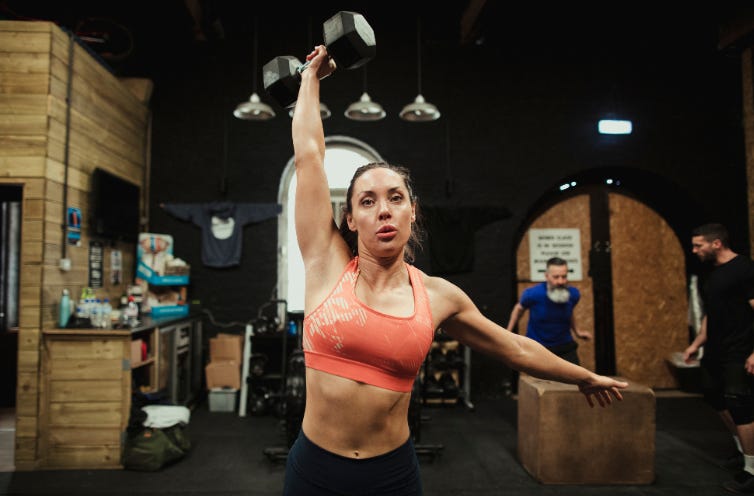
Physical asymmetry is part of being human. From handedness to the leg we naturally lead with, most of us have a side we favor—and some degree of difference in strength, mobility, balance, and coordination between sides is normal.
That’s one reason unilateral training—training one side of the body independently—can be so valuable. Rather than allowing the stronger or more coordinated side to compensate, unilateral movements ask each side to produce and control movement on its own. They can also reveal differences between sides that may be less apparent during bilateral movements.
Featured Movement: Single-Arm Overhead Walking Lunge
Today’s featured movement takes that concept a step further. Holding a dumbbell overhead in one hand while walking through alternating lunges creates an intentionally asymmetric load.
How to do it: Hold a dumbbell overhead with one arm extended and your shoulder stable. Step forward into a lunge, keeping your torso tall and the weight controlled overhead. Drive through the front foot to step into the next lunge. Complete the prescribed distance with one arm overhead, then switch sides.
Your legs produce the movement while your trunk and shoulder stabilizers work to maintain position and control the load. Balance, coordination, mobility, and muscular endurance all come along for the ride.
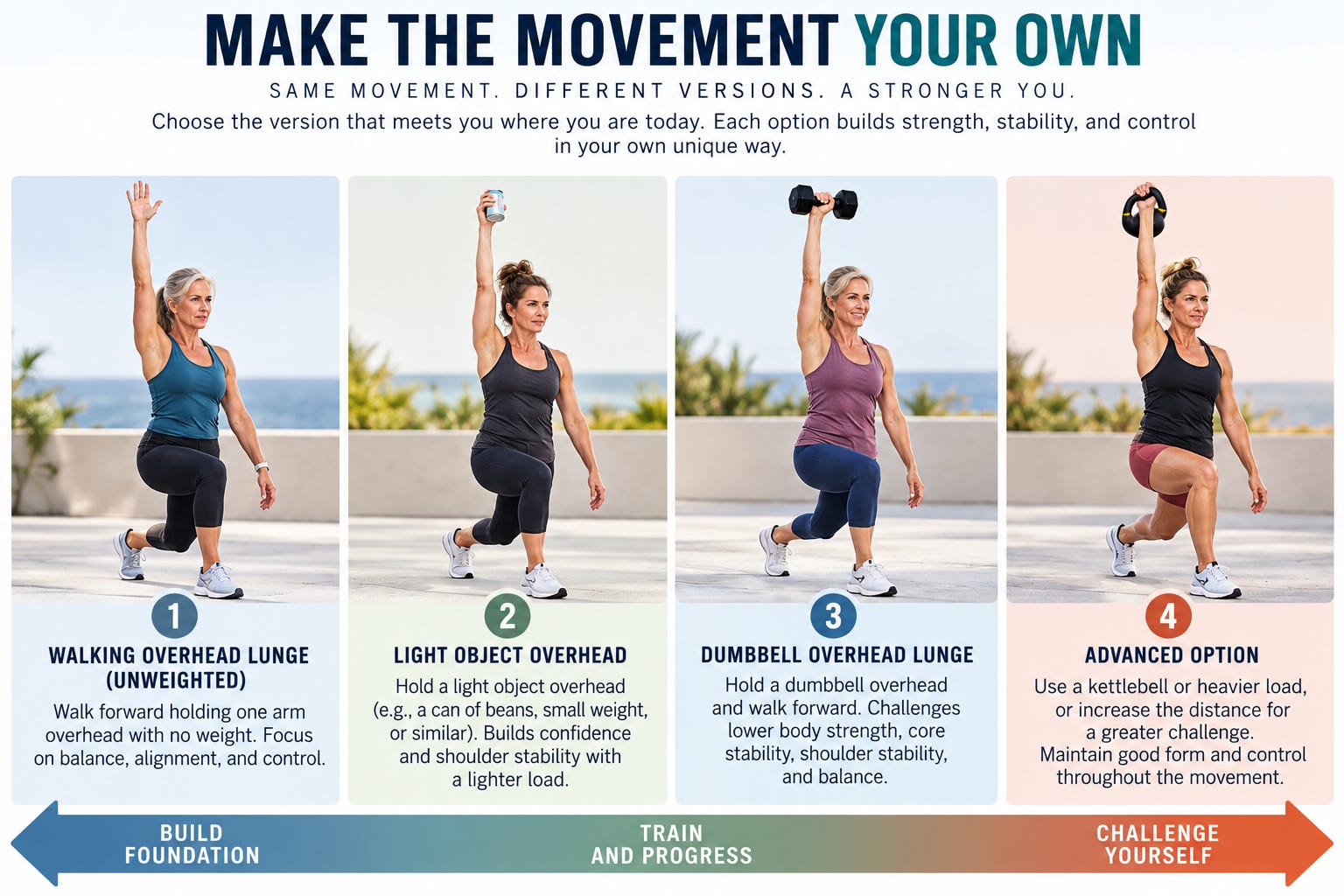
Make the Movement Your Own
One of the goals of the Athletic Aging Weekly Workout Series is to make fitness accessible for all skill levels and limitations. That’s why every post provides scaled options so that you can “Make the movement your own”.
Don’t be surprised if one side feels different from the other. The goal isn’t perfect symmetry. The goal is building strength and control on both sides.
Choose the version that meets you where you are today—from an unweighted overhead walking lunge to a lighter object, dumbbell, or heavier load. The goal is to preserve the intent of the movement while matching the challenge to your current strength, mobility, experience, and training goals.
The Bottom Line
For women at midlife and beyond, maintaining strength, balance, coordination, mobility, and the ability to stabilize a load matters both inside and outside the gym - especially when it comes to reducing the risk and impact of a fall. Unilateral training challenges several of these qualities at once while helping us continue to build strength on each side independently.
Whether you’re beginning to exercise, returning after time away, or looking for an additional performance edge, there’s a version of this movement for you.
Make the movement your own—then make it strong.
Now let’s train.
Warm Up
AMRAP 7 (As many rounds as possible in 7 minutes)
20 single-under jump rope (or simulated jump rope) -for a low-impact option: 20 high-knee march in place (R+L = 1 rep)
20 alternating lunge in place (left + right = 2 reps)
6 plank alternating shoulder taps (Knees or toes)
Once you have finished the 5-minute AMRAP, follow along with this anterior pelvic tilt stretch sequence from Train FTW. This is important! This sequence will help warm up the flexibility required for the overhead walking lunge.
Pre-workout stretch (follow along - 7 minutes): Anterior pelvic tilt sequence
Movement Practice
Take 5-10 minutes to test out your weights and select your options for the workout. Choose a weight that allows you to do the lunges unbroken while maintaining good form.
Movement options:
Substitutions for double unders: Single unders, simulated jump rope, or 1 minute of lateral steps over a line or use of an agility ladder with quick feet as a low impact option if jumping is not available to you.
Single arm overhead lunge options: Use no weight with arm extended straight overhead, for weight lighter than a dumbell, hold an object such as a shoe, can of beans or other small object overhead.
TIP! Be mindful of the body position achieved in the anterior pelvic tilt sequence. Engaging these same muscles in the overhead lunge will lend great stability, and core engagement and will protect your lower back.
Workout
Part 1 - 7-minute Core Activation - Follow along from Train FTW
Part 2 - AMRAP 15 (As many rounds as possible in 15 minutes)
50 single unders (30 double-unders or simulated jump rope, or 1-minute agility ladder work)
25-ft walking overhead lunge, right arm (or 10 alternating lunges in place)
25-ft walking overhead lunge, left arm10 plank alternating shoulder taps (right + left = 2 repetitions)
Cool Down
Finish up today’s workout with a 15-minute yoga stretch sequence to release the hips and hamstrings and return your energy systems to baseline.
Yoga to release the hips and hamstrings - 15 minutes
This just dropped…..

You did the workout, you ate “clean,” and your body still isn’t responding the way it used to. So what changed? In this episode, I sit down with Dr. Carla DiGirolamo, a double Board-Certified Obstetrician/Gynecologist and Reproductive Endocrinologist specializing in caring for active and high-performing women, to unpack what’s really happening to active women’s bodies in mid-life and beyond.
We get into why hypothyroidism can be misdiagnosed because of chronic underfueling, what LEA and RED-S are (and why most doctors have never heard of them), hot takes on microdosing GLP-1s and muscle/bone loss for midlife women, and how HRT, testosterone therapy, and IUDs actually fit together. This isn’t a decline — it’s a detour, and it comes with a new playbook.
NOW TAKING MEDICAL CLIENTS FROM COLORADO, CONNECTICUT, AND NEW HAMPSHIRE!
..in addition to MA, NY, NJ, PA, CA, FL, OH
If you are an active woman or competitive midlife athlete who feels abandoned by mainstream medicine, I’m here for you!

Active and athletic midlife women have needs and risk profiles that are different from the general population. These needs often go unmet by the mainstream medical community due to a lack of understanding of fitness and sport and their impact on mid-life hormonal physiology or even a lack of acknowledgment that this dynamic exists.
To speak to this need, I launched my Telehealth Consultation Medical practice focusing on the Reproductive Endocrine needs and Menopausal Care for active, athletic, and high-performing women.
We put your health, fitness, and performance at the center of the equation so that you can achieve your healthiest, highest-performing self!
You will find all my service offerings on my website including a link to my calendar so that you can reserve your place in my schedule!