

Sometimes the most productive part of our training lies outside the main training session.
Accessory work, which may target strength, skill practice, or mobility, is performed before and or after the main training session. This is typically lower-intensity work focusing on technique and skill-building. When thoughtfully programmed in the context of the workout of the day or for the week or month ahead, accessory work can be what moves the needle toward advancing your physical abilities and longevity.
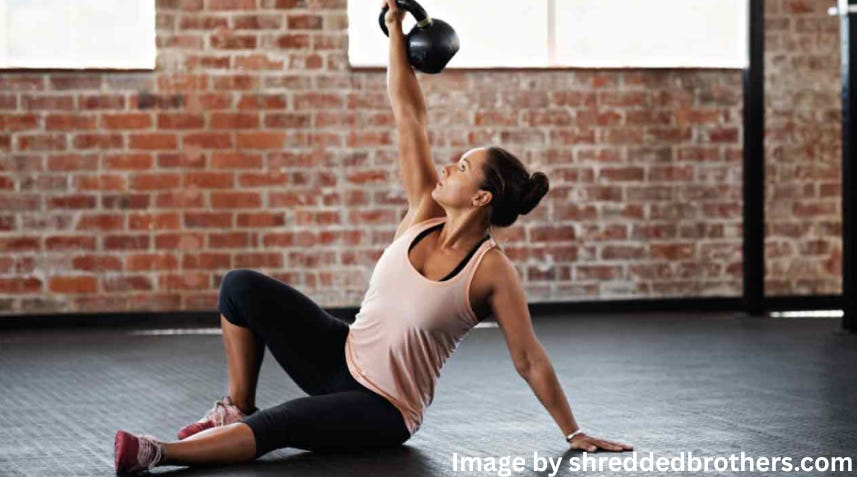
If there’s one movement I wish more active women over 40 would incorporate into their training, it’s the Turkish Get-Up (TGU).
Not because it’s flashy. Not because it’s heavy. But because it quietly builds the kind of strength that keeps you athletic for life.
What is the Turkish Get-Up?
The Turkish Get-Up is a multi-planar, full-body movement that takes you from lying on the floor to standing—while holding a weight overhead—and then back down again.
In the research literature, it’s described as a 7-stage movement pattern that begins in a supine position, progresses to standing, and then reverses back to the floor .
What makes it unique is that it’s not just a strength exercise—it’s a movement sequence that integrates:
A press
A roll
A sit-up
A bridge
A lunge
And a stand
All in one controlled repetition.
How to Perform the Turkish Get-Up
While the full movement has nuance, the general flow looks like this:
Start lying on your back with one knee bent and a weight pressed overhead.
Roll up onto your elbow, then your hand.
Lift your hips and sweep your leg underneath into a half-kneeling position.
Stand up while keeping the weight stable overhead.
Reverse every step back down to the floor.
For a demonstration and instruction, check out the VIDEO below:
The key is slow, deliberate movement, maintaining control and alignment throughout.
This is not a “conditioning” exercise—it’s a precision-based strength skill.
IMPORTANT! If you have never attempted this movement before, start by holding something light, such as a shoe or a can of soup. It’s important to become confident in the movement pattern before adding weight.
Why Should We Do This?
During the hormonal and musculoskeletal changes of mid-life, our focus now must include additional priorities:
Joint integrity
Stability
Movement quality
The Turkish Get-Up checks every one of those boxes:
Builds True Functional Strength
Unlike isolated exercises, the TGU trains the body as a connected system. Research on kettlebell training shows that movements like the TGU improve functional strength, neuromuscular coordination, and full kinetic chain activation .
This translates directly to:
Better lifting mechanics
More resilient movement patterns
Stronger carryover to real life and sport
Enhances Core Stability
The TGU is essentially a moving plank under load.
Your core is working the entire time—not to create movement, but to resist it. This “anti-rotation” demand builds a more functional, spine-protective core than traditional ab exercises.
Improves Shoulder Health and Longevity
The Turkish Get-Up trains the shoulder in a unique way:
Isometric stability (holding weight overhead)
Through multiple planes of motion
While the body moves underneath it
Studies show the TGU significantly challenges shoulder musculature and emphasizes coordinated activation across movement phases, which can help
Reduce injury risk
Improve overhead strength
Maintain long-term joint health
Develops Balance, Coordination, and Body Awareness
The TGU is not just physical—it’s neurological. You have to think, sequence, and control each phase. That builds:
Proprioception (body awareness)
Intermuscular coordination
Movement confidence
Research highlights improvements in balance, flexibility, and coordinated strength with Turkish Get-Up training.
As we move through mid-life, this becomes critical—not just for performance, but for fall prevention and long-term independence.
Restores Mobility While Building Strength
Most mobility work is passive.
Most strength work is rigid.
The Turkish Get-Up does both—simultaneously.
It improves mobility in:
Hips
Thoracic spine
Shoulders
While reinforcing strength and control through those ranges.
Today’s workout targets muscle stamina - the ability of muscles to move lighter weight over longer periods of time. These are higher-volume movements that engage different muscle groups, introducing cardiovascular endurance fatigue to increase difficulty. We conclude with some accessory work - The Turkish Get-Up
Scoring: Record your APPROXIMATE reps per 1 min round during your 1 minute of rest – not during the working rounds! … and if you don’t want to count and just stay in a mental zone, then no scorekeeping is necessary!
Warm Up
TABATA 20 sec of work/10 sec of rest. Perform each movement in sequence for a total of 6min, 4 rounds of each set of 3 movements.
Movement Practice
Take 5-10 minutes to run through all the movements in sequence for 5-7 reps to find your options for the workout. Select an option that you can sustain for the entire minute. You will use pacing to control speed and level of fatigue. The goal is to move smoothly from one movement to the next, efficiently accumulating repetitions, as each minute turns.
The strategy for approaching this workout is to utilize pacing the speed of repetitions to accumulate as many repetitions as possible. The challenge for this workout is to be working for the ENTIRE minute of each interval. There is a 1:00 rest interval after the 4 x 1-minute movement intervals. The series is a total of 20 minutes.
Workout
4 Rounds
1:00 Dumbbell or Barbell Thruster
1:00 Ab mat sit-up
1:00 Walking or in place alternating lunge
1:00 Burpees
1:00 rest
Score = total number of reps:
Accessory Work - Practice the Turkish Get-Up. Review the video carefully for technique and proper mechanics.
2 rounds
3 repetitions of the Turkish Get-Up on each side
Rest 1:00 between rounds
Cool Down
Team, you all worked hard today, so lets show your body some love and jump-start your recovery with thi 12-minute lower back and hip release sequence.
References
Liebenson C, Shaughness G. The Turkish get-up. J Bodyw Mov Ther. 2011;15(1):125–127.
https://pubmed.ncbi.nlm.nih.gov/21147428/
St-Onge E, et al. A descriptive analysis of shoulder muscle activities during the Turkish get-up exercise. J Bodyw Mov Ther. 2019.
https://pubmed.ncbi.nlm.nih.gov/30691756/
Shaw T, et al. Clinical application of the Turkish Get-Up to an acute phase rehabilitation program: A case report. J Bodyw Mov Ther. 2020;24(1):84–88.
https://pubmed.ncbi.nlm.nih.gov/31563381/
Ayash A, Jones MT, Hettler J. Kettlebell Turkish Get-Up: Training tool for injury prevention and performance enhancement. Int J Athl Ther Train. 2012;17(4):8–13.
https://journals.humankinetics.com/view/journals/ijatt/17/4/article-p8.xml
TAKING NEW CLIENTS!

If you are an active woman or competitive midlife athlete who feels abandoned by mainstream medicine, I’m here for you!
It is with great excitement that after more than 2 years of preparation, I have FINALLY launched my Telehealth Consultation Medical practice focusing on the Reproductive Endocrine needs and Menopausal Care for active, athletic, and high-performing women.
Active and athletic midlife women have needs and risk profiles that are different from the general population. These needs often go unmet by the mainstream medical community due to a lack of understanding of fitness and sport and their impact on mid-life hormonal physiology or even a lack of acknowledgment that this dynamic exists. We put your health, fitness, and performance at the center of the equation so that you can achieve your healthiest, highest-performing self!
You will find all my service offerings on my website, including a link to my calendar so that you can reserve your place in my schedule online! Looking for a more Human encounter? Call Mary, my awesome and amazing assistant at 754-262-5674 (M-F 9a-5p ET)
In case you missed it……
The Menopause Muscle Continuum….
Does the menopause transition directly impact muscle health and physiology?
This has been the subject of some very intense discussion recently. Join me and the awesome and amazing Selene Yeager for Hit Play Not Pause Episode 253 where we take a deep dive into the science behind this debate.

Hi Mohammad... Thanks so much for reading and for your comment! Whoever developed this movement was brilliant and it gets so little attention. Glad you liked the post! -Carla
This is one of those shoulder hacks that are so important for us as we get older. Especially as we see more frozen shoulder in women nearing menopause. And what you said, "This is not a conditioning exercise—it’s a precision-based strength skill" is really important. Thank you for a great post.