


If there is one muscle group that tends to get overlooked in many training programs, it’s the triceps.
That is unfortunate because the triceps are responsible for one of the most fundamental human movements: pushing.
Whether you’re lowering yourself into a chair, pushing yourself up from the floor, placing luggage into an overhead bin, performing a push-up, or locking out a barbell overhead, strong triceps play a critical role.
The box dip is a simple exercise that develops this strength with minimal equipment, making it accessible to nearly every athlete.
How to Perform a Box Dip
Sit on the edge of a sturdy box or bench and place your hands beside your hips with your fingers pointing forward.
Slide your hips just in front of the box while supporting your body weight with your arms.
Slowly bend your elbows, lowering your body until your upper arms are approximately parallel to the floor or until your shoulders remain comfortable.
Press through your palms and fully extend your elbows to return to the starting position.
Throughout the movement:
Keep your chest tall.
Maintain shoulders gently pulled back rather than rounded forward.
Keep the elbows pointing mostly behind you instead of flaring outward.
Move under control—especially during the lowering phase.
Quality matters much more than depth.
Why Train the Triceps?
Research consistently demonstrates that resistance training preserves muscle mass, strength, and physical function with aging.
Although studies rarely isolate the triceps specifically, elbow extensor strength contributes to numerous daily activities requiring upper-body force production.
For active, midlife women, maintaining upper-body strength has been associated with:
Improved functional independence
Greater ability to perform daily tasks
Better overall muscular endurance
Preservation of lean muscle mass
Improved bone health through resistance training
Enhanced performance in pressing movements such as push-ups, overhead presses, and burpees
The triceps also assist in stabilizing the elbow during many athletic movements, making them an important component of injury-resistant training.
Safety Considerations
The box dip isn’t appropriate for everyone.
The greatest stress occurs at the bottom of the movement, where the shoulder moves into extension while supporting body weight.
Individuals with a history of anterior shoulder pain, rotator cuff pathology, shoulder instability, or acromioclavicular joint symptoms may find deep dips uncomfortable.
Fortunately, there is an easy solution:
Don’t chase depth.
Current evidence suggests that strength improvements occur throughout the range of motion that is trained. A controlled, pain-free partial range is often a better option than forcing excessive depth.
If discomfort occurs, choose another pressing exercise rather than pushing through pain.
Progressions
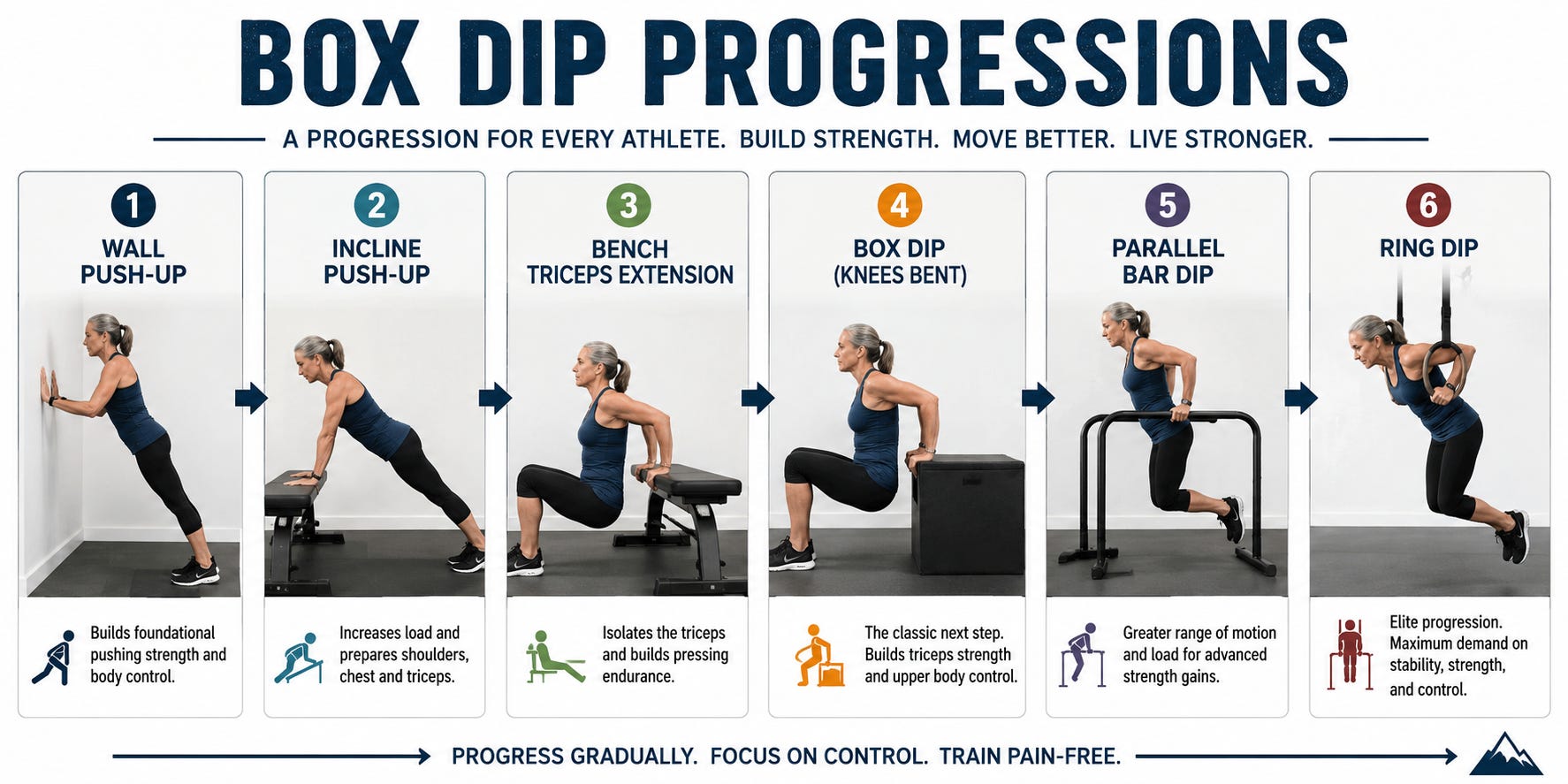
One of the best aspects of the dip is that it scales beautifully.
Beginner
Bench-supported triceps extensions
Wall push-ups
Incline push-ups
Intermediate
Box dips with feet on the floor
Bent knees to decrease load
Straight legs to increase load
Advanced
Feet elevated box dips
Parallel bar dips
Weighted dips
Elite
Ring dips: The instability of gymnastics rings dramatically increases demands on shoulder stability, core control, and neuromuscular coordination. Ring dips should only be attempted after demonstrating excellent control with traditional parallel-bar or box dips.
Bottom Line
The goal isn’t to become great at box dips. The goal is to preserve the ability to push powerfully throughout life.
Strong triceps help support everything from athletic performance to getting off the floor with confidence decades from now.
The box dip is simply one accessible tool to build that strength.
Train within a comfortable range, progress gradually, and remember that every great ring dip once started with a single supported repetition.
This week’s workout incorporates the box dip and the thruster to target triceps strength with some plyometrics for bone health to create a spicy combo of strength and cardiovascular stimulation! Enjoy!
Warm Up
Tabata 20:10 (20 seconds of work, 10 seconds of rest) x 6 minutes. Perform each movement in sequence for 20 seconds of work then take 10 seconds of rest until you have completed 4 rounds of the three movements.
Single-under jump rope (or simulated jump rope if no access to a rope)
Easy bench dips
Movement Practice
Take 5-10 minutes to select your weight for the thrusters and set up for your bench dips. Choose a barbell or dumbbell thruster weight that is on the heavier side. Select a weight that allows you to do all 7 repetitions unbroken across the 7 rounds. Be mindful of the fatigue that will be generated by the jump rope and the dips as you select your weight for the dumbbell or barbell thruster!
For the dips, set up a STABLE box, bench, table, or chair and watch the video to ensure proper technique. Select an option that allows you to do the 7 repetitions, ideally unbroken, but in no more than 2 sets during the later rounds).
TIP! 7 rounds is a long time. Manage fatigue by slowing your repetition speed and taking strategic short breaks during the jump-rope and the dips.
Workout
7 rounds for time
7 dumbbell or barbell thrusters (unbroken)
75 single-under jump rope (or 50 double-unders)
7 box dips (ideally unbroken, but alternatively, strategically break up into no more than 2 sets as fatigue sets in)
Score: The time it takes to complete 7 rounds of all three movements. Log your time! You may see this workout again for a re-test!
Alternative: If you are hankering for more volume and lighter weight, try 10 thrusters, 100 single-unders, and 10 dips
Cool Down
I bang this drum a lot because it is SO IMPORTANT, particularly for mid-life women, to dial down the stress response, be kind to your muscles and joints, and promote recovery of the body and the mind. Enjoy this post-workout restorative power yoga sequence! #dontskiptheyoga
15-minute post-workout restorative yoga
NOW TAKING MEDICAL CLIENTS FROM COLORADO, CONNECTICUT, AND NEW HAMPSHIRE!
..in addition to MA, NY, NJ, PA, CA, FL, OH
If you are an active woman or competitive midlife athlete who feels abandoned by mainstream medicine, I’m here for you!

Active and athletic midlife women have needs and risk profiles that are different from the general population. These needs often go unmet by the mainstream medical community due to a lack of understanding of fitness and sport and their impact on mid-life hormonal physiology or even a lack of acknowledgment that this dynamic exists.
To speak to this need, I launched my Telehealth Consultation Medical practice focusing on the Reproductive Endocrine needs and Menopausal Care for active, athletic, and high-performing women.
We put your health, fitness, and performance at the center of the equation so that you can achieve your healthiest, highest-performing self!
You will find all my service offerings on my website including a link to my calendar so that you can reserve your place in my schedule!
Triceps are the unsung hero of aging well. Bookmarking this workout
bench dips , a Ortho Doctor must have asked you to tell readers to do because needed new patients, may be the worst exercise for rotator muscles , sorry Like your articles but not this one. Yes you did put disclaimer but shouldn't have been written